
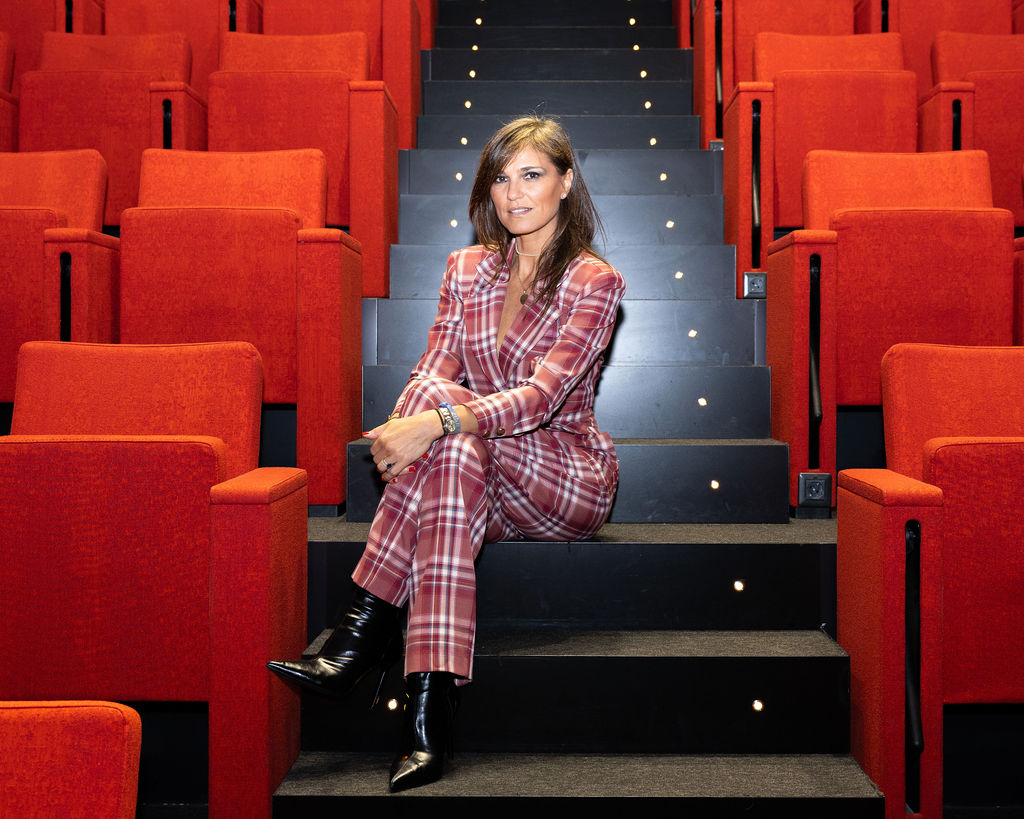
It isn’t always easy to answer a child’s questions, and how would we explain what the RAE is, its purpose and functioning over more than three hundred years? How can we make him understand that “Limpia, fija y da esplendor” does not refer to a cleaning product but to the motto born from eleven proposals to ensure the Spanish language remains bright?
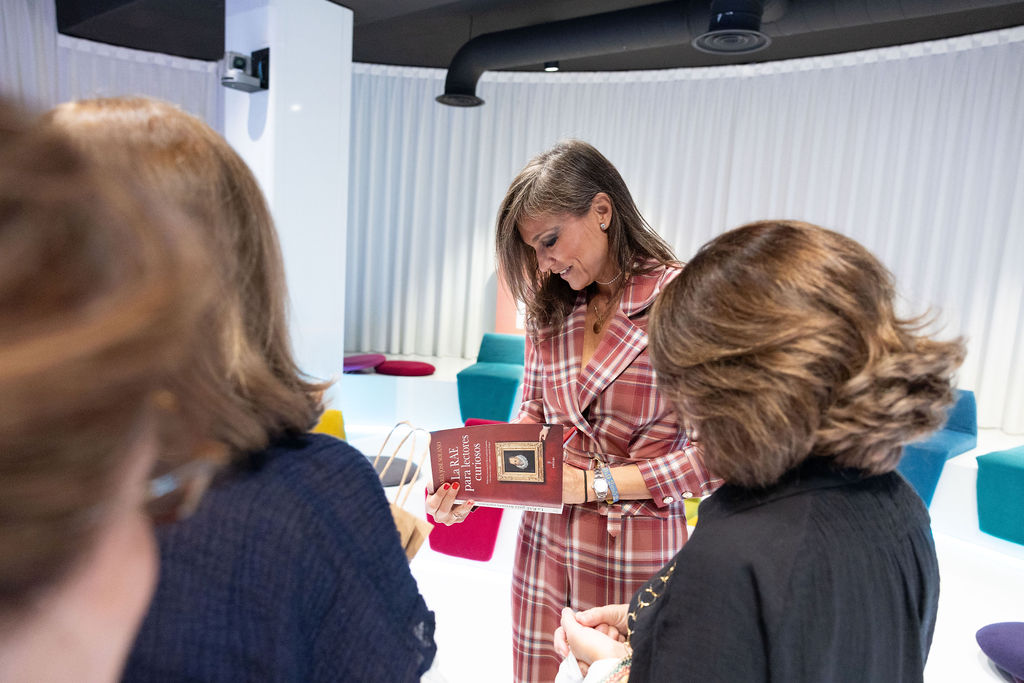
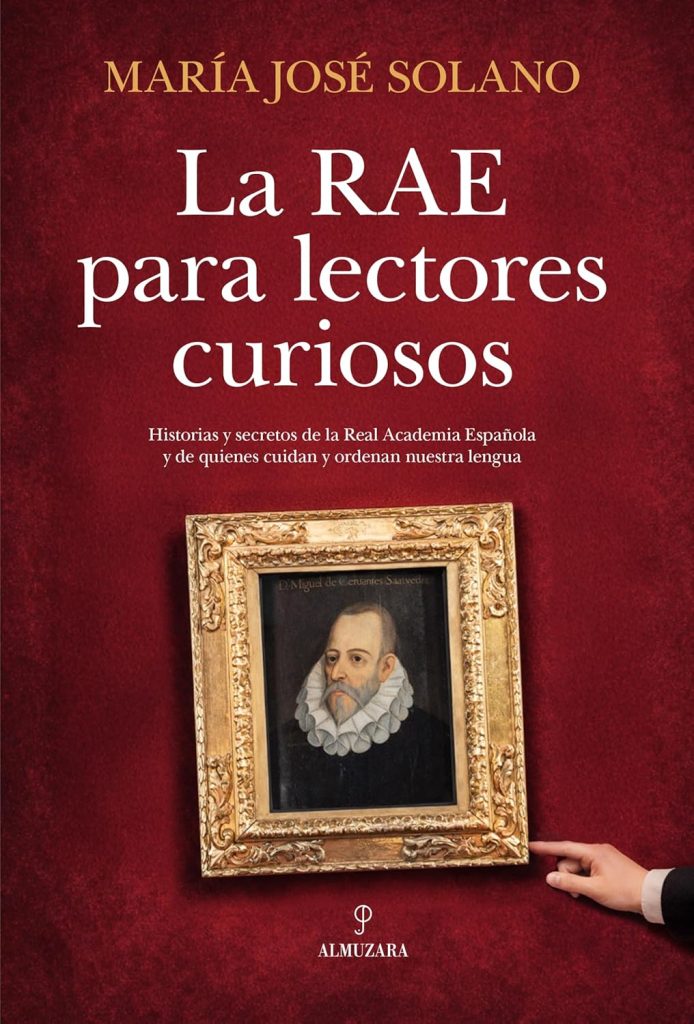
The RAE for Curious Readers, by María José Solano, is a book in which illustrious names parade by, from the Archpriest of Hita to Ramón Menéndez Pidal; from Antonio de Nebrija to María Moliner; from Lope de Vega to Blanca de los Ríos; from the Cid Campeador (to be precise, a fragment of his skull) to Emilia Pardo Bazán; from Cervantes to Gertrudis Gómez de Avellaneda. Ana Pardo, president of the Asturian Foundation 16 of 24, spoke with the author about her work.
*****
—You are a historian, writer, columnist, editor… How did your career begin?
—It starts, as with almost all the important things in my life, with books. I studied Art History in Seville and then earned a PhD in Fine Arts. I have been fortunate to move through different cultural realms. For ten years I worked at the Royal Spanish Academy, an experience that profoundly shaped my way of understanding literature and our language. After that came Zenda, the books, the columns in ABC, and many other adventures. In truth, I don’t think I’ve ever changed my craft. I’ve always done the same: look for interesting stories and figure out how to tell them.
—One day you joined the RAE. What exactly did you do?
—I joined the Academy to work on cultural, editorial, and communication projects. I participated in projects related to the institution’s history, in activities surrounding the third centennial, in initiatives related to literary heritage, and in the organization of meetings and cultural programs. The Academy is an extraordinary institution because it has two parallel lives. One is the public face: the academicians meeting on Thursdays, the dictionaries, orthography, grammar… The other is much less visible: its archives, libraries, patrimonial collections, research projects, and the people who work daily to keep all of that running.

—Did the book come about when you tried to explain to your son what the RAE is?
—Precisely. And it also arose from a small maternal failure. When my son was ten, I took him to visit the Academy. I was excited. I showed him the salons, the libraries, the stained glass, the portraits, and the corners I found extraordinary. He listened, took photographs, and seemed quite interested. A few years later, when he was thirteen and had entered that wonderful stage when children start to think their mothers know absolutely nothing, he asked me a devastating question. He said he understood I enjoyed working in that beautiful building, but it seemed to him like a museum full of older men. And he added: “What exactly is the RAE for?” That left me stunned. Because one thing is knowing what an institution does and another entirely is explaining it to a teenager without them falling asleep after three minutes. Then I realized I had to tell the Academy in another way. Not through a sequence of dates, directors, and publications, but through its stories: the academics who fought, the women who were not allowed to enter, the books that disappeared, the rivalries, the false portraits, the anecdotes, and the eccentric characters. That is how this book was born. And in a sense, it is also a book about motherhood: about the obligation we mothers have to find new words to explain a world our children are just beginning to discover.
—How and when did the Spanish Academy originate? How did it become Royal?
—The Academy was born in a library, which is a wonderful starting point for any story. We are in Madrid, in June 1713. An enlightened aristocrat, Don Juan Manuel Fernández Pacheco, the eighth Marquis of Villena, decides to gather in the library of his palace on the Descalzas square eleven gentlemen interested in language and culture. The Marquis was a fascinating figure. He had an extraordinary library, maps, globes, scientific instruments, and an intellectual curiosity that was unusually keen. He had observed what was happening in France and Italy. The French had their Academy, protected by Richelieu, and the Italians had an institution with a deliciously absurd name: the Academy of the Salvado, whose mission was to metaphorically separate the good flour from the impurities of the language. The Marquis wanted to do something similar in Spain. Those eleven men began meeting at his house, but soon realized they needed royal protection. They approached Philip V, and a few months later the king agreed to back the project, which received official recognition in 1714. The most amusing part is the choice of emblem. There were eleven proposals and one of the favorites was a bee buzzing among flowers with the motto “Approve and disapprove.” Eventually they chose the crucible and the famous phrase Limpia, fija y da esplendor. I have always liked that image of the crucible, because it expresses a lovely idea: words, like metals, need work, fire, and patience to preserve their shine. Although three centuries later we still argue about who has the right to light the fire.
—When was the current headquarters established and how is it funded? What has happened to Enlightenment urbanism?
—The current headquarters was inaugurated on April 1, 1894, with Queen Regent María Cristina and the young Alfonso XIII, who was eight years old. Until then the academics had led a nearly nomadic existence. They gathered in private palaces, royal offices, and buildings that were gradually becoming too small. Finally it was decided to construct a definitive headquarters next to the Prado Museum. The Crown donated the land and the Academy undertook the construction, which cost about two million pesetas, a real fortune. The architect, Miguel Aguado de la Sierra, designed a building of classical inspiration that seems to hide a Greek temple inside a large brick box. But what is truly interesting is where it was raised. The Paseo del Prado was an Enlightenment cultural project. There stood the Cabinet of Natural History, the Botanical Garden, and the Astronomical Observatory. In other words, nature, science, knowledge. The Academy arrived to complete that landscape with language and literature. I am fascinated by that city idea. An urbanism that is not limited to placing buildings but expresses a way of understanding the world. When did we stop thinking that way? I couldn’t point to a date, but there is a difference: those rulers wanted architecture to represent knowledge. Today it often seems that what matters is that it represents a real estate transaction. And that is not exactly the same.

—Is there a real split between philologists and writers?
—There is, naturally, a difference in formation and sensitivity, though I wouldn’t call it two irreconcilable camps. A philologist views language as an object of study. They analyze its history, its structures, its transformations. A writer uses it as raw material to create a world. One studies the instrument and the other plays it. But both need each other. The philologist can explain why a word means what it means. The novelist can make that same word make a reader cry. And there are writers with extraordinary philological training and philologists who write wonderfully. Another matter are the debates. The Academy, like any institution made up of strong intellectual personalities, has debates, disagreements, and small rivalries. But I don’t view that as a bad thing. On the contrary. An institution devoted to words would be quite suspect if its members did not argue. The troubling thing would be if everyone always agreed.
—The item number one in the heritage inventory: a fragment of the Cid Campeador’s skull.
—This is one of those stories that justifies a book on their own. Because you’d imagine the first inventoried object at the Royal Academy would be a dictionary, Cervantes’ quill, or some Lope de Vega manuscript. But no. It is a bone. Specifically, a fragment of skull attributed to Rodrigo Díaz de Vivar, the Cid. And that leads us to an extraordinary tale, because the remains of the Cid have had a posthumous life far more eventful than one would wish for a national hero. He died in Valencia in 1099, and his remains were moved to San Pedro de Cardeña. Centuries later, during the Napoleonic occupation, his tomb suffered the ravages of war and the remains ended up scattered. Part of that history relates to the circulation of relics and historical mementos, which in the 19th century became collectible objects. I’m particularly interested in the paradox: a institution founded to safeguard the immaterial heritage of our language keeps, as its number-one object, something as material as a bone. And moreover, the bone belongs to someone whose immortality owes less to military feats than to literature. For the historical Cid died almost a thousand years ago. But the literary Cid keeps riding.
—The great treasures of the library: codices, manuscripts, and incunabula
—The library is, for me, the true heart of the Academy. There lie its great treasures. And when I say treasures I’m not speaking metaphorically: some of those books have extraordinary historical and monetary value. Codices, autograph manuscripts, incunabula, princely editions… The exciting thing is that these books are not simply ancient objects. They are survivors. They have endured wars, fires, relocations, revolutions, and centuries to reach us. And they remain there, waiting for someone to open them.
—Women were barred from entering the National Library. What happened?
—This is one of the stories I love to tell because it shows that sometimes a revolution begins with a letter. We are in 1837. A woman named Antonia Gutiérrez Bueno wants to enter the National Library to document herself. She is working on a historical and biographical dictionary of famous women, so she needs to consult books and documents. But she encounters a small obstacle: women cannot enter. And she—who must have considerable character—decides that this is intolerable. After trying to resolve it through the usual channels, she writes directly to the queen regent María Cristina. The queen’s response is magnificent. She orders entry not only for Antonia, but for all women who wish to go to the Library. To me, this is an extraordinary scene. A woman wants to write about other women and discovers that she cannot consult the necessary books because she is a woman. It is hard to find a more perfect contradiction. And the most beautiful thing is that that decision opened a door that would not close in the same way again. Although, of course, many other doors remained to be opened.
—María Moliner, the woman who wrote a dictionary, but could not enter the RAE…
—The haters of the Academy. What’s going on between the RAE and the Cervantes Institute?
—I dedicated the last chapter of the book to the haters of the Academy because I find the story fascinating. The RAE has had enemies almost since its founding. And some of them were truly clever. In the eighteenth century, satires against the academics were published, mockery of their works, and even a work titled Memorias de la insigne Academia Asnal. Imagine that. The academics were still trying to organize the language and already some were calling them fools. But there is an explanation for that. Language is an extraordinarily sensitive territory because we all feel owners of it. And in a sense, we are. The more recent conflicts between the RAE and the Instituto Cervantes respond to another issue: the role each institution plays in the international projection of Spanish. I always explain it in a simple way. The RAE is the language laboratory. The Cervantes Institute is its export department. The Academy studies, describes, researches, and establishes linguistic criteria in collaboration with the American academies. Cervantes primarily handles teaching and spreading Spanish and our culture around the world. One thing we must not forget: Spanish no longer belongs only to Spain. Its present and much of its future lie in the Americas. So it would be reasonable for those who care for it and promote it to work closely together. Although I understand that after three hundred years of academic debate, giving up a good controversy must be quite difficult.
—To conclude, recommend us a Spanish classic, one foreign, and a contemporary woman writer
—This question is a small cruelty. Asking someone who has spent a lifetime surrounded by books to choose only three is like asking a mother to decide which of her children she likes best. But I’ll try.
—A Spanish classic.
—I am going to recommend a novel we have just recovered at Zenda-Edhasa and which I think is a small marvel: The Wandering Lady, by Pío Baroja, published in 1908. It is an adventure novel, but also a story about women’s freedom, something quite unusual in early 20th-century Spanish literature. Baroja turns travel into a sentimental and moral education. And he does so with that prose of his—dry, brisk, seemingly careless—that has an extraordinary ability to sketch an entire country in four strokes.
—A foreign classic.
—She was a writer whom many readers probably do not know, though I am sure they know her stories. Her name was Dorothy M. Johnson, born in 1905, and she was one of the great storytellers of the American West. A woman who spent a large part of her life in Montana and who wrote some of the most extraordinary tales in the genre. Do you know The Man Who Shot Liberty Valance, A Man Called Horse, or The Hang Tree? Well, all three films were adapted from her stories. The first one John Ford turned into a masterpiece starring John Wayne and James Stewart; the other two also came to cinema, with Richard Harris and Gary Cooper. And yet, how many viewers remember Dorothy Johnson’s name? I find her fascinating because she dismantles all the clichés.
—Two contemporary writers.
—The first, Karina Sainz Borgo, is one of the most powerful voices in contemporary Spanish-language storytelling. Her female characters are not conventional heroines. They are wounded, contradictory, sometimes ferocious women who try to preserve their dignity when everything around them collapses. And that interests me greatly. Because good literature isn’t about presenting exemplary characters, but real ones. My second recommendation is Paloma González Rubio, a writer I especially admire for her narrative sensibility and for her work in a literary field we still do not value enough: young adult literature. Paloma has the ability to address complex issues without paternalism or simplifications. Her novels respect the intelligence of young readers. And that, to me, is essential.
**
VIDEO: “The RAE for Curious Readers”, Foundation 16 of 24
—————————————
Author: María José Solano. Title: The RAE for Curious Readers. Publisher: Almuzara. Sales: Publisher’s website.
—————
Interview photos: Laborda.studio @gonlaborda