
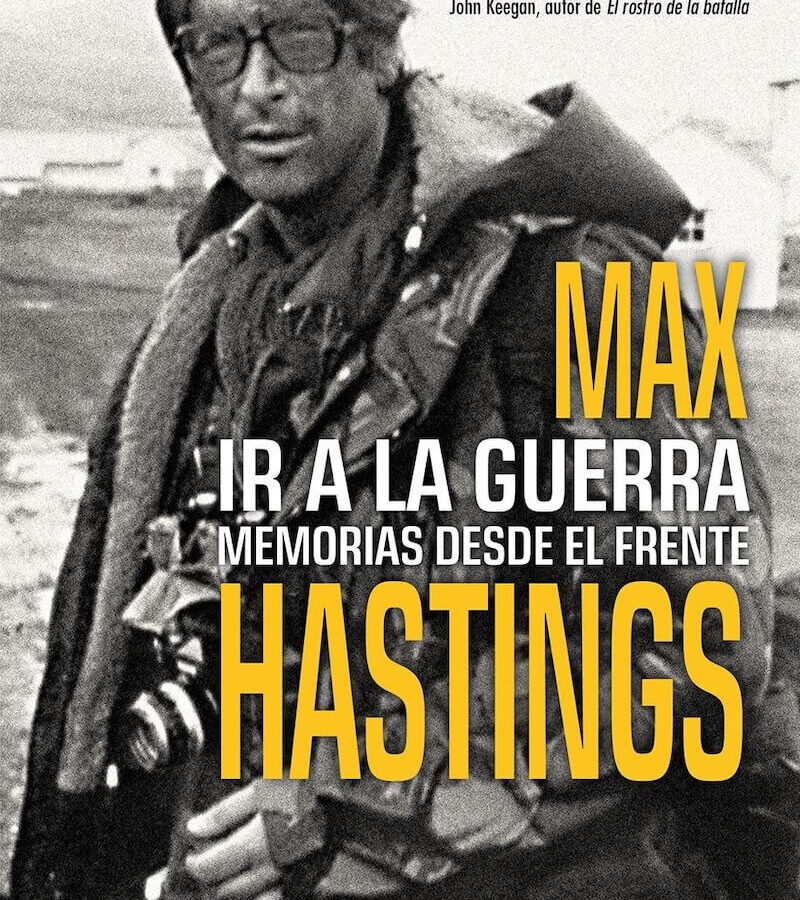
For the general public in Spanish, Max Hastings is a military historian specializing in, in particular, World War II. But in the United Kingdom, and probably the rest of the Anglophone world, Hastings is a veteran journalist — he has turned eighty — who spent about fifteen years as a war correspondent, and who, after stepping back from that “service,” has been the editor-in-chief of the Daily Telegraph and the editor of the Evening Standard. It is precisely his work as a war reporter, both for the press and for the BBC, that stands out in this partial autobiography about those years when he covered various wars across the globe, originally published in 2000. A quarter of a century has passed, but the reader can still sense in his pages the feelings that the then-fifties Hastings had about the adventures he lived between 1968 and 1982, and what it felt like being a guy who was not taken too seriously within the profession — or who was sometimes viewed as a rival who did not play on the same team, as some of his colleagues might say, and which he himself ultimately concedes. And indeed, the Hastings of that period, between twenty-three and thirty-seven years old, also regarded the craft of war reporting with considerable skepticism. As the son of MacDonald Hastings, a renowned journalist and war correspondent — especially during World War II — Max could feel at home what that profession meant, and throughout the book he does not fail to observe it with a certain detachment, considering that yes, war reporters risk their lives, but not more than the soldiers who fight in those conflicts they cover, or that it is not as “intense” as it is often portrayed. He makes it clear that it is a job for the young, or perhaps he was simply too old — and that, from 1968 to 1975, the period of greatest intensity in which he developed as such, he was between twenty-three and thirty years old —, that one does not need to have had a military career — in the first chapter he recounts his teenage experiences in a parachute unit; he knew he did not have the make-up of a soldier —, but that it is useful to know the Army and how it functions; something that, certainly, has enriched his military history monographs. These sensations throughout the book are as intriguing as the conflicts Hastings covered in that period. And pay attention to the list: the riots in Chicago in 1968, the Troubles in Northern Ireland from 1969, the Biafran War, the Vietnam War in several phases from 1970 — especially the fall of Saigon in 1975 —, the Yom Kippur War — which earned him a certain fame as a fervent pro-Israel advocate that later events would dilute —, civil wars in Rhodesia (later Zimbabwe) and Angola in the mid-seventies and, in particular — nearly a third of the book — the 1982 Falklands War: the last British imperial war and Hastings’ swan song as a war reporter. It remains an impressive résumé and, at the same time, a panorama that navigates between the peripeteia and disillusion regarding a very tumultuous period of world history during the Cold War. Not only are the conflicts Hastings covered of interest, but also how he did so in a time when journalistic chronicles did not arrive with the immediacy of today: there were no mobile phones, of course, and in many cases pieces were dictated via telex, at best, when technology allowed. He was not always inclined to leave his family to go to the other end of the world, and he did not always hit with his dispatches. But we do see that he learned to recognize when History with a capital H was lived in concrete moments: the Israeli victory against the Syrians and Egyptians in a war that caught them by surprise in October 1973; the chaos that fell on a Saigon that until then lived with a certain sense that the war was far away, until everything rushed in a few days; or what it meant to enter as the first reporter in Port Stanley, in the Falklands, when the war between the United Kingdom and Argentina for distant islands in the South Atlantic had been more disputed than it seemed and the journalists who covered it generally did not know the details. It is in this last conflict, for which Hastings did indeed beg his superiors to send him, traveling for six weeks aboard Canberra, one of the Royal Navy’s transport ships, that we felt first-hand what that war entailed, how the veteran reporter drew near to some operations, made good ties with some commanders, and what it meant to live the war “live.” Perhaps then, Max Hastings already felt that his professional life would never be the same again.
—————————————
Author: Max Hastings. Title: Going to War: Memoirs from the Front. Translation: Javier Romero Muñoz. Publisher: Desperta Ferro. Sales: Todos tus libros.