
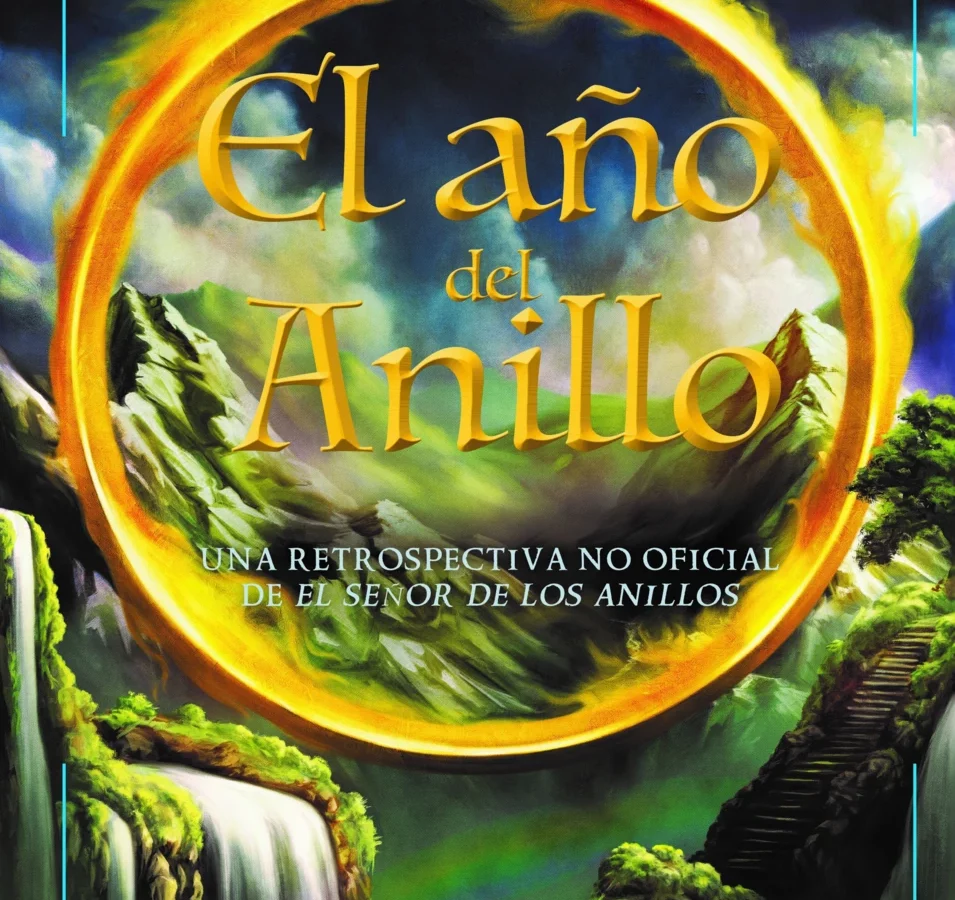
Did you know that Gandalf was not a man, but a Maia, a nature-spirit linked with fire, sent to Middle-earth? And that the title Gandalf the White had originally belonged to Saruman, lost after his moral decline? Did you know, even, that Frodo might have been named Bingo Baggins? These are some of the surprises that await between the pages of The Year of the Ring, a survey crafted by Susana Polo (translated by Victoria Fernández) through the universe of The Lord of the Rings, published by Minotauro as an invitation to look anew at a story we thought we knew by heart; in the author’s own words: “no matter how things change, The Lord of the Rings does not seem to reach the limit of its relevance.”
Always, I’ve considered myself an admirer of the Tolkien universe, because behind the members of the fellowship, their antagonists and supporting characters, their landscapes and deeds, there exists an extraordinarily complex literary, mythological, and — entering Jackson’s realm — cinematographic architecture. And precisely there lies the book’s interest: in the ability to pause at those details that usually escape the most faithful viewers and readers.
The Year of the Ring arises from an ambitious Polygon platform project launched in 2021 to celebrate the twentieth anniversary of The Fellowship of the Ring. The original proposal seemed simple yet somewhat audacious: publish every week a new approach to the trilogy. There were 52 installments throughout that year. When turning that archive into a book, Susana Polo reorganizes the files, adapts them, and adds new material to construct a kind of sentimental and critical atlas of the trilogy, addressing some of its major secrets; from the enigma of Two Towers to the enduring controversy over why the Eagles did not fly the Ring to Mordor, the articles combine documentation, humor, research, and a divulgatory perspective.
The volume also opens a window onto the behind-the-scenes of the films. We learn that Jens Hansen, the jeweler who designed the One Ring, died before he could see his creation on the big screen; that Howard Shore’s music begins with the ancient sound of a monocord, or that Tolkien’s story had to overcome the hurdles of a universe still to be built under the pressures of the publishing world.
Thus, Polo reminds us that a work of such magnitude is not born finished, but is built through intuitions, discoveries, doubts, and sometimes few certainties. The same happens with its cinematic adaptation, where every object, every sound, and every artistic choice contributes to erect a recognizable world. We are not dealing with a university monograph nor with a book of dull data for those who want to know how many hobbits appear on screen. It is, rather, a mosaic. There are essays, interviews, lists, curiosities, character analyses, reflections on the fandom, notes on the adaptation, and narratives of what happened behind the cameras. The book’s very structure participates in that fragmentary character: the texts can be read linearly, but also independently, like someone opening a photo album and pausing at that image that suddenly triggers a memory.
Polo starts from a certainty any viewer of the trilogy will recognize: we believe we know these films too well. We know the dialogues, the battles, the deaths, the gestures, and even the pauses. And yet, a slight shift in focus is enough to reveal something new. A reading that is queer of Sam and Frodo, the stories of Legolas’ fans, the reception of the films among conservative American Christians, the cultural origin of the orcs, or the history of Brett Beattie, an actor and body double connected to Gimli, all serve to prove that there are still zones, curiosities lurking in the shadow of a work that seemed fully illuminated.
It is also meaningful that the book does not settle for placing Tolkien and Jackson on an altar of nostalgia. One of its appendices deals with the origin of the orcs and the long history of that fantasy trope of the “monster,” while others approach cultural and interpretive matters that unsettle the more complacent image of Middle-earth. The book, then, celebrates but also questions. And that combination proves far more fertile than mere veneration that we might feel as fans of the saga.
There is, as noted, a particularly happy structural choice, namely that The Year of the Ring can be read as a calendar. Polo even retrieves the work from her former project On This Day in LOTR, built from Tolkien’s calendar dates, to organize part of the volume. The book begins in September, with Bilbo and Frodo’s birthdays, and advances following the temporal rhythm of the story itself.
The main caveat that can be raised about the book stems precisely from this matter, which constitutes part of its charm. Because it arises from a digital journalistic project, The Year of the Ring does not always possess the narrative continuity of a work conceived from the outset as a book. Some texts feel autonomous, even incidental, and at times a thesis tying them together is missing. It is the price of turning a year-long online conversation into a printed volume. The author herself acknowledges that some materials from the project had to be replaced and adapted to the printed format.
It is seemingly an eccentric idea that, to be sure, ends up revealing that one of The Lord of the Rings’ greatest virtues is having turned epic time into our own time; the universe of the Oxford professor works because its great events also bear everyday dimensions – in waiting, in nostalgia, in rest, in urgency, and in travel.
The Lord of the Rings speaks of a community that holds its members up when the road becomes too hard to walk alone. Returning to Middle-earth from these pages is, in the end, to discover that there are still paths to tread, ideally with company. As with all good stories, the journey does not end when we reach the destination, but when we begin to discover all that had gone unnoticed along the journey.
—————————————
Author: Susana Polo. Title: The Year of the Ring. Publisher: Minotauro.