
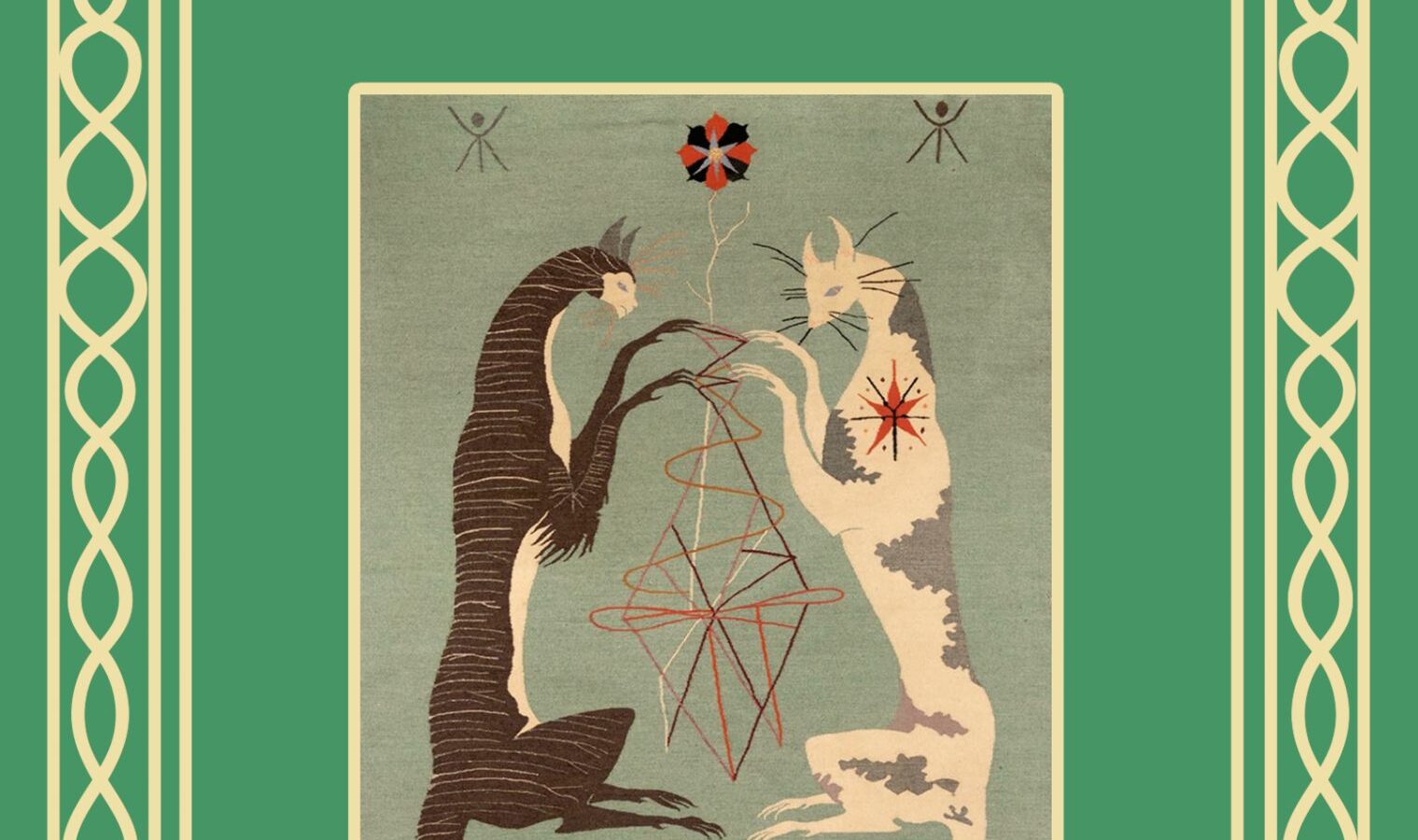
A writer arrives in Paris to investigate the figure of Gertrude Stein, but an encounter with two women unsettles her plans. Between the novel, the essay, and the biography, Deborah Levy crafts a luminous reflection on friendship, desire, freedom, and the possibility of reinventing one’s own life.
In Zenda we reproduce the opening of My Year in Paris with Gertrude Stein (Random House), by Deborah Levy.
***
1
PARIS. NOVEMBER 2024
Eva called to say she had lost it. She was referring to her cat, which had disappeared. Eva was my new friend in Paris. We liked not knowing too much about each other because there was so much to discover. When, at the end of July, I spent a month away from Paris, she sent a postcard to my London address.
“Summer kisses from me and Lo.”
I had to think about who Lo was, but I quickly remembered that that was indeed the name of her cat. On the back of the card Eva had drawn him in a tracksuit and lime‑green sneakers, wielding a blazing torch at the Paris 2024 Olympic Games. The return address simply bore my first name.
We checked every possible place where he might have ended up and knocked on the doors of every neighbor along the street. Eva lived in a studio on Rue des Trois Portes, a two‑minute walk from the Seine and from Notre‑Dame Cathedral in Paris. Before Lo’s disappearance, Eva left the front door barely ajar with a chain so that no one could enter downstairs when her cat went down to the courtyard via the stairs.
Her husband lived in Seattle, United States. Eva had lost him. The cat. It slept in its bed, and Eva said that its purring was like Christmas lights that would soon weave through the trees of our neighborhood. A week before the disappearance, a mutual friend, Fanny, who worked in finance, had renamed Eva’s cat Bob. Fanny had bright, clear eyes, wore a belt around her narrow hips, her nails jewel‑like, and often a cigarette tucked into her belt.
“Sorry, Eva,” Fanny had said. “I get myself confused. From now on it’s Bob. With Bob we’ll locate ourselves better.”
“And where do we locate ourselves?” Eva asked.
“I don’t know. In France Bob would be Rob.”
Fanny hardly seemed to be with us most days. She led a parallel life in the heights of eroticism with Lucia, her dearest lover, one of the three she had in November. She was the only French member of our circle of friends. Every day Fanny reminded me to ride my bicycle on the right-hand side of the road, not on the left, and to buy a helmet because I used one of those electric bikes rented via an app. Keeping her eye on her clientele, Fanny also watched the United States elections with keen attention, which would be held on November 5, 2024.
That morning Eva had trimmed her fringe in the mirror. It lay straight and symmetric just above her brows. She had inherited her mother’s black hair and her father’s blue eyes. Everyone cried out “Ahhh” when they looked into Eva’s eyes. She had discovered her favorite scent (thyme and cedar notes) in a hardware store on Rue des Écoles, displayed in a tall retro bottle alongside rust removers, cutlery, and tubes of caulking. Fanny believes Eva’s blue eyes must wrestle with the fantasy of perpetual feminine adolescence and the world’s submission, but she isn’t sure the industrial fragrance will help her in that struggle, though it will surely repel mosquitoes.
I call her Eva the Fifth because she speaks five languages: Danish, Spanish, French, German, and English. She laments not being fluent in German, even though she studied at a prestigious art school in Berlin, so she insists I change her label to Eva the Fourth. As for Eva, her cat was God in every language.
Bob was love. Black fur. White belly and paws. The right ear smaller than the left. Much smaller. About the size of the tiniest toe on a human foot. Fanny, raised as a Catholic, noted that God was a presence that judged, and Bob did not, but Eva insisted that, without a doubt, her cat judged her.
All that drama, which Eva perceived as a tragedy, served to distract me from the essay I was writing about Gertrude Stein, a figure I seemed to know too much about and yet nothing at all. Stein had placed many obstacles in my path. In the pursuit of understanding, which she herself did not believe in. Sometimes, as I read her disconcerting and captivating texts, I felt like slapping them. Stein desired that readers would find her, but a part of her could not bear to be found. She was ashamed that her autobiography had become a bestseller because it was so comprehensible. When I look at her photographic portraits, I cannot penetrate her eyes. From time to time I had to remind myself of the basic facts, so lost I was in the whirlwind of information about her.
Gertrude Stein was born in 1874 in Allegheny, Pennsylvania, United States. The daughter of German Jewish immigrants. Her father, Daniel Stein, a Bavarian by birth, came to North America in 1841 at the age of eighteen to open a clothing store with his brother Solomon. Her mother, Amelia Keyser, daughter of Bavarian immigrants, was born in the United States. Daniel would become a wealthy entrepreneur. His younger daughter, Gertrude Stein, would become a legend—a leading figure of literary modernism, perhaps the only avant-garde writer in the world whose name appeared in glowing letters in Times Square. A novelist, playwright, poet, essayist, and librettist, and a collector of the boldest artworks of the early twentieth century, she also wrote “verbal portraits” that she hoped would resemble the radical ideas of Cézanne, Matisse, and Picasso. Man Ray and Cecil Beaton would photograph her; Picasso would paint her portrait; from the age of twenty‑nine she would live in France and she would die at seventy‑two. Yet, Gertrude Stein found it difficult to publish and only attained fame and glory when she was nearly sixty. During World War II she was friends with a collaborator of the Vichy regime. Ernest Hemingway, in his description of her, said she had “immigrant hair.”
I was lost. Who was Gertrude Stein?
Immigrant hair. What did those words mean?
Gertrude Stein deliberately reduced her vocabulary as a writer. She did not want to work with a broad menu of words. Her future wife, Alice B., would devise a wide menu of dishes, including a crystallized violet soufflé.
[…]
—————————————
Autora: Deborah Levy. Título: Mi año en París con Gertrude Stein. Traducción: Antonia Martín Martín. Editorial: Random House. Venta: Todos tus libros.

© Sheila Burnett