

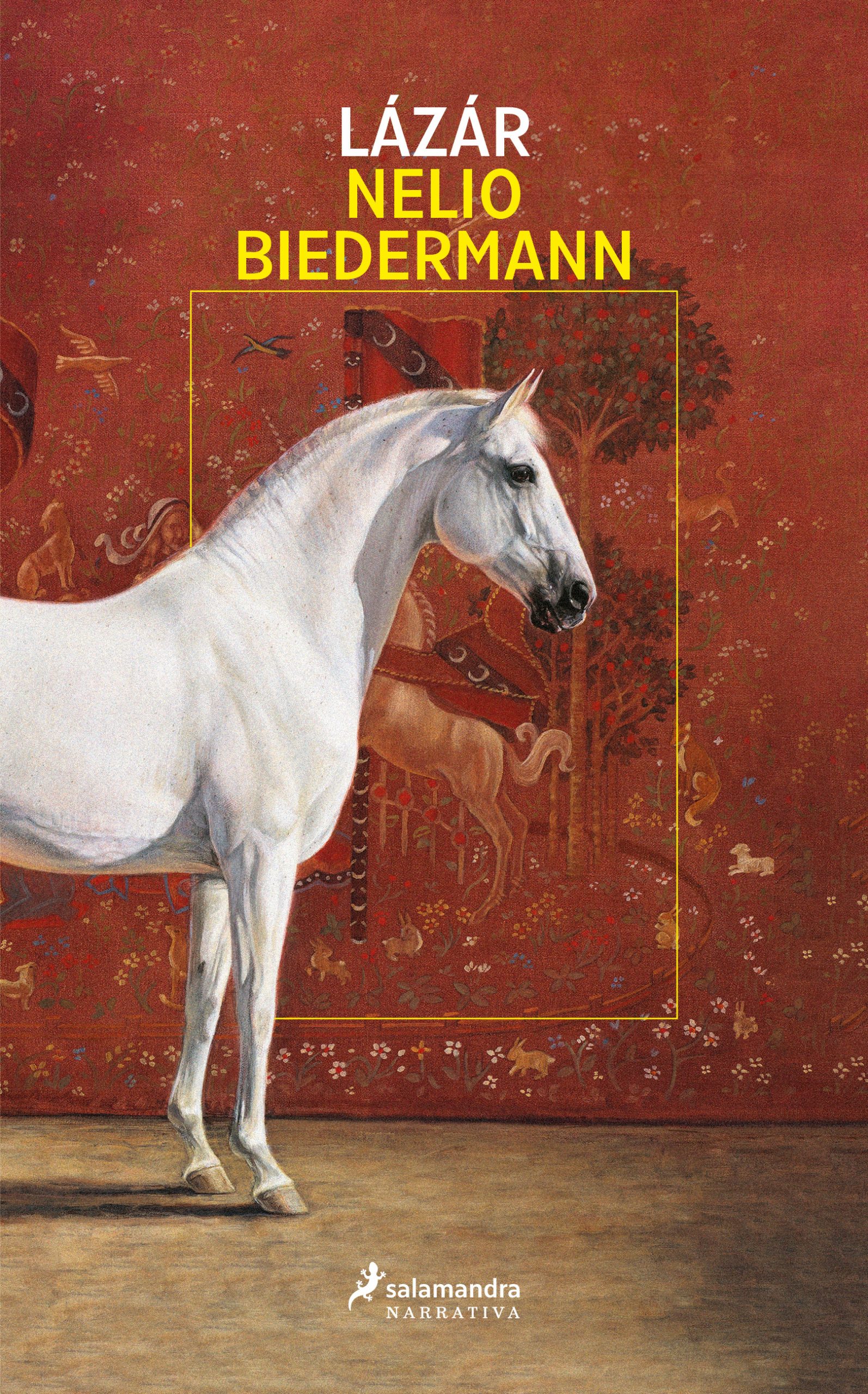
With his meteoric rise on the scene of narrative fiction, the young Swiss writer Nelio Biedermann, at the age of 23, has sold 200,000 copies in Germany alone of Lázár, a work rooted in the story of his family, a Hungarian aristocratic saga through which he traverses the tumultuous 20th century in Europe.
Biedermann, accompanied by his Catalan-language editor, Pilar Beltrán, has acknowledged being surprised by the novel’s success, an international publishing phenomenon, about to translate into 27 languages and with the film rights sold, which in Spanish is published by Salamandra and in Catalan by Edicions 62.
Lázár, with touches of magical realism, centers on the fictional Von Lázár lineage, after the birth of Lajos, a transparent boy with blue eyes, in a castle near a forest, which drives him to madness, at the dawn of the 20th century, at a moment when the old order is crumbling.
Sensorial novel, with many layers, its author has made clear that when he began working on this project, which counts, among others, with Patti Smith’s endorsement, he did not intend to create a kind of mirror to current reality, but “the more I wrote the more parallels emerged,” though he stressed that his novels are not based on ideas.
Nevertheless, and when asked about what is happening around the world with the rise of the far right, Biedermann did not hesitate to affirm that it is “very important to combat the false narrative of history, to act and root it in the consciousness of the population. A little this is the task that art and literature perform. It is disheartening to see the narrative that these political forces peddle and the effect and impact it has on the masses, but this is even more a reason to act and to move forward and not fall into discouragement or demoralization.”
He recalls that, at barely sixteen years old, he began to mull over writing a book inspired by his family history, in which “the past has always been very present,” although there might have been a few gaps. “It was about shedding light on the darkness through fiction and my imagination.”

Efe / Toni Albir
The origin of his Lázár lies in the tales his grandmother told him “over and over again”, including traumatic stories, such as Hungary’s flight to Switzerland, but she recounted them as if they were adventures. For the younger members of the family, listening to this woman, who had lived in a castle, was “very interesting and thrilling,” and everything she narrated had the flavor of a fairy tale. “Every family always has positive and pleasant stories that are told a lot, but there is also a great deal of silence about the rest. My grandmother, moreover, delved into day-to-day life and that was very important for me because it led me to investigate everyday life, that era, how they spoke, how they dressed, how they ate or earned money.”
Nelio Biedermann, when asked how his family had received his second literary proposal, after Anton will bleiben, wanted to share an anecdote about his father. During the lengthy writing process, which lasted several years, the only thing he told his close ones was that he was deeply immersed in a new novel, without specifics. Yet, he took advantage of a period when he was traveling to Mexico to send them the manuscript so they could read it and process it. His father, after a while, called him to reproach him for not having told the truth about the family, to which he replied that he had to reread it because it was not a portrait of the Biedermanns, but of the Lázár. “Two weeks later he called me back and said he was retracting what he had said because he had understood that it was a story very closely tied to family history, but it was a novel.”
Nelio Biedermann has stressed that, precisely, one of his objectives when sitting down at the keyboard was for “the real history and fiction to mingle in such a way that they could no longer be separated, and if my father could distinguish that, I had achieved my goal.” The rest of the family also understands that this is fiction, and for that reason they do not feel “neither attacked nor harmed if at times I do not present that family in such a positive light, because this is about the Lázár and not about the Biedermann“.
——————————
Source: Efe