
To commemorate the 90th anniversary of the Civil War, José Ángel Mañas recreates in Zenda, day by day in this section, what happened in 1936, perhaps the most pivotal year in all of Spain’s recent history.
Friday, November 13, 1936: Three English Brigadists
Should we advance?
—We advance!
Let’s go!
Two days had passed since the start of what Cornford called “the great assault,” in the Aravaca sector, and four since his baptism of fire at the Faculty of Philosophy and Letters, guided by General Kléber. But that, amid the little sleep and the intensity of what they had lived through, seemed like an eternity.
The first comrades had already fallen, and it was becoming clear that war was no joke. While they moved out from their positions and joined the rest of the English in the assault, John Sommerfield longed for a good breakfast. None had tasted coffee since their truck journey when, after getting lost on the way to Madrid, they stopped at a Vallecas coffee shop. The boiling coffee warmed their insides. They drank it, gripping the cups with numb fingers. Large steaming portions of churros confirmed what Cornford said: as they drew near the front, the food seemed even more delicious. If back then they had warmed up and felt human again, that feeling did not last long. Since the British had taken up their first positions in the Ciudad Universitaria, they had endured three nights of horrendous cold at the front.
The only one prepared, due to his experience in Aragon, was John Cornford. He never parted from that dreadful green coat that reached his ankles, the one Bernard Knox teased him about, but whose usefulness was now evident. The jackets provided little warmth; no one had warned them about Madrid’s cold. In addition to the coat, John Cornford, who ran a few meters ahead of the rest, wore a belt of machine gun rounds around his body and a rifle slung over his shoulder. A bandage wrapped his head: a bullet wound grazed his skull the day before.
In that elevated bend of the Casa de Campo, the Guadarrama hills lay behind them. They first noticed them when, arriving in Madrid, hotel signs or car brands began to appear along one side of the road. Then they crossed the workers’ neighborhoods to reach the city center, where they encountered food queues, closed shops, war posters, militiamen on patrol, barricades on street corners…
But the Casa de Campo was another world, Sommerfield thought as he fired from behind an oak. War, close up, had something of absurdity: firing at silhouettes, watching them flee or advance, advancing or fleeing oneself. If you advanced and saw a body, you felt like a good shot. Sometimes you killed because you were attacked and it was you or them, but it was impossible to know whether you were winning or losing the battle. News arrived at night, back in the trenches, when an officer listened to the radio or relayed the information from Madrid.
For the moment, more brigadists appeared around them. There was a skirmish. The Moroccans on the other side of the hill stopped firing.
—They’re fleeing! —exclaimed Cornford.
The position seemed to be taken. While they occupied the abandoned barricades, Cornford set his rifle aside. He turned to Sommerfield and Bernard Knox to offer them tobacco.
—It’s not like in the books, is it, guys?
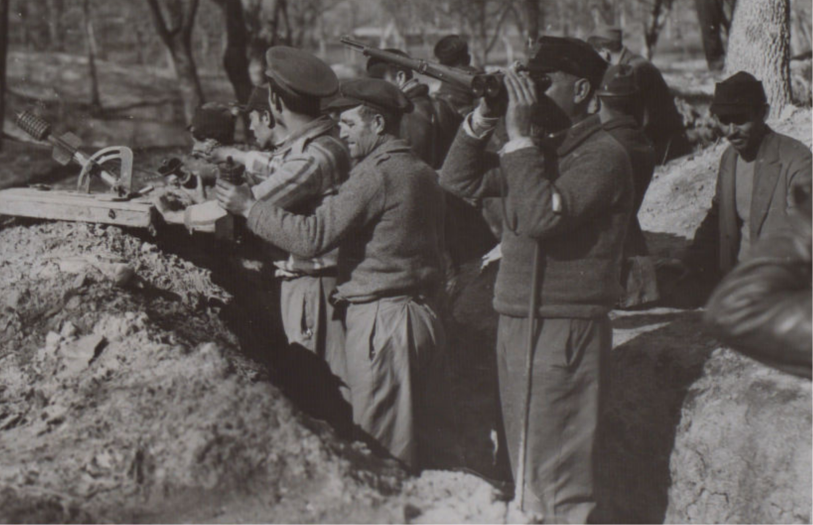
The others arrived and set up the machine guns. In the end, Kléber had managed to secure the Lewis guns that several of them carried on their shoulders, strapped with a belt, like a rifle. One, after losing the tripod, fired it by holding it with his feet. Those that remained intact were placed along a slope facing the small grove of the Casa de Campo. Two Frenchmen shouted that they should take cover. A bomb fell nearby. The earth shook. The grass twisted in the wake of bursts of hot air.
Sommerfield took the opportunity to look at his comrades: by then no one was afraid. Before going into action, he thought war would be like standing at the edge of a precipice and feeling dizzy, but once the first tremor passed, the only thing he noticed, amid the bombardment and the smell of gunpowder, was the tension.
Todas las entradas de 1936 día a día
Entrevista con José Ángel Mañas sobre 1936 día a día