
To commemorate the 90th anniversary of the Civil War, José Ángel Mañas recreates in Zenda, day by day in this section, what happened in 1936, perhaps the most pivotal year in all of Spain’s recent history.
Wednesday, November 18, 1936: The Clinical Hospital
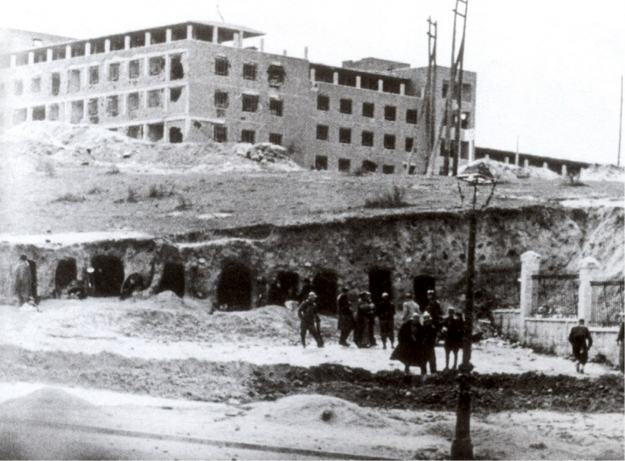
The photograph is by Robert Capa.
The fortifications of the International Brigades can be seen at the foot of the impressive ruins of the San Carlos Clinical Hospital, occupied by legionnaires and regular troops. Only God knows how much it was bombarded. But neither artillery nor the initial mines in the foundations managed to drive out its occupants from what had already become a Trojan horse inside Madrid.
From the outset of the war, rumors circulated about the Moors. That they would behead people, violate women, kill children, castrate prisoners. With them, the ancient fear of the Moor resurfaced. Now those dark-skinned Maghrebi fighters were entrenched in the Clínico, thrusting the muzzle of their rifles out through the windows.
Although their positions were assailed by Republicans with heavy artillery from around the Model Prison, the building’s rubble helped both the regulars and the legionaries to take cover. It was proven that the Moroccans — skillful marksmen — could set themselves up with their rifles for hours, and suddenly shoot down the unsuspecting militiaman who failed to heed precautions. Given the building’s height and its privileged position, the Clínico was a top target for the Defense Board, which remained determined to eject its occupants: it was the Francoist wedge closest to the city’s heart. The men defending it, and those attacking it, were rotated frequently.
A new form of combat was born. Members of the International Brigades listened to their Moorish or legionary adversaries in the adjacent rooms. From time to time they chipped a hole in the wall with two picks. If there was a gap, the mouth of the machine-gun’s barrel was wedged in, and fire was unleashed, killing everything within range.
Thus, the legionnaires of the Fourth Banner and the brigadiers of the Edgard André and Ernst Thälmann battalions fought for control of the Clínico. The number of dead kept rising. At night the brigadiers carried away the lifeless bodies to rear cemeteries. The legionaries, in turn, were buried near the Clínico, and their wounded were transported across the Manzanares footbridge to the blood hospital set up by Valera in Griñón.
But today everything could change, as the government guards stationed at the foot of the building whispered.
—Do you know who’s coming? —asked a militiaman, offering his companion a cigarette—. Durruti and his men.
—The few who remain will tell you. It seems they’ve beaten them quite hard… I don’t think they can handle the Moors.
As the Basque militiamen defending the Clínico could not hold back the legionnaires, the Board had decided that Durruti’s visit would be good for morale. Despite the dwindling numbers, he remained a mythical figure.
—They’ve given him this second chance… After the latest collapses, he wants to redeem himself before Miaja —said the first militiaman.
And he slowly lit his cigarette. Tobacco, in war, was essential.
Todas las entradas de 1936 día a día
Entrevista con José Ángel Mañas sobre 1936 día a día