
To commemorate the 90th anniversary of the Civil War, José Ángel Mañas recreates in Zenda, day by day in this section, what happened in 1936, perhaps the most momentous year in all of modern Spanish history.
Monday, November 2, 1936: The Requisitioned Housing
Well, here it is. You go first, Pepe.
The new flat was on the Fortuny Street. A modern building, with a concierge, inhabited at the time by well-off people, now outside Madrid. Possibly in the south of France or in Portugal. Since the summer it had been occupied by refugees from towns taken by the nationalists. People were fleeing as their advance neared. The building was almost entirely occupied by evacuees from Navalcarnero. A jumble of mothers, children and old folks, even a goat, turned the old salons into camps. Seeing them through an open door, the Mañas had been struck. The noise was the sound of a courtyard. The smell, a mix of crowds and stew.
—Well, it’s all very clean —said Rosa.
The four looked around. They were in the foyer. Across from them were two closed doors. Inés opened them: they led to a dining room in semi-darkness. The shutters remained closed.
—We need to air this out…
Mariana turned to the window. In the center of the room there was a round table. A white cloth protected it from dust. On top, a bronze and crystal chandelier, with candle-shaped bulbs. The chairs were made of good wood, as was the parquet — how it creaked under their feet! — and in front of the French fireplace there were two sofas facing each other, covered with white slipcovers.
—Well, it’s very nice —said Mariana.
Behind them, two militiamen, who were arriving with mattresses and bundles, left everything on the floor.
—Cheers, comrades! And enjoy the flat.
—Are you sure it’s all for us? —Rosa asked.
—That’s what they’ve said.
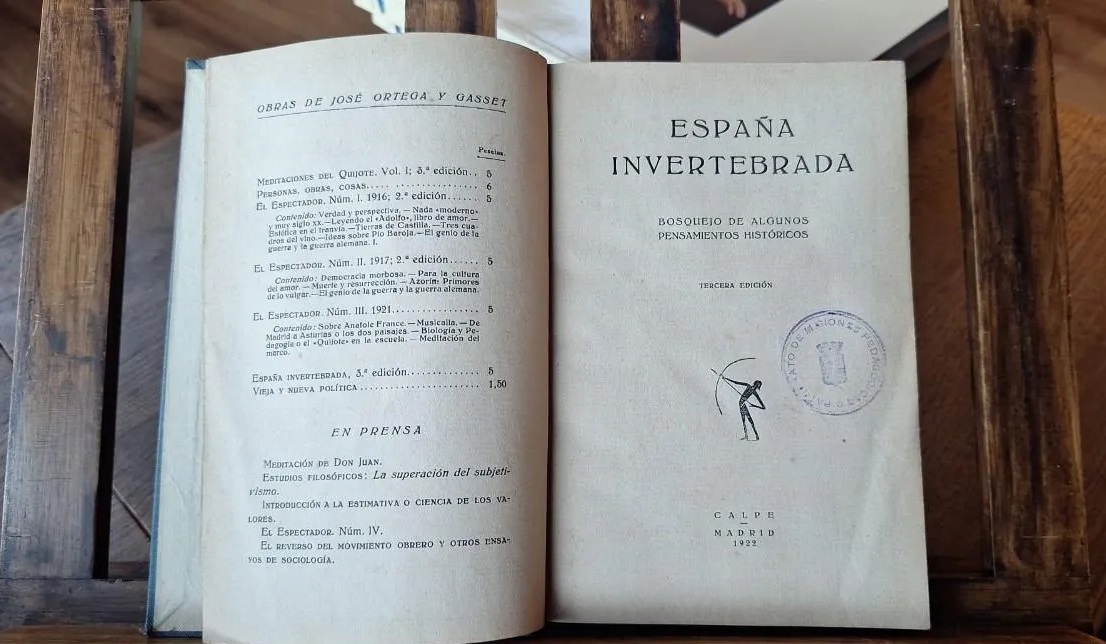
Outside, the neighbors could be heard. There was a commotion downstairs in the landing. Someone insulted a woman, who replied: “Idler, what you have to do is go to the front to fight!”. With their belongings inside, Mariana locked the door. She tied the key to a string under her skirt. Pepe went to the small bookstore on a wall of the living room: volumes of poetry by Campoamor, Zorrilla and Gabriel y Galán, novels by Blasco Ibáñez and Baroja, essays by Marañón and Unamuno, the The Invertebrate Spain of Ortega.
—Now, come on, let’s settle in. It’s clear this place has been empty for a long time, there’s a lot of dust —Mariana ran a finger along a shelf, beside where Pepe was leafing through a volume—. What do you think, Pepito?
Mañas returned Ortega to its place. He remembered having seen the philosopher with his literary circle at La Granja El Henar. Madrid had changed a lot. While he lifted one of the mattresses, Rosa and Inés opened the windows of the house.
—Come, Pepito, let’s go look at the bedrooms —said Mariana, pulling at his arm.
Todas las entradas de 1936 día a día
Entrevista con José Ángel Mañas sobre 1936 día a día