
To commemorate the 90th anniversary of the Civil War, José Ángel Mañas recreates on Zenda, day by day in this section, what happened in 1936, perhaps the most pivotal year in all the recent history of Spain.
Sunday, November 8, 1936: The International Brigades Arrive
ARISE YE WORKERS FROM YOUR SLUMBERS, ARISE YE PRISONERS OF WANT… FOR REASON IN REVOLT NOW THUNDERS…
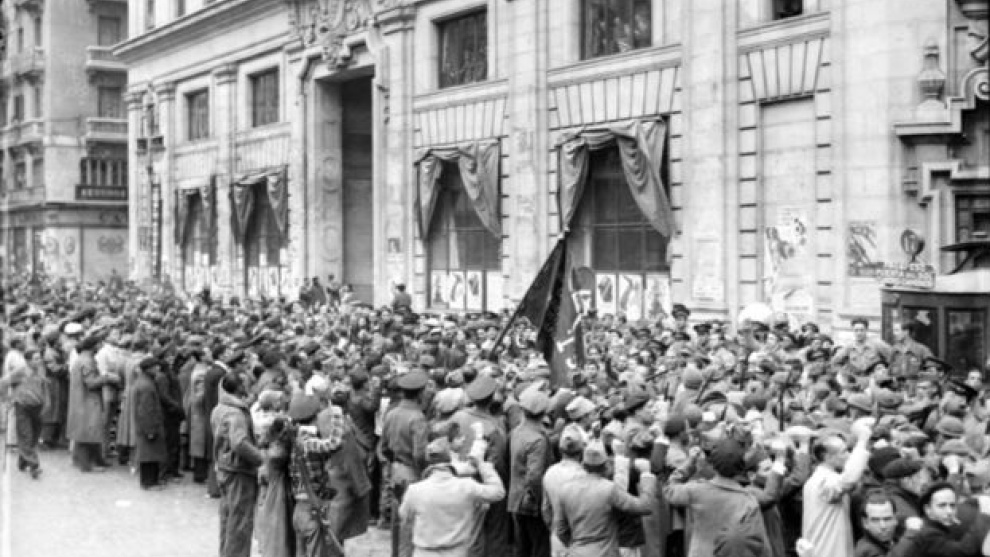
The International was shouted aloud. Along the Gran Vía, the same British brigadiers who had arrived at Vallecas the day before now advanced, rifle over shoulder, marching amid rows of field guns and machine guns. From the balconies of the buildings, Madrid residents waved red pennants. On the façades, Russian films announced themselves, presented by the Ministry of Education. The latest premiere was The Kronstadt Sailors.
It was impressive to see the brigadiers leading with a huge red flag at the head, each company preceded by its crimson banner. Those who sang with the strongest voices were the Germans. They had pulled out elegant khaki uniforms, origin unknown. They marched ahead of the British, singing the songs of Hans Eisler that accompanied the demonstrations back in their country. Their voices were deep, harmonious. The voice of a free Germany. They wanted everyone to hear it.
The British appeared less martial in bearing. They were less energetic in song, though Cornford and Bernard Knox, who sang well, tried to keep up the spirits. Still, they seemed more disciplined and professional than the French, the nationality most numerous among the brigades. The three leaders were adamant that everyone should look presentable and sought to make the best impression while marching and singing the International in their own tongue.
—SO COMRADES, COME RALLY AND THE LAST FIGHT LET US FACE. THE INTERNATIONAL UNITES THE HUMAN RACE…
The English were disappointed with the French machine guns, a Saint Étienne handed to them at the station. They had taken them out of their boxes. Seeing the tripod and the complicated elevation mechanism, they grew concerned. When they realized that the gun itself was even heavier than the tripod, thinking of transporting them across open terrain, they began to trade jokes and frowns alike.
—The famous Saint Étienne —said a French veteran—. A regiment of my country tried them in August 1914. They abandoned them after a month. They jam every time. They stop functioning when the smallest dirt enters their locking mechanism. I tell you, if it weren’t for the Non-Intervention Committee, we would have decent machine guns… So many gears and sliders—do you know what they make me think of? An old clock, one of those whose mechanisms indicate the days of the month and eclipses…
Immediately they went to complain to a man with general insignia. They said they needed American Lewis guns, with a circular magazine. Among the British there were specialists. That big man, casual in attitude and with amused eyes, promised them in good English that he would do what he could. Later they learned that he was General Kléber, an agent of the Komintern within the International Brigades.
Nevertheless they tried the machine guns that very morning, and after a nap, at two o’clock they packed their kit, distributed boxes of ammunition, and dismantled the Saint Étienne. Since Sommerfield was the tallest, they loaded onto him the central body of one gun: fifty kilos that he had been dragging since they left the ghostly Atocha Station, with many trains parked without lights. There they formed up alongside artillerymen of the Fifth Regiment, under a light drizzle. The sky was gray. The station’s courtyard filled with men with tired faces, unshaven. Opposite stood a grand hotel with a portrait of Stalin hanging from its façade.
—Se sabe ya que los fascistas se abren paso. Están luchando en otra parte de la ciudad. Hoy mismo, después del desfile, nos incorporarán al frente —dijo John Cornford.
Now the drizzle had stopped. They marched. Since it was still early, there weren’t many people watching them. Madrid residents cheered from the windows.
—Long live the Russians!
But they did not seem convinced. No one believed that, after so many defeats, the war’s course would change. As they passed through wind-swept streets, fatigued, poorly equipped and hungry, between shuttered shops, Sommerfield, Cornford, and Bernard Knox had the impression that the people on the sidewalks looked at them as if they were arriving too late.
—Keep singing! —shouted Cornford, who marched wrapped in his threadbare overcoat.
To Sommerfield the Saint Étienne hammered his shoulder. Its metal pieces stabbed into him with the fifty kilos. He also wore a backpack, a blanket, a canteen, ammunition, a bayonet, and heavy boots. Luckily Bernard supported the rifle for him, he thought. After twenty minutes of marching, those carrying the machine guns were already sweating, and shivering with exhaustion.
All the daily entries of 1936 Day by Day
Interview with José Ángel Mañas about 1936 Day by Day