
To commemorate the 90th anniversary of the Civil War, José Ángel Mañas recreates in Zenda, day by day in this section, what happened in 1936, perhaps the most pivotal year in all recent Spanish history.
Sunday, October 11, 1936: The Russians Are Everywhere
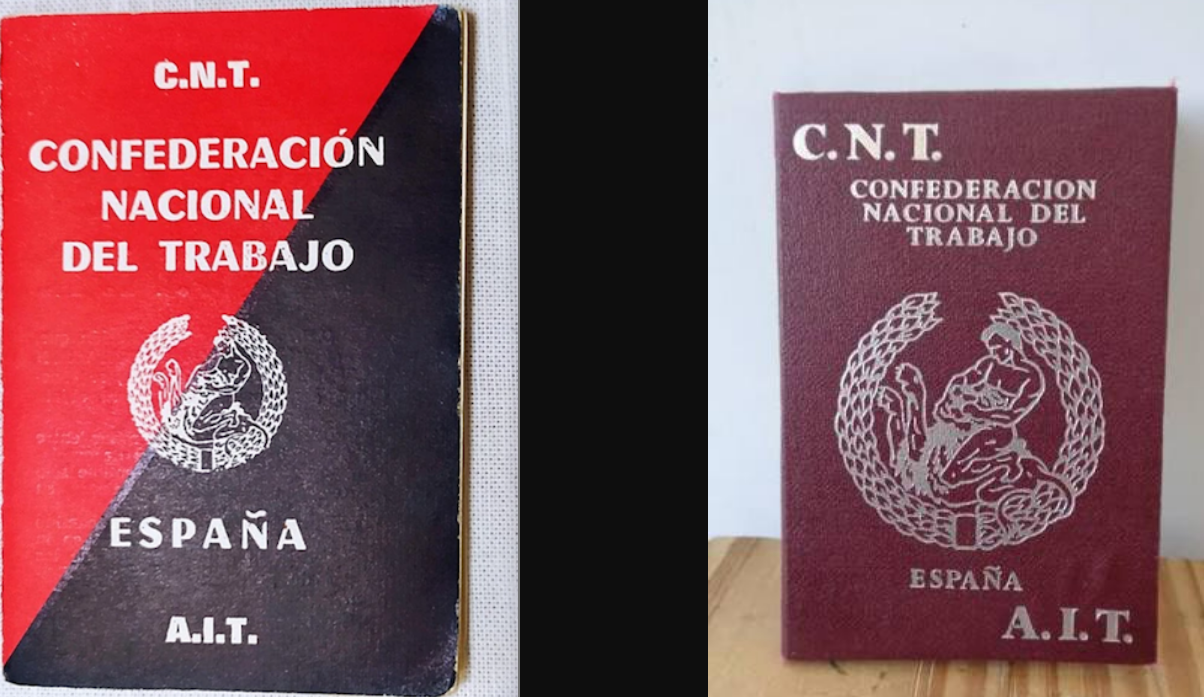
The CNT card — I have it right in front of me — dates from October 11, 1936. The red-and-black cover is the classic one, with the CNT seal. I open it and to the left it reads: “UNITY IS STRENGTH. WORKER: the union is your binder. In it the union of the proletarians who walk with their heads held high toward their emancipation is formed.” On the other side: “The emancipation of the workers must be the work of the workers themselves.”
In the next page there is a catechism with libertarian postulates: “The anarcho-syndicalism and organized anarchism are governed by the law of the majority,” “The militant has the right to express and defend his thesis, but is obliged to obey the majority decisions…,” “A card, without its corresponding confederal stamps, has no value,” “The confederal stamp is the only income that the Regional and National Committees have. Not stamping it is sabotage…,” “We reject individual authoritarianism, but we accept, and one must comply with, the collective and majority mandate…,” “Mental agility to see the danger and overcome it quickly is what is needed. Wasting time wandering in meetings with philosophical digressions is counterrevolutionary…”.
My grandfather
He took it the day after his friend Ángel Navarrete pulled him off the truck as they were being taken away for the “paseo.” I know that while they were eating together that day they had a serious discussion. Navarrete warned him about the decree with which Largo Caballero militarized the popular militias and spoke ill of the Communists.
—Yesterday there were four monkeys, today they are everywhere. Since they are the ones who control Soviet armament, Caballero pays them too much heed. They are wolves in sheep’s clothing. They pretend that their only interest is the triumph of the Popular Front, when the Russian ambassador and that fellow Koltsov, two lapdog puppies of Stalin, keep sniffing around the ministries. They seek to control the Army. And they are succeeding. Largo Caballero has appointed Líster as head of the Mixed Brigades. People know it. That is why more and more are joining. If we don’t do something, this will end up like in Russia.
Mañas knew that Navarrete had begun to draw nearer to the pestañistas, though he did not know to what extent. But his friend had it clear.
—Pepe. Pestaña was among the first to travel to Russia and see the danger. He met Lenin in person. He quickly understood that he was a Slav who reduces everything to authoritarian principles. The Bolsheviks reduce life to formulas. They dream of a perfect organization that leaves nothing to spontaneous initiative. That each person knows hour by hour, day by day, what to do, what to think, how to have fun, how to eat. That the State forms specialists in every field who think for you and give you everything ready-made. They want the country to be a kind of Taylorist system, all foreseen in advance. For an anarchist, that is unacceptable. Upon his return, Pestaña denounced it within a Confederation where Andreu Nin began to advocate Bolshevik proselytizing. He was the first to openly denounce what was happening and his intervention in the CNT assemblies was key to persuading the organization to part ways with the Third International.
Mañas was silent, pensive. Navarrete continued.
—He himself recounts how at the Congress of the III International they cut off the floor to detractors and pressured minorities. The nocturnal arrests also left a mark. Only three days later is the reason for the detention disclosed, with a sentence that remains secret until twenty-four hours after the verdict. No one finds out until the following day about the execution, through the notice in the official newspaper, with the unchanging epitaph: shot for counterrevolution. Their police are as bad or worse than those who serve the State everywhere. If we don’t curb them, Pepe, they will exterminate us all.
Todas las entradas de 1936 día a día
Entrevista con José Ángel Mañas sobre 1936 día a día