
To mark the 90th anniversary of the Civil War, José Ángel Mañas recreates in Zenda, day by day in this section, what happened in 1936, perhaps the most pivotal year in all of modern Spanish history.
Monday, October 12, 1936: Viva la muerte!
Miguel de Unamuno, the university rector, waited patiently in his seat. Unamuno presided over the panel in the Paraninfo of Salamanca and hesitated. He had leaned from the very first day toward the rebel side and contributed five thousand pesetas to the national subscription. He explained this in August to La Prensa, a Buenos Aires newspaper. Moreover, on behalf of the faculty he issued a statement to universities around the world denouncing “the criminal acts carried out by the Marxists.”
And there he was, on October 12, the Day of the Race, welcoming in the faculty the cream of Spain’s rebel faction. In an event he himself presided over. Sitting beside him were Carmen Polo, the unremarkable wife of General Franco, Millán-Astray, founder of the Legión, the Bishop Pla i Deniel, and the poet and writer José María Pemán, who had backed the military from the outset.
First to speak was Francisco Maldonado, a professor of literature, with a stern address against separatism. Those who knew Unamuno could see how his features tightened, as the audience’s reaction grew more exalted. At one point the elderly rector, tired of cries against Basques and Catalans, stood up from his seat and asked for the floor. A grave silence fell as his gaze wandered across the audience.
—You know I did not want to speak, because I know myself, but the words have forced themselves from my tongue and I must say them. There has been talk here of an international war in defense of Christian civilization. I have done so myself on other occasions. But no, ours is only a civil war. I was born cradled in a civil war, I know what I am saying. To win is not to persuade. And there is above all the need to persuade. But hatred that leaves no room for compassion cannot persuade. Hatred of intelligence, which is critical and discerning, inquisitive, but not inquisitorial. There has been talk of Catalans and Basques, calling them anti-Spain. Well. Here is the bishop Pla i Deniel, Catalan whether he likes it or not, to teach you the Christian doctrine you refuse to learn, and I, who am Basque, have spent my life teaching you the official language, which you do not know…
Almost immediately, General Millán-Astray rose to his feet. Seeing that he was not being given the floor, he began to shout.
—Catalonia and the Basque Country, the Basque Country and Catalonia, are two cancers in the body of the nation! The fascism, Spain’s remedy, comes to exterminate them by cutting into living and healthy flesh like a cold knife!
Unamuno looked at him coldly. He tried to regain his composure. He said:
—The general Millán-Astray is a mutilated man who would like to create a new Spain, undoubtedly a negative creation, in his own image. And for that reason he would desire a mutilated Spain…
—Death to intelligence! Long live death! —shouted Millán-Astray—. Enough of bastard intellectuals, intellectuals who poison the minds of our youth! Long live death and a thousand times death!
—No! Long live intelligence! Let the bad intellectuals die! —said, uneasy, José María Pemán. But it was too late for compromises.
—This is the temple of intelligence, and I am its high priest! —Unamuno raised his voice—. You profane its sacred precinct. You will win, but you will not persuade, because to persuade you need something you lack: reason and justice on the battlefield…
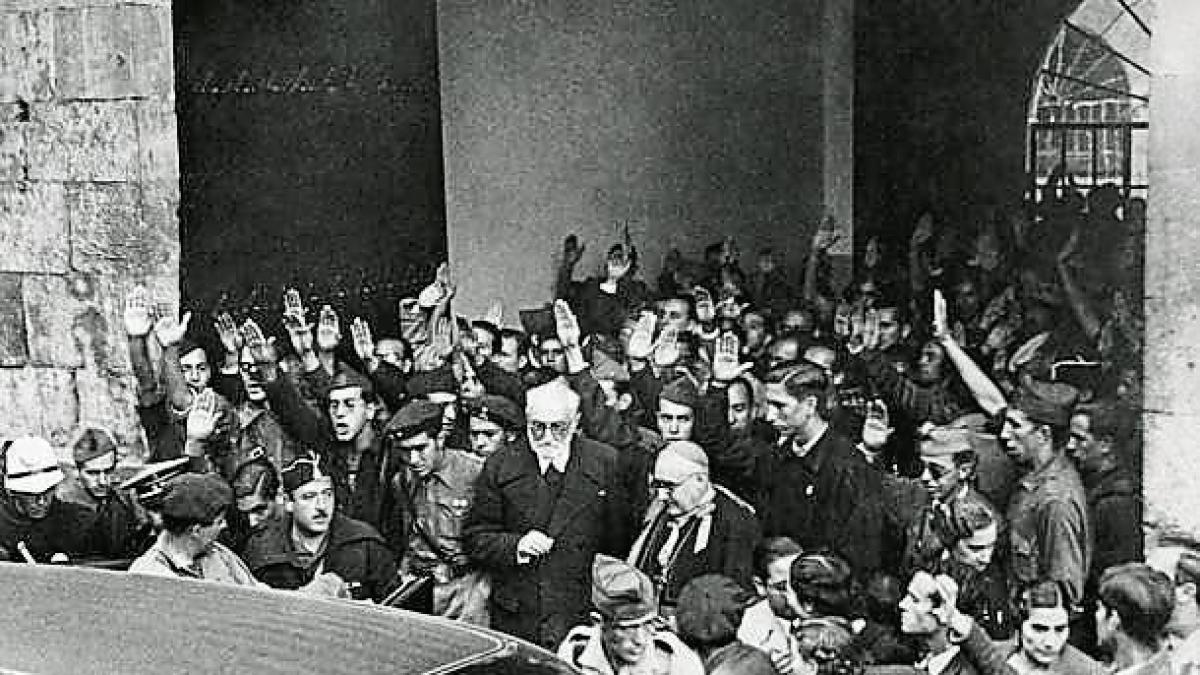
He could not continue. The uproar was such that Carmen Polo herself grabbed his arm to lead him away, amid pushes and insults. If it hadn’t been for her, he might not have reached the car.
In the photograph that immortalizes the moment, Unamuno is seen, coat on, serious, his gaze lowered, amid a sea of raised arms and red berets whose meaning is unclear—whether they are bidding him farewell or forcing him out. More than a few people would have liked to shoot him. It was cold, very cold that day.
Todas las entradas de 1936 día a día
Entrevista con José Ángel Mañas sobre 1936 día a día