
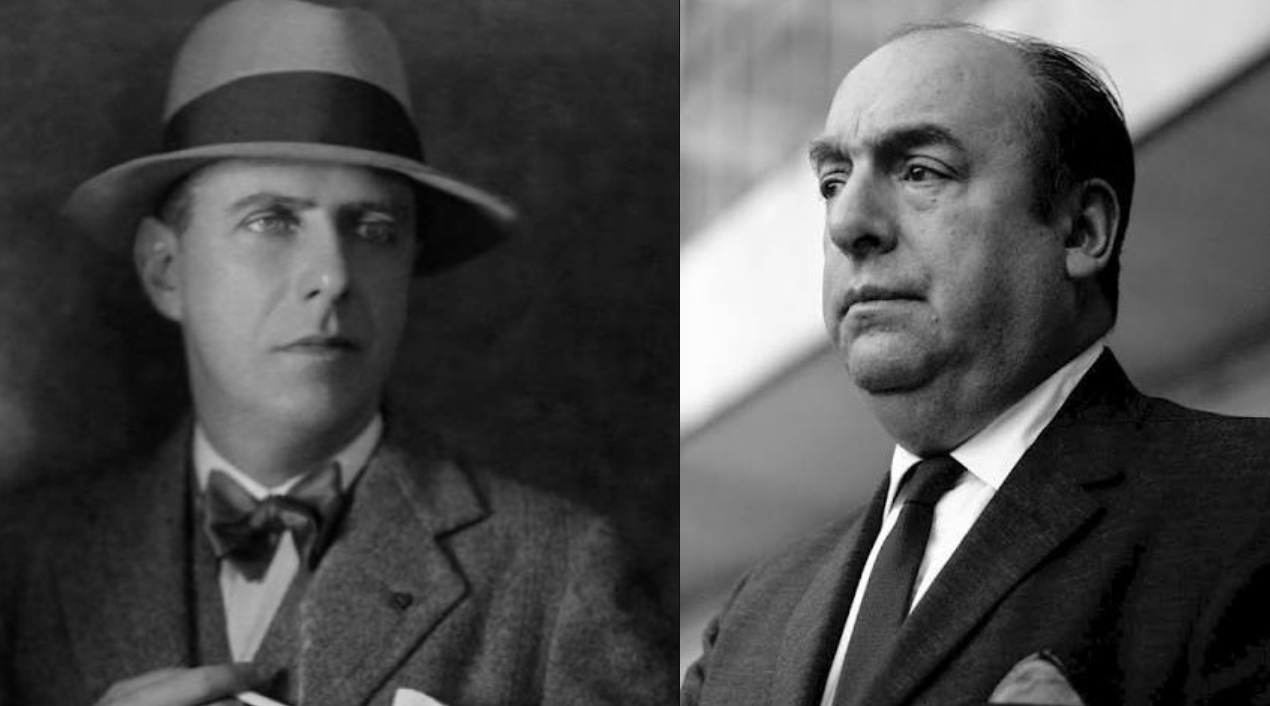
To commemorate the 90th anniversary of the Civil War, José Ángel Mañas recreates in Zenda, day by day in this section, what happened in 1936, perhaps the most pivotal year in the recent history of Spain.
Thursday, October 15, 1936: Carlos Morla and Pablo Neruda
Carlos Morla Lynch woke up startled. The Chilean diplomat had just dozed off in an armchair in his bedroom after lunch. Since the start of the war he had housed in his residence around twenty refugees, among friends and acquaintances. The arrangement proved difficult. On top of the lack of privacy came the inevitable frictions. He never would have imagined it would be so hard to be a host, and he rested to recover the hours of sleep when the doorbell rang.
—Sir Morla, shall I open the door? —asked
the maid.
The murmur of conversations inside ceased.
—No, thanks, dear, I’ll be right there.
Carlos Morla Lynch approached the entrance door, pressed his eye to the peephole. It was Pablo Neruda and the printer Manolo Altolaguirre, two inseparables since Neruda was in Madrid. Altolaguirre had given shape to the Nerudian poetic project, that renowned Green Horse. Pablo arrived with his beret pulled down. The tall Altolaguirre accompanied him, with a serving air, together with a boy who seemed impressed. Not far away were the guards. In all the embassies they had changed the people in charge of surveillance. And that despite the protests of the diplomats.
—I can’t stay, Carlos —said Neruda—. But I need you to lend me a hand. There’s a persecuted person who needs protection —added, turning toward the addressed.
To Carlos Morla Lynch it was hard to believe that everything had changed so much. That Madrid—liberal and salon Madrid, supportive and generous—where he used to host García Lorca or Cernuda at his Alfonso XII house, no longer existed. In reality, he still could not come to terms with Federico’s death. To that Madrid teeming with talent succeeded this other, sordid and dangerous Madrid, in which the character of many was revealed. What happened was that while he opened his doors to a dozen refugees — he ended up hosting fifty-three — Pablo kept his consulate empty.
—I’m glad you’ve come, Pablo. Come in, I want to introduce you to my guests… —he took him by the arm—. Ladies and gentlemen, this is the poet Pablo Neruda, who has come to greet you. Do you see that boy with black hair and dark eyes, Pablo? He hardly speaks, he watches, reads, enjoys the music. For the moment he sleeps on a mattress on the floor and has only what he wears; his torn shoes weigh on all our hearts. His father, unfortunately, is imprisoned. Carmen, the Duchess of Peñaranda, with those airs of a brazen gypsy, is grand in Spain, as well as brave and cheerful, mocks everything. Her boy, in the corner, is named Fernandito. Antonio de las Heras, who keeps his hands in librarian-like gestures, is a cultivated man; I hope you can converse another time. And here I introduce Fernando García Díaz, my son’s friend, an excellent young man. That other one, tall and thin, is Ramón Alear Baux. That very distinguished man, the Count of Villada. His wife, Cocolín; and his mother, a good organizer and young grandmother, María Antonia Areces. In total I host these fifteen refugees, gladly, under my roof. And you, how many do you have at the consulate, Pablo?
—Carlos, don’t do this to me…
—Not for anyone, Pablo! But don’t worry. I’ll find a way to lodge your protected person, here or at the embassy, if you insist…
Neruda did not take long to say goodbye, and was followed by Altolaguirre, who did not know what face to put on. Carlos Morla returned to his chair. When one of his refugees approached, he asked thoughtfully if, in the event of a military victory, they thought they would be treated more generously.
—Not at all —answered the countess—. They will be as ferocious as the Reds. They will kill everyone they can… especially people like you.
To Carlos Morla Lynch a long sigh escaped him.
All the daily entries of 1936 day by day
Interview with José Ángel Mañas about 1936 day by day