
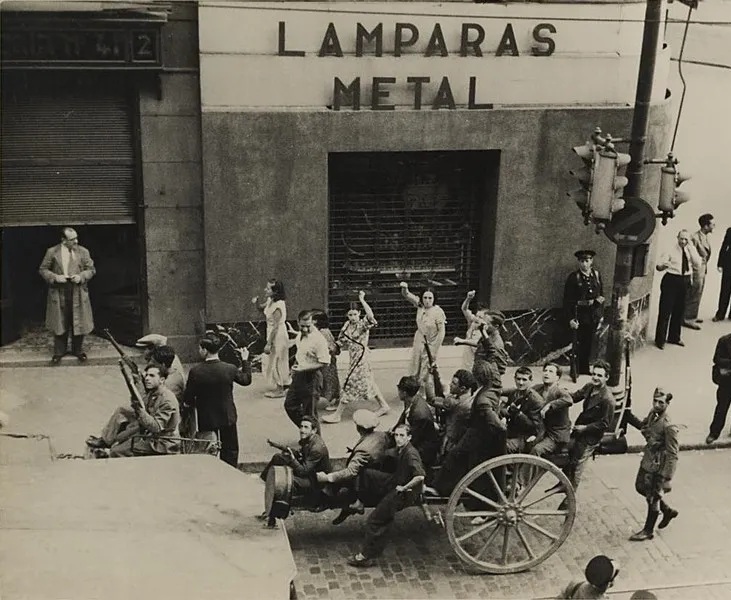
To commemorate the 90th anniversary of the Civil War, José Ángel Mañas recreates in Zenda, day by day in this section, what happened in 1936, perhaps the most momentous year in all recent Spanish history.
Friday, October 16: Mañas gets his CNT card
My dearest Merche:
If you could see me, you wouldn’t recognize me. My only suit is full of patches. My best shoes have holes in the soles. But I am not the only one. Except for those who end up wearing a uniform —you can tell them apart because they wear it impeccably—, those of us who try to dress in our own clothes come to be viewed with suspicion and are stopped at the checkpoints.
Ángel Navarrete has insisted that I obtain the CNT card. With it in my pocket I travel the route from Carabanchel to the Swan promenade, where the Secretariat of the Supplies Committee is, my new office. There I help the accountant, compare earnings, duties, and from time to time I pass by Cisneros’ house at City Hall to deliver accounts to the mayor.
If I haven’t been militarized yet, it’s because I have three women under my care. Mine is the only income at home, given how little the shop yields. That’s why I need to reintegrate into active service as a civil servant. We have to draft a letter requesting readmission, and I’m on it.
You won’t be surprised to know that I’m still crushed by my father’s death. Even now, when I open the door to the house, I feel as if I’ll find him lighting a cigarette. Or I go out and I wait to see him, sleeves rolled up, in the garden. How many times did I get angry when he disappeared on horseback for a couple of days! How I came to hate him, sheltered in my mother’s skirts, not knowing but to criticize him, almost wishing that he would disappear! Today it is my treacherous memory that leads me to remember the moments when we faced off, and I feel as if I caused it and pushed him, with my bad feelings, toward death.
The worst part is the night. By day, I manage to keep up my spirits to some extent. Moreover, so many neighbors have died, some on the front, others “paraded” through the streets, that I cannot express my sorrow: everyone has lost someone. Carabanchel is a madhouse full of orphans, mothers and grandmothers, but without men, who are at the front or working in the central union offices.
At night, when it’s time for bed, the ghosts appear and the pain grips your throat. Among the shadows I think I hear footsteps. I imagine it is my father returning from one of his escapades. Or worse: I hear a car stop nearby and I think they are coming for me. Then come my mother’s sobs and that dryness in the throat, the difficulty swallowing, the unsettled sleep, the bitterness in the morning when I wake up. I spend the hours shooing away bad thoughts.
What saves me is the day-to-day, the routine tasks, step by step. And to think that I have three women to look after, and that you are waiting for me in Ciudad Real. These are sad days… I hope you are all better.
With love, your Pepe
(from my family archive)
All the entries of 1936 day by day
Interview with José Ángel Mañas about 1936 day by day