
To commemorate the 90th anniversary of the Civil War, José Ángel Mañas recreates in Zenda, day by day in this section, what happened in 1936, perhaps the most pivotal year in all of Spain’s recent history.
Friday, October 2, 1936: The Supply Committee
My name is José María Tárrega. Who sent you here?
—
Ángel Navarrete
—said Mañas—. From the Carabanchel federation.
Pepe Mañas reported to the secretariat of the Supply Committee of Carabanchel, which the CNT had moved to a requisitioned building on the Paseo del Cisne, No. 20. It had taken him several days to feel able to step out of his house, and he came at Navarrete’s request. The pain of losing his father was compounded by the neighbors’ misunderstanding and a sense of guilt. In Carabanchel many believed that if Luis Mañas had been killed it was because he served as sacristan at the parish of San Miguel, together with his cousin the priest, who had just completed military training, or because “he must have done something.” Mañas heard that offensive murmur behind his back every time he entered or left his mother’s shop of groceries.
—And how was last night’s bombing? —inquired José María Tárrega.
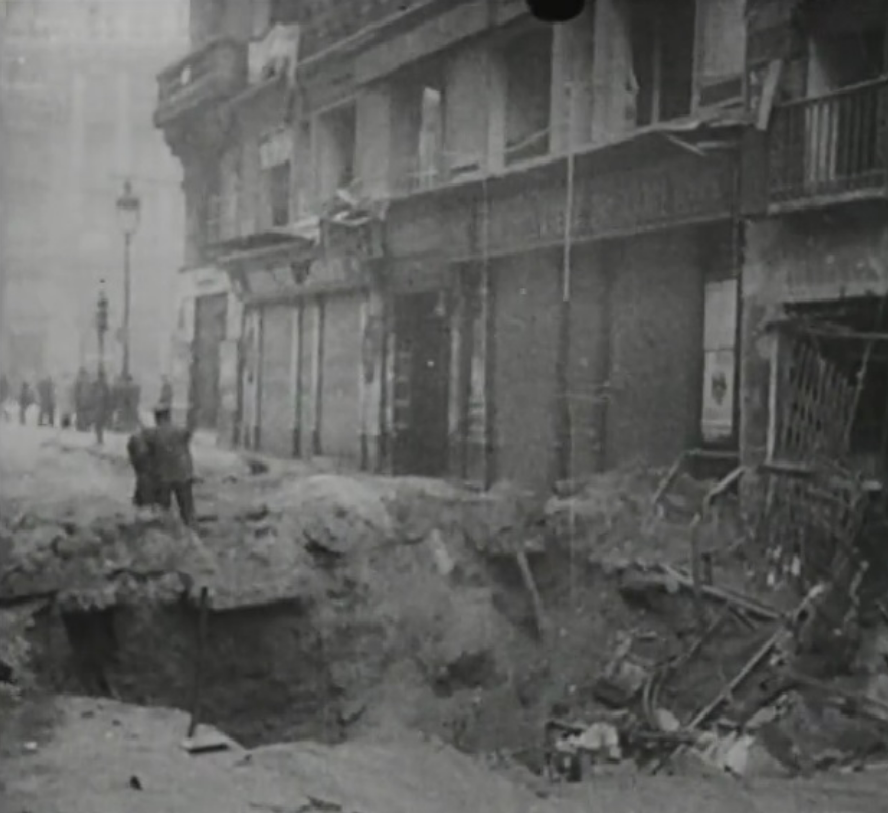
—In the early hours. They say the planes aimed at the Getafe airfield. In Carabanchel a bomb fell without exploding —Mañas replied—. I went to inspect it first thing, with more neighbors, the majority of them women, since the men are at the front. A gigantic, steaming funnel has formed in the middle of General Ricardos. Three horses could fit inside it comfortably.
—According to the reports, they are 100-kilo, high-powered Rheinmetall bombs, not manufactured in Spain —continued José María Tárrega, filling out the form.
Mañas nodded and scanned the room. This was the office of a fugitive lawyer. Only Tárrega and he wore suits. Proletarian dress had become one of the hallmarks of besieged Madrid. That was even as many began to voice opposition to such needless plainness. They argued that one should dress as one always did, buy the usual goods. The rest, they claimed, was to intensify economic troubles in the rear. More than going without a jacket, tie, or hat, he thought, what is needed is for money to circulate, for industries to run, and for those who pretend to be proletarians without ever having been so to do more than smother their fear and sabotage the nascent economy.
Mañas never wore a hat, by republican conviction. Yet he tried to keep wearing the jacket, despite it being increasingly worn and mended, a stubborn habit his mother tended to repair.
—It seems they have set up anti-aircraft guns on trucks at Cibeles —added him.
This time Tárrega nodded. He was a thin, ungainly, somewhat shabby man, with a faintly hoarse pronunciation, but he seemed intelligent and decent. Mañas felt an instinctive rush of sympathy. He was also relieved that his speech did not brim with “comrade” or “fellow” terms. When he finished filling out the new hire’s papers, Tárrega stepped back from the counter and introduced him to the team.
—Those over there are the Mendívil brothers, your desk mates. In the back is your desk. The hours are flexible, but it’s probably best not to arrive very late. You will, of course, leave at a time you deem best — he concluded.
Todas las entradas de 1936 día a día
Interview with José Ángel Mañas about 1936 day by day