
To commemorate the 90th anniversary of the Civil War, José Ángel Mañas re-creates in Zenda, day by day in this section, what happened in 1936, perhaps the most momentous year in all of Spain’s recent history.
Friday, October 23, 1936: Talking with Companys (II)
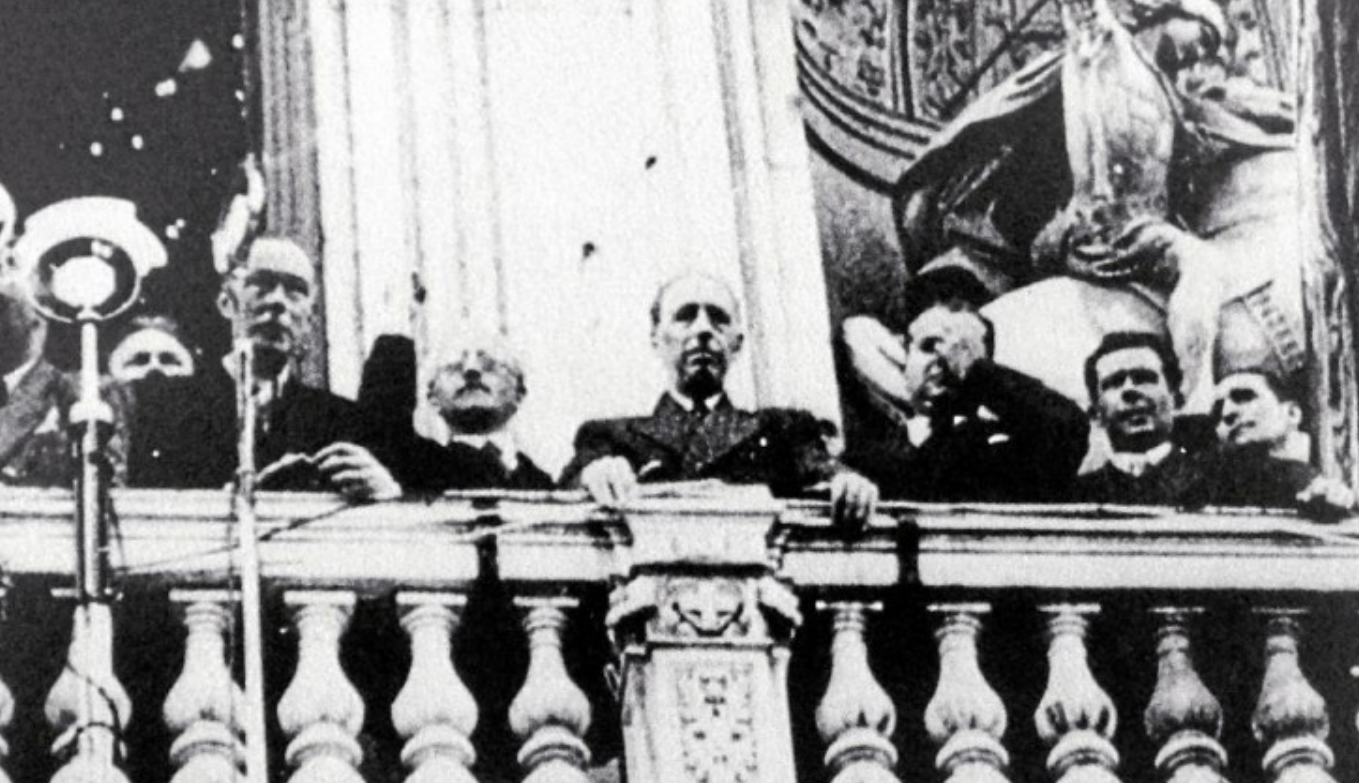
Continuing with our report, Mr. Companys, I would like to revisit your controversial involvement in the 1934 revolution. For Spanish readers it is impossible to separate your figure from that of the president who proclaimed the independence of Catalonia from the balcony of the Generalitat, in Plaça de Sant Jaume.
—I, Nogales, declared the independence of the Catalan State… within the Spanish Federal Republic, I suppose you remember. I have always been, more than anything, autonomist.
—That is a detail.
—Not for the Catalan nationalists. But before we get into evaluations, perhaps it would be useful to clarify the facts. Where would you like to start?
—If you please, at the moment you peeked out from the Generalitat balcony that six of October. I understand that when you re-entered, while yours were congratulating you and applauding, you did not look happy. They say you seemed concerned, that you said (correct me if I misquote): “It’s done. Let’s see if now you’ll also say that I am not a Catalanist. We’ll see how it ends.” That “we’ll see how it ends” interests me. There are those who say you suffer the Leticia syndrome, Napoleon’s mother, who in dramatic moments said something similar about imperial glory. It is pessimism, as your friend Ángel Ossorio has told me in Madrid, of whom you know he has leapt blindly, from the boy whom his companions had to push into the void and whom they fling themselves with, euphoric, thinking how wonderful it would be to swim in the pure waters of independence. What was your real mood when you took that desired and feared leap, in 1934, in front of the full Plaça Sant Jaume, having militarily occupied Barcelona with your militia since the previous day?
—I think you have summarized it reasonably. He had the fear of facing a powerful enemy and having taken one step too far, a premature step, given the results. You can tell it like that. He was worried. He saw around him an excess of euphoria. And we were still waiting to know what our reply from General Batet would be. I had sent Batet a note urging him to place himself under my orders.
—A note that was brought to you by the Director General of Labour, Juan Tauler…
—He was the one who informed me by telephone that Batet would give his reply in an hour. It was a response that was at least unsettling, which could not fail to provoke uncertainties.
—Is it true that, in such a delicate situation, you decided to sit down to dinner?
—I have been criticized a lot for, instead of moving and acting, sitting down to dine. But it seemed appropriate to me. I had to calm the long faces. I wanted to show composure, security, dispel ghosts. And it worked. We all calmed down. It had a soothing effect. Normalcy was total. In fact, we were making plans for the new Catalan state, when around ten-thirty or so, some gunfire from outside brought us back to reality. The political insurrection had begun. There it was understood that this would not be a bed of roses. On one side there were uniform, military discharges, on the other side stray shots: it was a fight between amateurs and professionals. In those bursts we received Batet’s response and I learned, unfortunately, that my intuition had been right. That we had allowed ourselves to be carried away by enthusiasm. That Catalonia was not yet mature enough for independence…
—Does this have anything to do with the reception that Azaña has received these days?
—What reception are you referring to?
—Azaña has been in Barcelona since yesterday. He complains that he is being received as if he were a foreign head of state. He says that since he arrived in Barcelona the Generalitat has not ceased to snub him.
—I would say that Azaña is excessively sensitive. The Catalan nation and its Generalitat have received him with all the honors and respect due to his office. We have installed him in the citadel of Barcelona, and soon he will have permanent accommodation in the Montserrat Monastery… We can do no more.
Todas las entradas de 1936 día a día
Entrevista con José Ángel Mañas sobre 1936 día a día