
To commemorate the 90th anniversary of the Civil War, José Ángel Mañas recreates on Zenda, day by day in this section, what happened in 1936, perhaps the most pivotal year in all modern Spanish history.
Friday, October 30, 1936: The first international brigades
The young Sommerfield rummaged with the plunger in one of the five toilets at the international brigades training center.
The bloody toilet clogged without any of the dozens of volunteers offering to unclog it. Of course, they come to fight for freedom, to be heroes. Those prosaic tasks wait for the Spaniards to do them. Or even that, thought a grouchy
John Sommerfield. He kept scrubbing. But someone had to do it, and in the end, upon seeing that no one volunteered…
—You’re a bunch of dogs —he told John Cornford, Bernard Knox and the rest of his companions, who of course laughed.
He had taken off his jacket, rolled up his shirt sleeves, grabbed a bucket of water, the plunger. After covering his face with a scarf and asking for gloves, he knelt beside the toilet. He pulled out the clumps of dried filth that littered the bowl with a few scraps of paper and tried to breathe through the scarf. The filth clogged the pipe. He dumped it into the bucket. Seeing that it wasn’t enough, he used the suction to draw the conduit. When he flushed and found that even that failed, he decided to dismantle the entire siphon behind the toilet. He did so without stopping to inhale through the scarf, with a grimace of disgust, and remembered the oath he had made upon arrival.
—I am a volunteer with the International Brigades because I deeply admire the courage and heroism of the Spanish people in their fight against international fascism. Because my enemies today are the same as those of the Spanish people: the fascists. Because I know that if fascism wins in Spain, tomorrow it will reach my country and my home will be devastated. Because I am a worker, a laborer or a peasant who would rather die than live on his knees. I am here because I am a volunteer and I would give, if necessary, until the last drop of my blood to save the freedom of Spain, the freedom of the world.
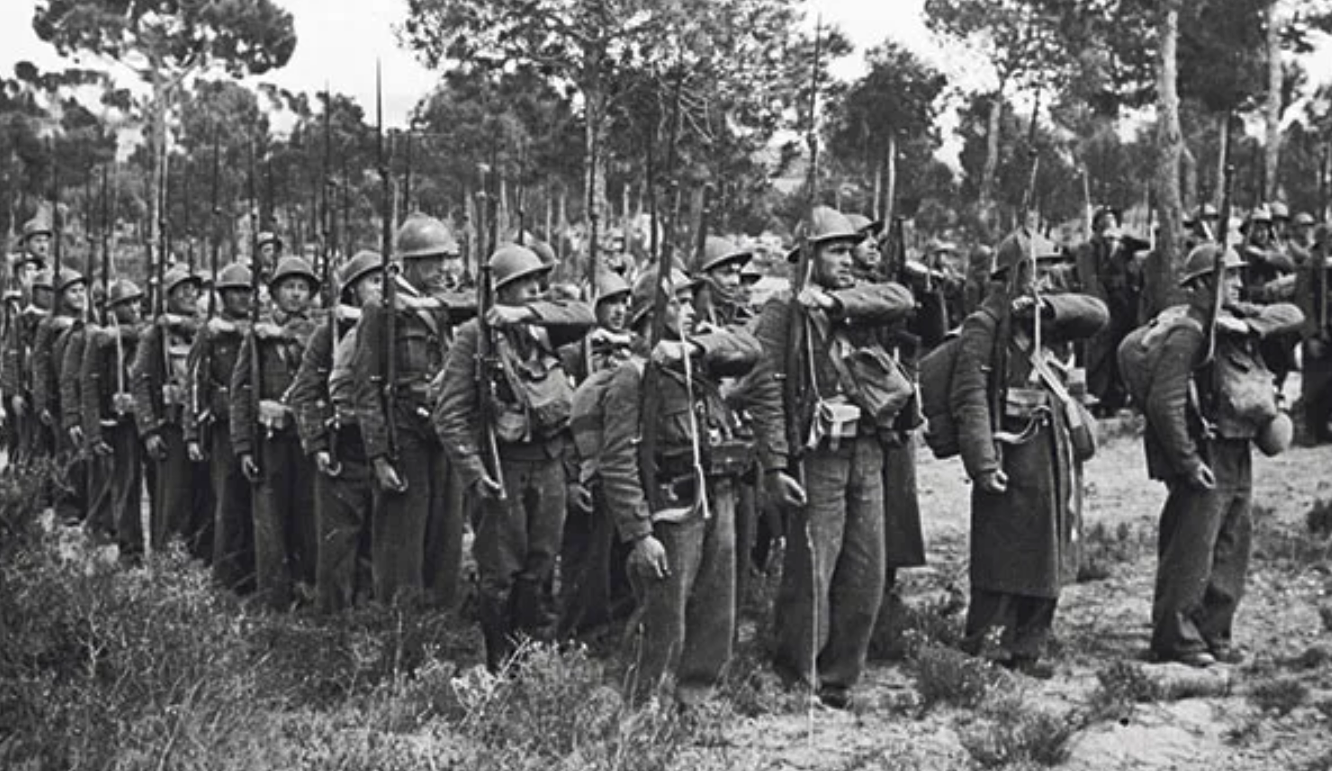
That was all very well. That oath was taken by the pragmatic Marty, the French hero of the Russian Revolution. He welcomed the first five hundred brigadists arriving via Perpignan and Barcelona, and had housed them in the old Civil Guard barracks for training.
On their arrival, some were struck by the dried stains of blood, remnants of the July fighting, that could be seen on the walls and the floor of the ground floor. They had preferred to sleep on the upper floor. The guards left behind dirty bed linen, bayonet scabbards, empty wine bottles, some anti-venoms like Blenocol, magazines, well-worn, with photographs of movie stars. The only ones sweeping, with their brushes, were the French.
Sommerfield was not like John Cornford, his namesake, a descendant of Darwin and a budding poet, who had arrived in Spain with the pistol his father used in the First World War, Capital by Marx and the tragedies of Shakespeare. Sommerfield was no Cambridge man, as Knox was. No. He was a true working class lad. He arrived full of idealism, and for the moment the only enemy he faced was the shit.
—Bloody hell! —he exclaimed as he unclogged the toilet drain.
Todas las entradas de 1936 día a día
Entrevista con José Ángel Mañas sobre 1936 día a día