
To commemorate the 90th anniversary of the Civil War, José Ángel Mañas recreates, day by day in this section on Zenda, what happened in 1936, perhaps the most pivotal year in all of Spain’s recent history.
Tuesday, October 6, 1936: Soviet aid has a price
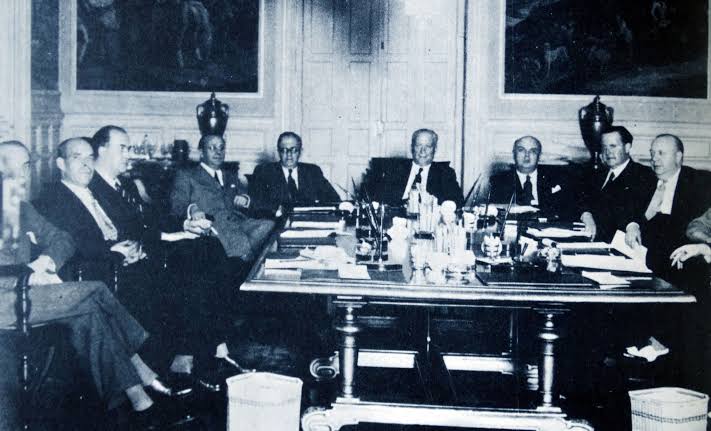
Even the Council of Ministers in Madrid were changing. To the soporific meetings of the time under Alcalá-Zamora — and not to mention the interim governments of Portela — followed others in which excitement and nerves reigned in the same measure that politeness faded. Waistcoats gave way to American jackets. Although most still wore a tie, it was not uncommon for Jesús Hernández, the Communist Minister of Public Instruction, to appear in a militiaman’s shirt. Guns were left outside. But everything was dominated by the war.
The very language itself was transforming. When it was the turn of the vehement Juan Negrín, Minister of Finance and rising figure in the Government to speak, no one was surprised that Largo Caballero, from the front, addressed him in a brusque, informal manner.
—Shorten your speech and tell us exactly how much gold we have, minister —said Largo Caballero.
—As of today, Mr. President —answered Negrín—, the Republic owns seven hundred and seven tons of gross gold accumulated over the centuries. It is the principal economic asset of the State. We are one of the world’s most important reserves. Of that amount, as the ministers know, six hundred and thirty-eight tons in ingots were transported last month, with the utmost secrecy, to the port of Cartagena. They are currently stored and well protected in the La Algameca powder magazine.
—The reason for the transfer —as the Minister of the Interior explained— is to avoid the danger, which we knew would be imminent due to our informants, of a coup being planned by the Catalan anarchists led by García Oliver. The same people who asked us to move to Barcelona were planning an armed assault. It was debated in the Small Council. And in anticipation of it, and given the proximity of Franco and Mola’s troops, the transfer was decided.
The allusion carried weight. Everyone was aware that for several weeks —specifically since the Russian ambassador had been in Madrid— Largo Caballero was flattering and making concessions to the CNT, which he intended to use to counter the communist influence.
Largo Caballero ignored the remark.
—And the rest of the gold?
—There is a reserve deposit as a loan guarantee at the Bank of France, Mont de Marsan. Fifty-nine tons. With this, French aid could initially be negotiated. And ten tons in the hands of other agents. That, not counting five hundred twenty-two tons of silver that were sold in Paris and those that were transported to New York, more than a thousand tons that today belong to the United States Federal Reserve.
—And even so it hasn’t been enough? —asked Prieto, who had been silent until now. His hands were crossed over his belly. He fiddled with his thumbs.
—Unfortunately, no —said Negrín, whose pro-communism was evident—. In my frequent contacts with Mr. Rosenberg, who as you know is the ambassador of the USSR —the remark drew sighs. Rosenberg had a habit of entering ministries unannounced, expecting to be told everything, and some minister had complained to Largo Caballero—, Rosenberg reiterates that this is Stalin’s main demand. If the gold leaves for Moscow, aid will arrive at the end of the month in the quantity of tanks, airplanes and instructors agreed with the Ministry of War. If the gold does not leave, there will be no aid. I fear there is no alternative. Either we receive Russian armaments, or Franco and Mola’s armies, with German and Italian material, will end the Republic, gentlemen.
All the entries of 1936 Day by Day
Interview with José Ángel Mañas about 1936 Day by Day