
To commemorate the 90th anniversary of the Civil War, José Ángel Mañas recreates in Zenda, day by day in this section, what happened in 1936, perhaps the most pivotal year in all of Spain’s recent history.
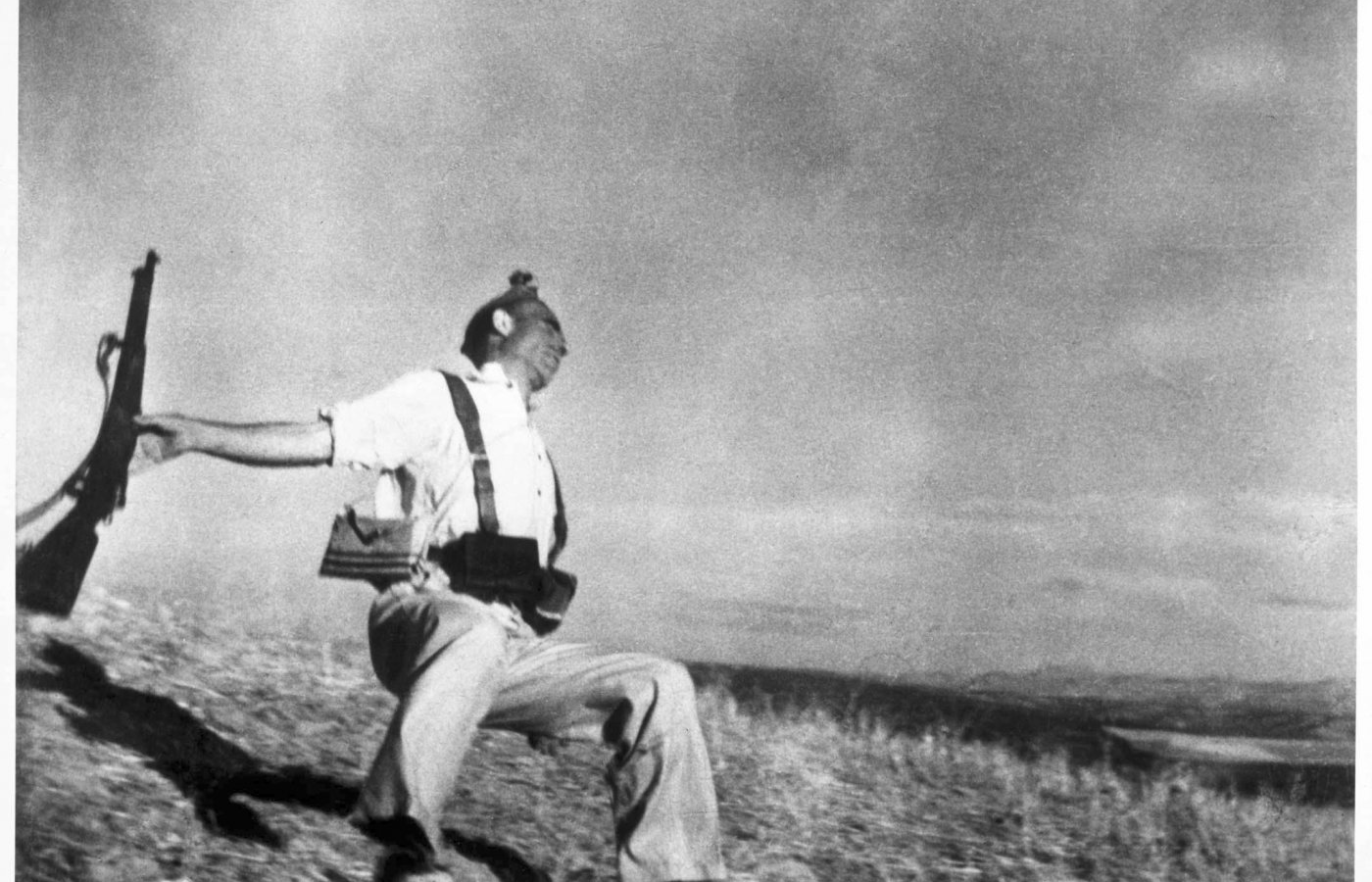
Friday, October 9, 1936: Capa’s Dead Militiaman
It is the most famous image of the civil war. A militiaman takes a bullet in the midst of battle. The man was named Federico Borrell. He was an anarchist. When Capa captured the image, he had spent the whole day tracking his unit. At the moment the photo was taken, he had just been struck by the bullet. It looks as if the impact hit his back, given the body’s movement. The right arm is extended. The hand opens, releasing a rifle after the shot. Borrell is in civilian clothes, save for the black cartridge belts at his waist, and his expression, with closed eyes, conveys pain.
—“It’s magnificent, Robert. Your image has circled the world. Bravo!”
Robert Capa thanked the compliment and set the magazine on the table. He was in the Paris office of the weekly Vu, returning from Spain. He felt satisfied with the success of the snapshot, but also guilty for profiting from the death of a man he had photographed several times during the day with his Leica, in Córdoba. Suddenly he remembered the enthusiasm with which he and his companions resumed their march. Their chants, the life, and then, amidst the gunfire, the end. Nothing more. The war in Spain shocked with its rawness, and he was already thinking of returning, as he had told his smiling boss, who, seated on the other side of the desk, repeated that Vu would be happy to receive more photographs, though he did not entirely understand the war.
—“What is it that you don’t understand?” asked Robert Capa, fixing two dark eyes on his boss. The director, a very French-type man, was tall, blond, and had light eyes.
—That newfound fascination with Spain. I don’t understand how people who have never cared for a country four centuries behind the rest of Europe, which for many is the very embodiment of fanaticism and cruelty, leave their families and go to fight for it, risking their lives and enduring all kinds of hardships…
—I admit I’ve asked myself that question as well. The answer is that they aren’t fighting for the Spaniards, but for the survival of an idea. We have three decades of fascism. Revolutions have been crushed in Germany and Hungary. Mussolini has destroyed the Italian left, and Hitler has annihilated the German workers’ movement, the strongest in Europe. The same for Dollfuss, in Austria, the only country where the working class defended itself, though in vain — he said, gracefully sidestepping the Jewish question.
—I agree. But aren’t we going too far? Aren’t we overemphasizing the conflict?
—In my opinion, Spain is the fiercest battle of the war being fought across Europe since the Bolshevik triumph in 1917. Since Hitler and Mussolini aid Franco, it has ceased to be a local matter. Without German and Italian planes, the insurgents would not be where they are. France, despite London’s pressures, morally stands with the Republic. And Russia cannot allow the counterweight that France represents against Germany to weaken, with whom they will eventually go to war. It is what drives the volunteers. And they are not just communists. The communists merely channel a broader antifascist sympathy that arises spontaneously everywhere — concluded Robert Capa, who found it awkward to have to explain something so basic to someone supposedly educated.
Todas las entradas de 1936 día a día
Interview with José Ángel Mañas about 1936 day by day