
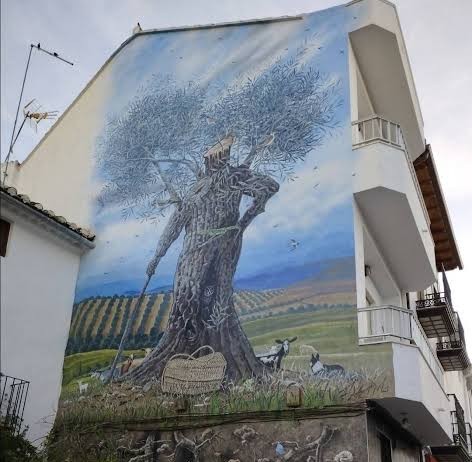
In Peal de Becerro, a man tugs at his shawl to gather olives at the foot of the olive tree. The elderly María explains to me the laborer’s fatigue, the cheekiness of the jackdaws that peck at the olives and then leave black droppings on the balconies, and every so often she interrupts the conversation to shout at a little bodeguero dog that stares us down: “But would you stop barking, creature?”. And she bursts out laughing. Because the laborer, the olive tree, the jackdaws, and the dog are all painted in a hyperrealistic mural by the local artist Faustillo, opposite the lady’s house. “That dog won’t let me sleep; wherever I go he’s always looking at me, but he’s so beautiful and he gives me so much company.” I visit Faustillo’s six street murals; I am struck by the one of the shepherd transformed into an olive tree, rooted in the landscape, watching the goats.
What moves me even more is then, in the fields of Baeza, meeting Lucas. He was born in Barcelona, the son of Jaén émigrés. Twenty-five years ago he came to his parents’ homeland to tend olives, and his bearded face began to acquire the color of the olives and the texture of the gnarled trunks. When he walks and turns his body to check if his dog is coming, rescued from the pound, Lucas looks like an olive tree stepping out of the row and strolling forward. Today he has finished pruning. He will rest while the olives bloom. “There aren’t two days alike here. I’m not going back to Barcelona, not crazy. Look how happy the dog is in the field, look how happy we both are.”