
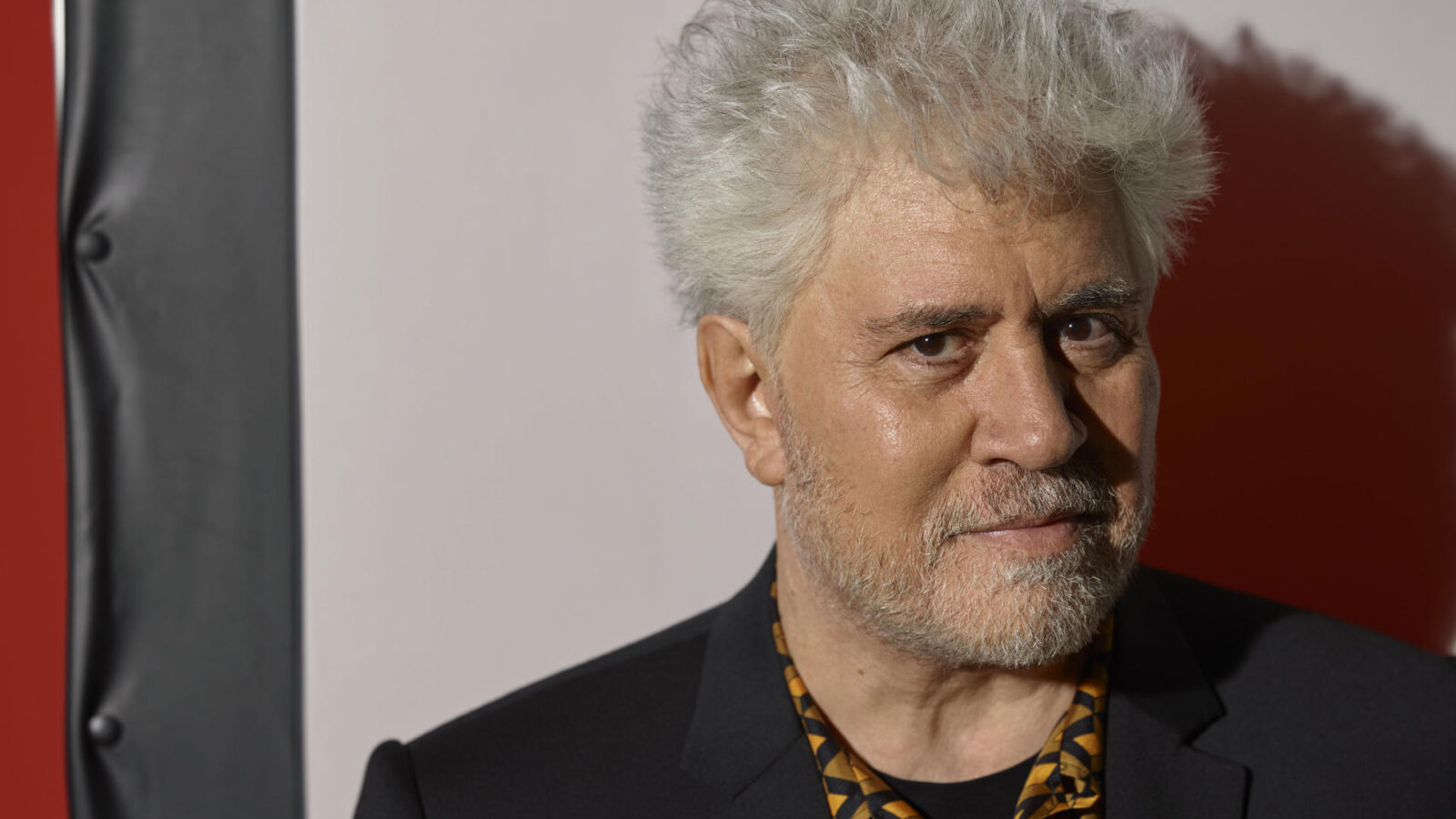
The profound relationship between Pedro Almodóvar’s cinema and literature also defines the filmmaker’s first novel, which narrates the trials and tribulations of a “thief of ideas” who rewrites his favorite authors — the so‑called “fan fiction” — in a dizzying, forward-moving chase that proves that “art is an endless chain,” the director asserts.
“The good fiction must be eternal”, muses Almodóvar (Calzada de Calatrava, Ciudad Real, 1949) in an interview with Efe at El Deseo’s headquarters about The Man Who Only Wrote on Planes (Reservoir Books), his first foray into the novel, though not into literature, since he is the author of three other books (Fire in the Belly, 1981; Patty Diphusa, 1991; and The Last Dream, 2023).
He has also written screenplays such as Bitter Christmas, during the filming of which he began the novel that is published this Thursday, and in which, through varied and fragmented styles, he speaks of his protagonist’s love for literature—Flavio, an eager reader who will discover his path after a journey through a multitude of professions.
Like his own fictional counterpart, Almodóvar uses in his writing numerous quotes, fragments, and ideas that he has gathered and internalized over the years, some his own and others from authors such as Clarice Lispector, Roberto Bolaño or Jorge Luis Borges. “It is good to keep what you write, because later, without having planned it, it finds its place in a story or, in this case, in a novel,” says Almodóvar. Thus, over his 256 pages, he resurrects pieces such as the original monologue The Addiction, about a very painful breakup, which he adapted and halved to be recited in Pain and Glory (2019) by Asier Etxeandia. “I wrote it for Carmen Machi and to do micro-theater in a tiny room, because I have never done theater, but this I dared to do.”
He has also revived, updating it, a science-fiction story he began in 1983 after watching the film Blade Runner, and which connects with artificial intelligence — “the perfect storm for sending us to disaster,” he notes — and fan fiction, a genre he admits to loving. “I suddenly watch a TV series and think about giving it a continuation, because it’s about believing that fiction should never end. You take up the baton and keep writing on your own terms, and you also hope someone will pick up yours. I like that fertility born from loving a book or a movie you don’t want to end,” Almodóvar explains, who has no plans to adapt this novel to the cinema, but would gladly grant the rights to do so.
The character Flavio, who also rewrites The Aspern Papers by Henry James, “has a bit of a thief of ideas about him but without it seeming immoral,” though at times he does slip into blatant copying, as when he performs the same stunt he narrated in ¡Mártir! by Kaveh Akbar. “I enjoy giving the protagonist a little of both—a bit of good and a bit of harm—and making him not admirable.”
The novel exudes a sense of insecurity about the act of creation, which may surprise the Spanish director who has become the most internationally known figure in cinema since Luis Buñuel, a legend who won two Oscars, two Golden Lions, two Golden Globes, two Cannes prizes, four Baftas, three César, six Goyas, three Feroz, and a Donostia Award, among other honors.

“I continue to feel, both in the literary aspect and in filmmaking, that I have no sense of security. I approach each film and each screenplay as an adventure in which the most enjoyable and important thing is to live it until I can give it a closing word,” summarizes his experience in 24 films directed over 45 years. It is a work that will outlive him, even though he dislikes thinking about “posterity,” because it is tied to his death. “But films are more important than us, and of course I wonder how people in future times will understand and feel certain things that you did with all your heart. A question that has no answer.”
Meanwhile, Almodóvar has just begun an experiment: he has started writing collaboratively with another person, something he had already announced he planned to do at the past Cannes Festival. “I don’t know how it will go, but last week I started with another writer,” he reveals. He has the impression that they will be able to mesh despite the habits developed after many years of working solo. The filmmaker intends to be “making films for many years,” but he also knows that he does not have much time left and wants to escape that anxiety. “Time has become something urgent,” he acknowledges, and that is why he has begun this process with someone whose name he does not want to reveal yet. “Sometimes my screenplays have many layers, and after each layer it takes time for another to appear,” he explains. This happened in works with complex structures such as Talk to Her or The Room Next Door, which took years to fit, compared to cases like Women on the Verge of a Nervous Breakdown, which came together in three months flat. “And I’ve grown tired of the dialogue with myself while writing. I prefer that dialogue to be with another person who brings something to my own writing.”
———————
Source: Marina Estévez Torreblanca, Efe.