
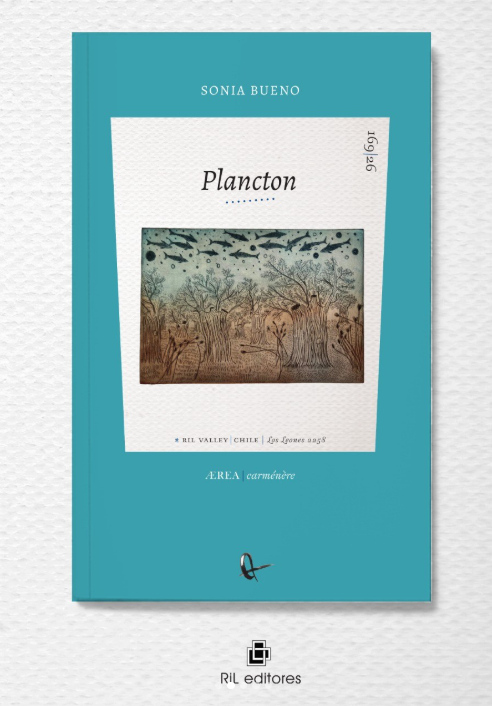
«Moras», the first part, opens by linking that initial “click” to a few lines that act similarly to a dramatic cue: «[the clasp of the coin purse clicks. a half-open sound sketches].» These «Moras» germinate in the bramble of childhood:
– but some summers only know
of oranges. they roll through the passageways
secrets
of memory
:the childhood dune hardens»
Childhood as the root of an adult life, whether as a narrow street or a cobblestone or a looking-glass or a fragment, which has braided the present, and therefore must endure in memory, because that childhood is the substrate of plankton: «weave the essence of the flight of plankton – the lap / emptiness nourishes»
Childhood must not falter, neither its own nor that of others, thus it weaves a lineage of childhood and female memory:
«I am all the mothers who go to pick blackberries. and all the daughters
who weave the juice of separation
I gather myself
:fruit»
The challenge to the reader of Plancton, with the aim of intensifying a certain rationalized irrationality, rests on an orthotypographic game where the constant use of lowercase predominates, the spatial expansion across the page, dots as silences, colons to join meanings, parentheses, italics, questions or exclamations only indicated by the final mark… which evoke Vigilia conjeturas sobre la ilusión by María Beleña (Olifante, 2025) and with which she explores the semantic and phonetic corners of language and grants the word an unusual versatility. The rhythmic and phonetic anatomy is also heightened with onomatopoeias and exclamations, ras!, clic, ¡hechos trazo estoy!, that intensify orality and bring us closer to the poem. On the other hand, the partial use of “footnotes” diverting or expanding the original senses, a resource explored by Chantal Maillard or Lola Andrés, places us in a double interpretive plane, in a speculative game. Sonia Bueno proposes that the expanding waves of the poems reverberate against one another; for this reason, they can be read as a long continuous sequence or as independent poems, though connected.
The central part of the book, Microscopio, is not only extremely brief but the poems or poem (however one chooses to read it) are written from dialogue with other poets: Antonio Machado, Emily Dickinson, Edith Södergran, Olvido García Valdés, Daniel Faria, Héctor Viel, Inger Christensen and Rainer Maria Rilke. The microscope enlarges what is seemingly invisible, making evident the substrate that any good poet must possess and nourish: reading. That poetic plankton in which the coin-poem is delivered in a clear evocation of payment to Caronte: «the place from which to flee and where to stay / the coin in the mouth, bank shore».
This is not the only reference to the classical world in the book and it is not casual, since it is dedicated to her Latin and Greek teacher; thus she refers to Plato as only a shadow in an allusion to the shadows of the cave or «eve that does not cease Parnassus mute, pure vision. without poets».
«Plancton» closes the book. If the orthotypographic play is lesser, though periods and commas disappear, the constant use of lowercase remains and the enjambments become more abrupt and steep. This part can be read again as a long poem or not, with very brief verses, sometimes of a single word or a letter, which give it a very dynamic rhythm. The first and last poem respond to one another in a circular structure through the image of a workshop: «to enter/ the workshop/ of winters/ I sometimes/ must/ bolt/ the bolt/ of my temple» and «a workshop/ that/ is/ a carving». That workshop is none other than life and writing, both united; however, there is a certain distancing from the irrational and thought emerges and poetic writing as labor, without causing the images to lose strength in their plasticity:
«Share
language and bread
kneaded
beneath the earth my teeth
I lend
to the dead
drift
the ears of
their shrouds
resound
I break
a plate
(they say
absence)»
Latent at the bottom of Plancton, as if at the bottom of a crystal-clear well, are coins and a key. The coins have symbolized chance in a relentless march as they pass from hand to hand: «in the coin that dances if the ground insists / coin without a calculation of memory», also coins-that-keys that make it possible to access a desire, even if this may be the last journey: «[in the darkness of the counter gleams like a tooth the / last coin]». Coins that sleep in that well, a poet’s nature, of desires: «there are coins that wound the / well of desires – so piercing sinkholes the car does not / dodge. perhaps a voice», like a key: «to the well / falls the key that / I frequent». Throughout the book the coins, the keys, and the well recur as an underground thread that fashions the symbolic framework and sustains a silent architecture of correspondences: they pass from one poem to another, transforming their meaning. In that persistence of the small and everyday lies one of its keys: in each object resonates beyond itself, as if each piece contained, in miniature, the secret pulse of the whole. The coin is chance and link, it is poetic word and key with which to open new meanings:
«Coin that is in the hand
perhaps should be kept;
the coin of the soul
is lost if it is not given.»
Sonia Bueno has not written an easy book. She dares with deftness in Plancton to propose a formal estrangement whose end is nothing other than to provoke us to weave irrational connections, where the importance lies in the image itself rather than in the way of expressing that image. Those coins are not only ritual objects for the passage to the beyond, they are also poetic word, plankton and substrate, capable of crossing the deep waters where language and life continue seeking each other.
———————
Author: Sonia Bueno. Title: Plancton. Publisher: RIL.