
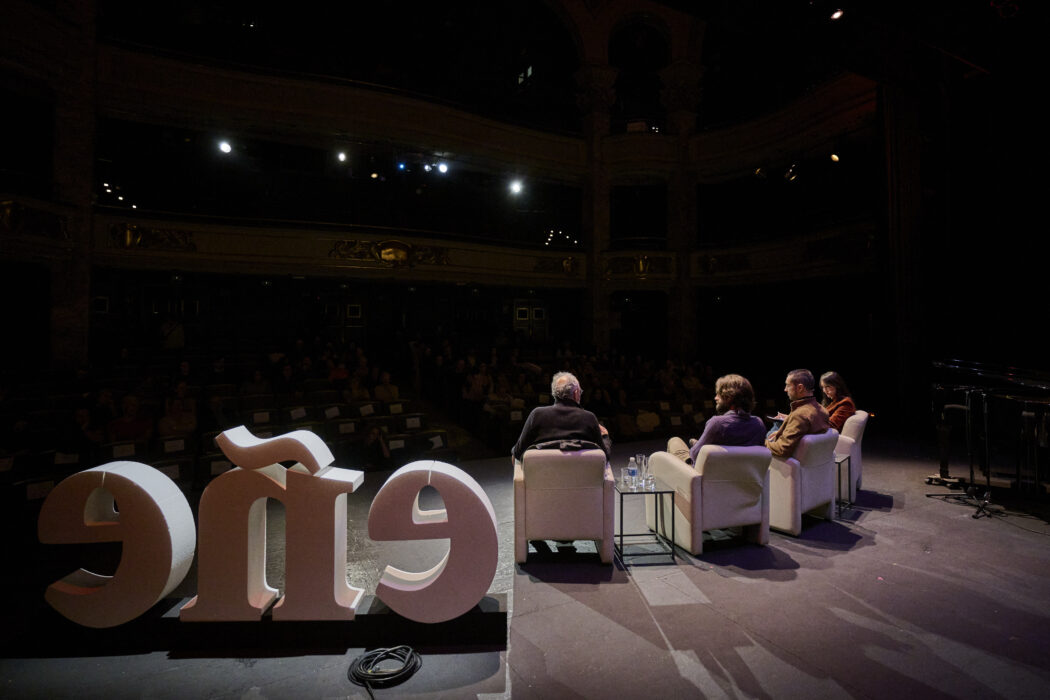
The eighteenth edition of Eñe, the festival of literature and creation in Spanish will begin in Madrid on November 4. For another autumn, its main venue will be the Círculo de Bellas Artes, and its various activities will extend until the 25th of the same month. As has become customary lately, on the 21st the Málaga edition will join the encounters, which in its Andalusian version will have one of its main venues at the Centro Cultural Generación del 27. And it will be precisely that poetic group, understood in its broadest sense, extending to encompass the entire generation of creators and intellectuals who were the origin of a true Silver Age of Spanish culture, one of the main axes of the new Eñe. Thus, alongside the great poets of the time — García Lorca, Cernuda, Guillén… — there will also be activities around Luis Buñuel, the journalist Manuel Chaves Nogales — one of the sharpest chroniclers of Spain in that era — and the Sin Sombrero, that group of women, artists and intellectuals, which, in addition to their creative activity, is almost forgotten as a whole — not so in individual cases: some like María Zambrano, Rosa Chacel or Elena Fortún have been celebrated from their time to the present day — and are one of the early references of feminist vindication in our country. In short, even the humorists of the 27 — Edgar Neville, Enrique Jardiel Poncela, Miguel Mihura… — will be the subject of talks at the Madrid gathering.
In this edition, the keyword for the event — as last autumn was Pleasure — will be Poetry, a word to be understood as the festival’s rallying cry: “Not only because all the commemorations of the 27 are bearing down on us, but also from a fairly engaged and vindicatory perspective — notes Jesús Ruiz Mantilla, artistic director of the gatherings. We do not believe poetry is only the patrimony of poets; it belongs to everyone, and the Festival wants to demonstrate this with its multidisciplinary backbone. And in this world of darkness, polarization, confrontation, violence, and trumpets of an apocalypse that will not come, each generation, out of egotism, thinks that the Apocalypse is coming. But it does not come. The world continues in spite of all of us.”
Another axis of the Festival is the guest country, which this autumn is Poland. “Poland has a very rich literary heritage, especially in poetry,” explained Maria Ślebioda, director of the Polish Institute of Culture, who joined Ruiz Mantilla at the presentation of the next Eñe. “Because of our history, those 123 years of partition during which Poland was erased from the map of Europe, and the fifty years of communism, poetry became the language of freedom, the expression of national identity. That is why poetry is so deeply rooted among us.”
And Poland will have such a presence at the Madrid gathering that this 18th edition will be inaugurated with a conversation with filmmaker Agnieszka Holland at the Prado Museum. The motto leaves no doubt: Poetics of Cinema and Painting. Martin Scorsese —in the presentation of a cycle of Polish cinema that a few years ago toured the world’s film archives— said that the grand screen of that country is “deeply humanist, visually innovative and with a surprising narrative force.” Any film aficionado worthy of the name considers Polish cinema to be one of the finest film traditions in the world. Therefore, pay close attention to the films from that country programmed at the Cine Estudio of the Circulo de Bellas Artes in collaboration with Eñe.
Among the Polish writers who will gather in Madrid to meet their readers, we should note Mariusz Szczygiet, Margo Rejmer and Katarzyna Kobylarczyk, the poet Tomasz Różycki, the playwright Weronika Murek, and the pianist Rafat Blechacz. Let us not forget that Chopin, the most classical of Polish pianists, elevated the polonaises — the old Polish dances — to the highest artistic level, while at the same time turning them into a symbol of Poland’s struggle against the Russian Empire.
But the grand moment of this year, already foreshadowing the various commemorations of the Generation of 1927, which we will attend in the coming months on the occasion of the centenary, will be the so-called 27 Hours with the 27. “I believe it is the festival’s main pole of attraction. It will take place over three days, the 13th, 14th and 15th of November at the Circulo de Bellas Artes. This program will be the prologue and the starting pistol for next year’s events. Alberto Conejero, the screenwriter of La bola negra, has put together a tremendous show. I can only name a few of the attendees: Carmen Linares, Pedro Casablanc or Irene Escolar. There will be dramatized readings of the latest interviews with Federico.”
Piedad Bonnett, Roberto Saviano, Jaime Siles or Juan Manuel de Prada are just a few of the many writers and creators who will also gather at the Circulo de Bellas Artes, as they have done since its early editions, the closest collaborator of Eñe.