
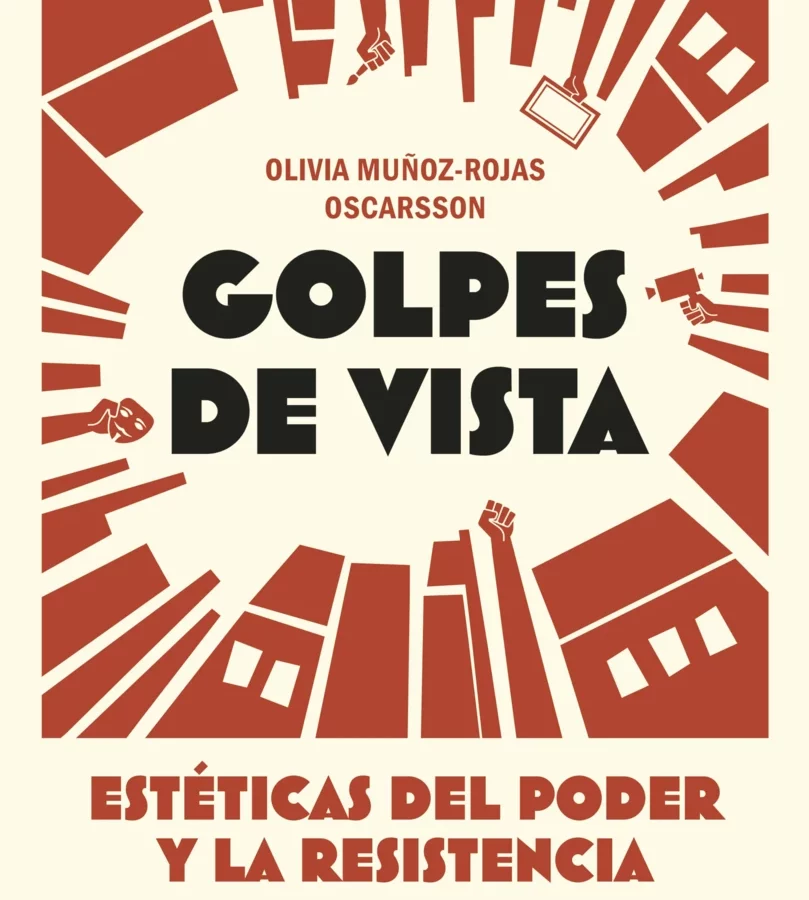
This book offers an original reading of the last 250 years to demonstrate that politics is not only decided in parliaments and battlefields, but also in images, monuments, clothing, films, and screens. Power is staged, legitimized and naturalized through visible forms; and in that same terrain, resistance learns to recognize itself, organize, and challenge the collective narrative.
In this making of Olivia Muñoz-Rojas Oscarsson explains how she wrote Golpes de vista (Paidós).
***
There they found a thread that interested them, although
they did not want to publish a collection of texts.
They proposed that I conceive a book with its own argument and structure, which could draw on my articles and previous research, but had to become something else.
That thread was a way of looking that I had been cultivating for some time. More than two decades ago, toward the end of my bachelor’s degree in Political Science, I had begun to become interested in how the visual arts not only reflect a political order, but also contribute to creating its imaginary, its values and meanings. Over the years I applied that gaze to different objects —cities, monuments, design, clothing— until I turned aesthetics into a form of inquiry into the political.
From the outset I was clear that I wanted to address different dimensions of the visual: painting, urban planning and architecture, design, fashion, cinema and digital culture. The book could not remain a mere sequence of independent essays, so I sought a chronology that would lead the reader from the revolutions at the end of the eighteenth century to our days. At the same time, I wanted to show the different political actions that can be carried out through aesthetics, and thus I arrived at the concepts that also structure the book: imagining, subverting, staging, prescribing, disseminating, hacking.
This chronological and thematic structure appeared in a more or less organic way: from painting it would move to clothing and, from there, to the urban space; from the city to home design as a political instrument. Then I would address cinema and its capacity to disseminate imaginaries on a large scale, and end with the internet, where images circulate and mutate at an unprecedented speed.
In some cases I started from materials I had already worked on: the relaxation of forms and the clothing associated with the angry left, or the social-democratic imaginary that can be read behind Ikea. Other parts required new research, such as French revolutionary painting or Mexican muralism. The chapter I found most challenging was the one devoted to cinema. I wanted to contrast Bollywood with Hollywood, drawing on the experience of having lived in India, but it is not easy to access Indian films from here, and they are not always subtitled. On the other hand, writing from Paris has the advantage of the extraordinary holdings of the Bibliothèque Nationale de France.
I have enjoyed the freedom that comes with writing an essay aimed at a broad audience and not strictly academic. Without renouncing rigor, I have been able to follow intuitions and establish connections between objects, eras and places a priori distant, and suggest associations that perhaps I would have approached differently in an academic essay.
The hardest part was reaching the end of that 250-year journey. Almost inevitably, writing about the present means doing so about a moving image. When I began the book, a little over two years ago, we were still largely under the woke cultural paradigm. A counter-movement was already foreshadowed, a reactionary subculture, but its political consolidation was not as evident as it is today. While I wrote, the aesthetic-political landscape was evolving.
Perhaps that movement confirms one of the ideas that runs through Golpes de vista: that aesthetic and political forms advance in a dialectical or pendular relationship. What emerges as transgression often ends up becoming the norm and, in turn, prompts new forms of resistance. It will always be easier to characterize an aesthetic regime once some time has passed, as is the case today with both the Franco dictatorship and the Spanish Transition, although the underlying thesis of the book is that if we learn to detect those initially subtle aesthetic changes, we can better anticipate social and political changes of greater impact.
—————————————
Author: Olivia Muñoz-Rojas Oscarsson. Title: Golpes de vista. Publisher: Paidós. Sales: Todos tus libros.