
Parallel lives I do not intend to prolong
merely so they may be cut
in their petty infinity
I take pleasure in recalling those lines
even when they were cut
by the moment of day when they first knew each other
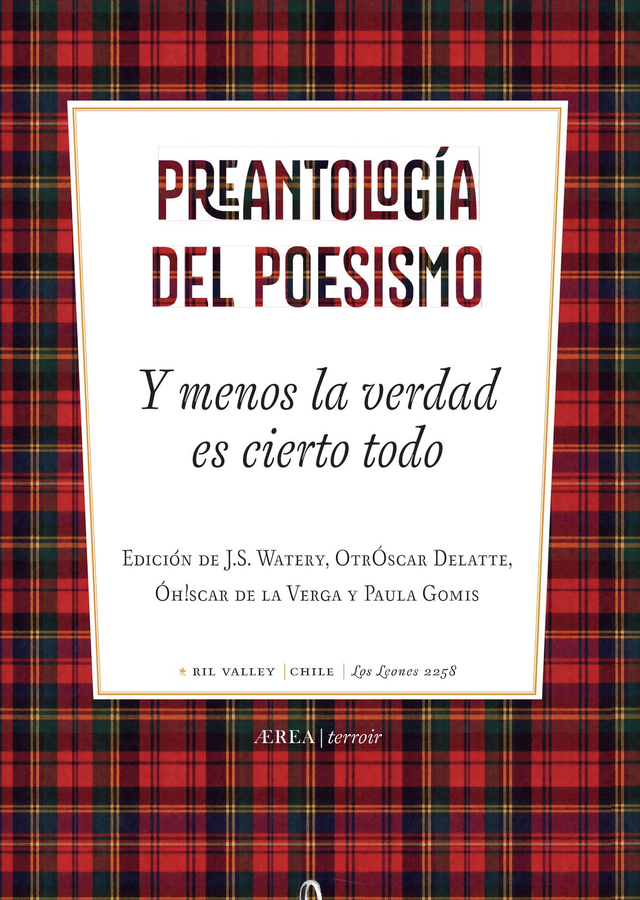
As with any anthology, the book opens with a critical study of the poesist movement written by Óscar de la Torre (an heteronym known to the Extremaduran writer Julio Cesar Galán), closes with an epilogue by Jesús Aguado, and includes notes by the editorpes (who are not editors), J. S. Watery, OtrÓscar Delatte, Oh!scar de la Verga and Paula Gomis. Afterward we encounter a collection of poems authored by Paulus Elmundo and fourteen other hetero-names.
Across more than three hundred pages, moving through different techniques, metrics, and poetic styles, a number of poems unfolds that cannot be fully encompassed by a single review. Not only due to quantity, but also due to the exuberant language, the wordplay, the jargon, the invented lexicon, the extreme polysemy and the anti-diction that the very manifesto of poesism declares as its principles (yes, it also includes a manifesto—or, to be precise, a manifesto). A glut of words that seeks to overwhelm the reader and demands more than one, delicious rereading. It is not hard to conclude that Preantología del poesismo is a book written with humor toward art. An anthology of invented poets that offers a slightly exaggerated view of the contemporary poetry scene, connecting it to the canon with the most raucous possible approach.
Affinities:
In my own fashion, everything remains as it was, and unchanged.
Snow in May is like thinking clearly: you need only change hemispheres.
I wonder how I can avoid falling into all the traps that such a book lays for a reviewer. How does one avoid catching the epidemic of words that the anthologized cast hurls at the reader like arrows, sharing a BlaBlaCarcaj? How difficult it is to value poetry above the satirical thrust of this carnivalish troupe that might be composed of Carlos Edmundo D’Ory, Quevedo, Gloria Fuertes, the protagonists of Larva by Julián Ríos, Valle-Inclán, Perec, Nicanor Parra, Darío Fo or the leader of the No Me Pises Que Llevo Chanclas. How to prevent the attempt to seize hyperbole and extravagance from burying the depth and mastery of many poems?
Forget the name by which you are called
Call it what no one will remember you as.
Do not abandon anything as mere accessory
and sow your skin with surfaces.
Embrace with your eyelids what no longer looks at you
for outwardly only the visible remains.
There are two ways to place a literary mirror before us (well, or perhaps more than two, but I find it convenient to settle on two for this review). One is science fiction. In a distant future, a parallel society to reflect. The second way is satire, the carnival, where—through humor and exaggeration—an unflinching reflection of reality is revealed.
The first path has already been trodden by books such as the anthology of future poetry Voz vertebra (Kriller, 2017) and the project by Juan Ángel Asensio, Anthology of Poetic Humanity (Eolas, 2026). In the latter, an extraterrestrial scholar compiles, translates, and interprets humanity’s latest poetic testimonies. On the other hand, a substantial number of authors signing under extraterrestrial heteronyms (perhaps more aptly called avatars) engage in Voz vertebra, experimenting with the mirror of placing humanity under the voices of poets from thousands of years in the future. Both books aspire to a certain totality and cosmogony.
The second form of mirroring our society is the path chosen by the editor of the poesism anthology: to imagine, satirically, a poetic movement. Thus, what is depicted is poetry itself, and since poetry seeks to project outward the inner workings of each poet, the result is not a simple mirror game but a labyrinth of mirrors. Valle‑Inclán’s Cat Alley transformed into an endless corridor through which a carnival procession marches. Distorted reflections are augmented by masks, music, clamor, laughter, and excess. Each hetero-name will contribute, with their disguise, a distinct style of poetry. Some write avant-garde verses, others epigonal poems, some write soleares, haikus, aphorisms, prose poems, dictionaries, and more. Every poem is a concave or convex mirror, or a blend of lenses and refractive elements.
Ukiah
Officiating mirages,
master of sand,
my errors know more.
“Everything a poem makes does is bend back toward language itself,” wrote Mario Montalbetti. It is hard to make a tiger appear dangerous within a poem about the jungle. That danger only arises when the language is forced. This is a book about poetry, so let us beware: what becomes dangerous is the poet, the poetry itself, the reader of poetry, and the reviewer.
In the cases of other invented anthologies, the authors are somehow known. In Voz vertebra, although it does not indicate which pseudonym belongs to which author, the rights reveal their real names: Raúl Quinto, Berta García Faet, Lola Nieto, Aurora Luque, etc. In other books, the author appears as editor and anthologist; this is the case of Anthology of the Human Species or the magnificent 50 States: 13 Contemporary Poets of the United States (Kriller / Fulgencio Pimentel, 2022), in which Ezequiel Zaidenwerg translates and interviews fifteen American poets whom he himself has invented.
In this case, the author is entirely unknown. I wonder whether an anonymous book could win the National Poetry Prize. Beyond this book, the Barrett publishing house has decided to publish eight entirely anonymous books this year, 2026, a “blind catalog” that includes the poetry collection Idealista. Would the jury of the National Prize be capable of resisting the author’s biography? Would they accept, as Roland Barthes proposed, the author’s death? Would they be willing to renounce fame, prestige, the public presence of readings, lectures, panel discussions, interviews in the media, the market, and the creation of content? The British artist Brion Gysin once told William Burroughs that literature lagged behind painting by fifty years. Perhaps this is because the entities with which the writer works are less “manipulable” than the materials of painters. Perhaps poetry needs a Banksy, a Paulus Elmundo of Broncy. The titanic work of Preantología del poesismo deserves to be heeded.
whatever it was
the sieve is what it is
I am not referring to me
for one by one we go
and we become so many that with each occasion
we move farther from the zero
or the absolute me
One thing is clear to me after finishing this reading: it would be harder to uncover the identity of the author of this book than to uncover Banksy, just as I feel uncertain when I think it easier to spot a Banksy on a wall than a witty poem painted on it.
——————
Author: VVAA. Title: Preanthology of Poesism: And Less the Truth Is True of Everything. Publisher: RIL.