
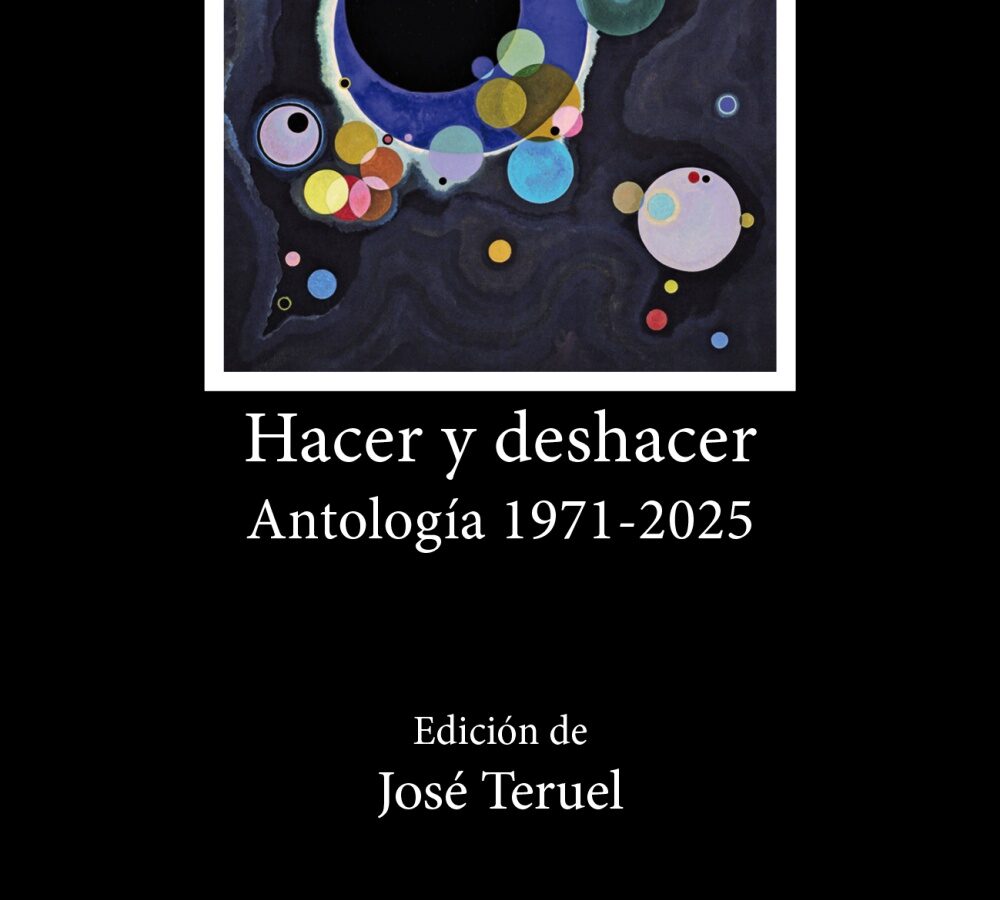
The opinion of Gerardo Diego can be confirmed by anyone who reads slowly and with due attention the poetic texts gathered in that book, which chronologically span from the early 1970s to just a few months before 2025, when Pureza Canelo, in collaboration with her anthologist and scholar, completed such a rich corpus for the Letras Hispánicas collection. In addition to this peculiarity, the anthology also has, among other features, that after including various creations from the author up to her most recent book published to date, the 2022 De Traslación, it culminates, as a premiere, with several works belonging to two sets opened to new textual incorporations. We refer to Volver and to Olvido, works begun, respectively, in 2023 and 2024. The title Hacer y deshacer was chosen by the author herself, and her anthologist interprets it, noting that “poetic creation for Pureza Canelo is an operation of hacer y deshacer, and even more so the second than the first” (79).
That reading is supported by a quotation from the writer referring to the notion that the already-made poetic creation dissolves when it is revised, and moreover that revision is continuous. In that approach is evident the trace of the model proposed by one of her indispensable poets, Juan Ramón Jiménez, who also left a mark on some of Pureza Canelo’s lyrical renderings that we read in the anthology. For example, in this very evident passage from his ongoing book Volver, where a celebrated topos of the Moguer poet is reworked and made more complex by saying “I call blue hour to that time of sky that slowly stains before night. And it will continue when you are not in the place of the Universe from which you had the transparency of the mortal instant” (524).
Being pertinent the interpretation that José Teruel makes of the tandem hacer y deshacer, because it adheres to the same as linked by Pureza Canelo, it happens that sometimes the two words appear detached in her poetry, as I have noted, and then each one can bear other meanings. In the 2008 collection Dulce nadie the poem “Deshacer” acquires a sense that brushes against a personal ontology in lines such as “This new body / of the undoing that I am / corresponds to a strange return” (308). And in the 2018 collection Retirada, written in “poured” poetry, by accepting the term given by the Cáceres-born poet to the prose poem, as well as to other modalities more or less adjacent, we find that the doing would point to the thesis embedded in the book’s title. It would be a withdrawal that is resolved within the mind itself, and it alludes to a different way of being in the world and of continuing to deepen in a writing as personal as possible. Such a withdrawal occurs without heaviness or solemnity, but rather, on the contrary, because “withdrawal is the great doing; it is the conquest” (423).
In the anthology’s preface, certain fundamental components of Pureza Canelo’s poetry are highlighted. I will try to synthesize them in my own way by saying that her lyric responds to an indissolubly metapoetic inquiry rooted in her biography, through which a critique of poetry itself is explored. The speaking subject does not transmit confessionalism, but does project a view of living and of expressing that responds to an inherent moral issue. It does so through a writing in which it would be a sine qua non to create poems from a type of syntax that Pureza Canelo defined as “crazy” in her 2008 theoretical text Fiel a una poética, and that in Volver she will confirm as essential to her “wild” poetics. It consists in saying: No respetar sintaxis, desafinar en el alero de la expresión, abrasarme en un estilo indómito de oca en oca y tiro de mi lengua (517).
In Pureza Canelo’s literary trajectory, four central poetics can be distinguished that intertwine and contribute distinct elements to her experience as a writer. The first spans from her beginnings to the late seventies, and as José Teruel notes, the essential impulse was “the creative illusion of an alternate nature” that arose “in a space of crisis and critique in which the struggle with language also involves a contest with solitude, but not against solitude” (40). In the 1979 book Habitable, the second poetics is already openly evident, and it will cover the eighties’ creations, in which the Extremaduran author has shed the anecdotal material from her original landscapes to insert herself into and above all into language, and into the self-critique of her poetry. It appears in the poems gathered in Tendido verso, a book published in 1986, in which the so-called, though she does not call it so, amorous impulse peeks out. The third poetics will be evident in Pasión inédita, a collection in which amorous feelings also appear, as in Tiempo y espacio de emoción. In the fourth poetics, the 1999 book No escribir will be distinguished by an even more in-depth expression than before, manifesting metapoetic reflections in which life and poetry are woven into an inexorable osmosis. Since then the lyrical voice has fully assumed and inscribed in its language the corporeal, the existential, the reflective, and the self-critical.
A new turn in Pureza Canelo’s poetry will manifest in her 2008 book Dulce nadie, because it, in José Teruel’s view, represented a revision of the writing materialized over the four decades that elapsed between Habitable and No escribir. In Dulce nadie the writer returns to the genetic wellspring of her poetry, and ten years later she will make known another crucial work, Retirada. There, her entire poetic experience is recapped while the speaking subject gradually concludes that the expectation of forgetting can ironically be its own “salvation” through poetry.
In Volver Pureza Canelo will end up auditing her work through a writing she describes as a “diary of confession” (513). From it she had already left behind along her poetic path various scraps as testimony and a vademécum for readers in general and analysts in particular. This is how I understand it when reading one of the poems titled “Pizarra,” which alternate in the 2022 book De Traslación with those titled “Celeste.” In both cases we are facing compositions of great lyrical essentiality, accompanied by an extreme ascetic slenderness of form, since most lines are reduced to a single, simple word, though full of meaning, where “La sintaxis / se ofrece / anhelante. // Pierde / hasta los huesos. // En eso / estamos / ella y yo. // En la bárbara / conjugación / existo” (484).
—————————————
Author: Pureza Canelo. Title: Doing and Undoing: Anthology 1971-2025. Publisher: Cátedra. Available at: Todos tus libros.