
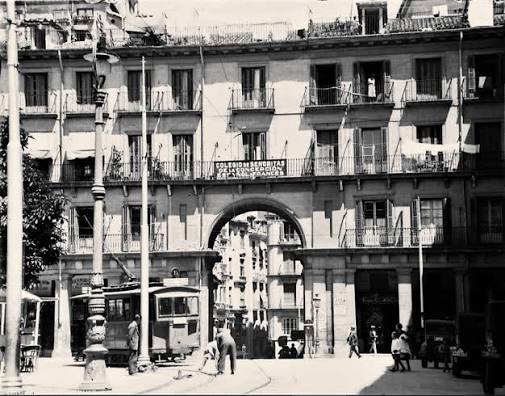
To commemorate the 90th anniversary of the Civil War, José Ángel Mañas recreates on Zenda, day by day in this section, what happened in 1936, perhaps the most pivotal year in all of modern Spanish history.
Tuesday, September 1, 1936: In the Grocery Store
Woman, the lentils are the best we’ve received. They come from Motilla del Palancar.
—May I pay you with the vouchers, Mariana?
—What choice. The City Council requires it.
—But later, for you they’re exchanged for money, aren’t they?
—We come every Saturday. Sometimes they cash them in and sometimes they don’t. Maybe no one pays the electricity bill or the rent anymore, but food still seems to have some value.
Mariana, at the counter, attended the neighbor who entered the shop and took as many legumes as she could: the quantity per person was limited. At the doorway, a militiaman from the CNT stood watch to ensure that the women waiting in line followed the rules without quarrelling. Next to Mariana was Pepe Mañas, who helped by taking the amounts from the sacks as he was instructed.
Mother and son wore pale faces and showed signs of sleep deprivation. It had already become a ritual that at midnight a truck or car would awaken them, heading toward the cemetery, where soon after gunfire could be heard. Those noises repeated so often that Pepe felt real terror when the first hour of the early morning arrived. Not only because it was the moment of fascist bombardments, but because the executions, which did not cease. As the neighbor explained, the guardian of the San Isidro Cemetery, who was her brother‑in‑law, had begged her to look after his children.
—He says that living beside the cemetery is terrible, with gunfire, shouts and crying. That frightens the children. But the worst part is tending to the families who come every morning looking for their dead. With the shortage of coffins, he has to place the unclaimed bodies in the common grave.
—Aren’t they buried by the militiamen?
—Sometimes. But when they are, the grave is shallow. There’s always a hand or a leg left exposed, and my brother‑in‑law has to finish the job.
Pepe Mañas listened. Everyone tried, amid the horror, to preserve some sense of normalcy. After two months of war there were still enough provisions for the shops to operate. Restaurants, bars, taverns remained open. After the general shutdown at the end of July, the Government had ordered reopenings and aimed for commerce to function in a situation where legal money coexisted with a widely used system of vouchers, especially among the militiamen. It was inevitable that counterfeits would appear. And of course the militiamen tended to enter stores with rifles and pistols. It was difficult to charge them without being accused of counterrevolution. The protection, out of friendship, of Ángel Navarrete was the only thing that gave the Mañas some reassurance.
—Thank you very much. Salud.
—Likewise. Who goes next? —said Mariana.
All the entries of 1936 Day by Day
Interview with José Ángel Mañas about 1936 Day by Day