
To commemorate the 90th anniversary of the Civil War, José Ángel Mañas recreates in Zenda, day by day in this section, what happened in 1936, perhaps the most pivotal year in all of modern Spanish history.
Sunday, September 6, 1936: Interview with Pío Baroja
Transcript of an interview with Pío Baroja conducted in San Juan de Luz by the Uruguayan Pablo Minelli. The text is in his own handwriting and kept in a private Madrid archive. Despite its length, I reproduce it in full.
The Spanish politicians who have taken refuge at the border currently dare not make compromising statements. The diplomats are silent. Nobody wants to say anything. The other Spaniards speak within their groups with conspiratorial air and great restraint. They wait for the scales of the balance to tip to one side or the other to be more explicit. Here, in San Juan de Luz, there is a non-political Spanish refugee, a novelist, and we are going to see him.
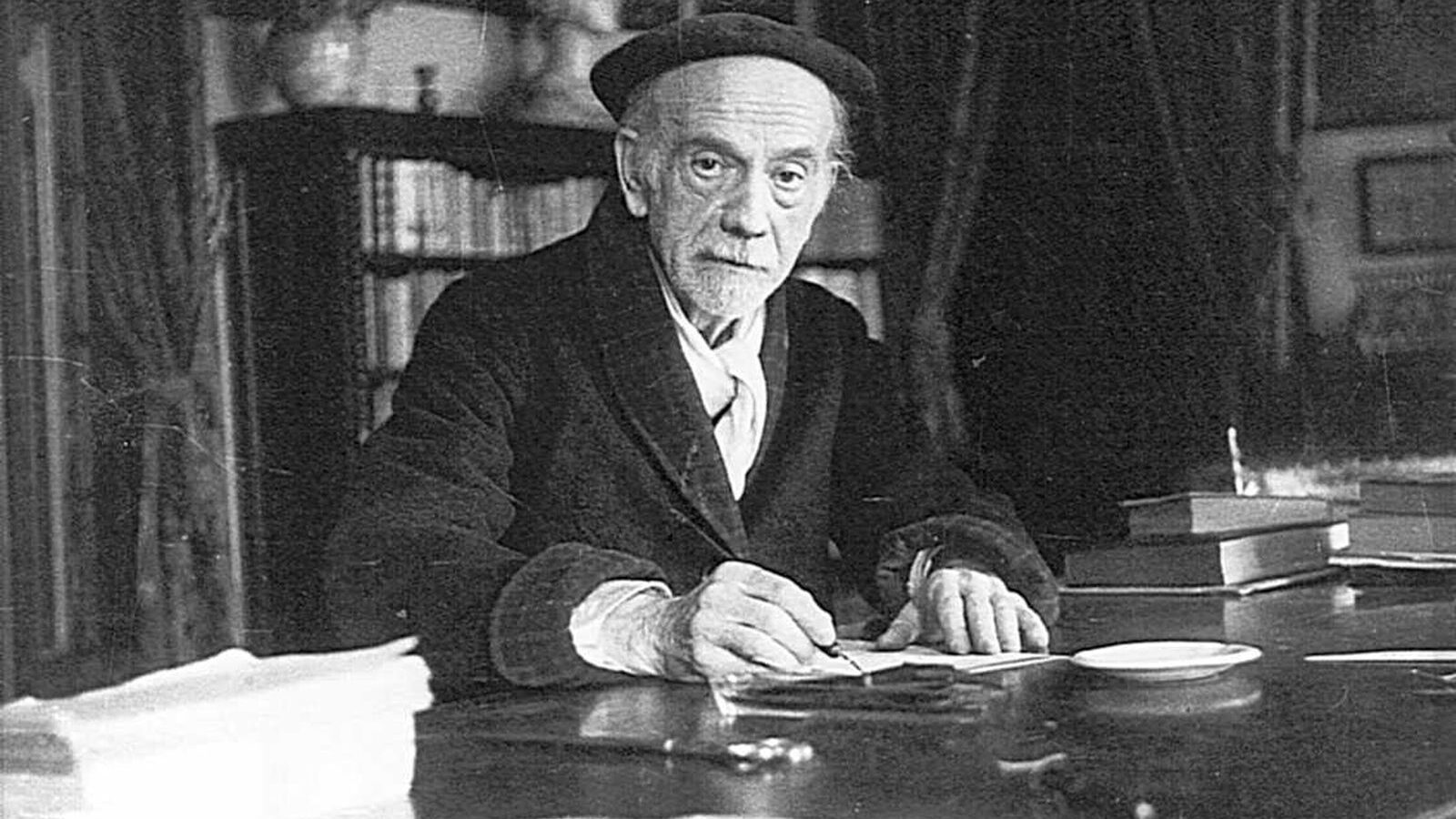
Don Pío Baroja is a Basque writer who spends the summer in Vera de Bidasoa, a border village of Navarre. He has written novels and essays. He was chosen a member of the Spanish Academy a year ago without seeking it and wrote a welcome address that caused a certain emotion and some scandal. Don Pío Baroja has found himself imprisoned one day in July in his homeland by the Carlist requetés and had to escape to France.
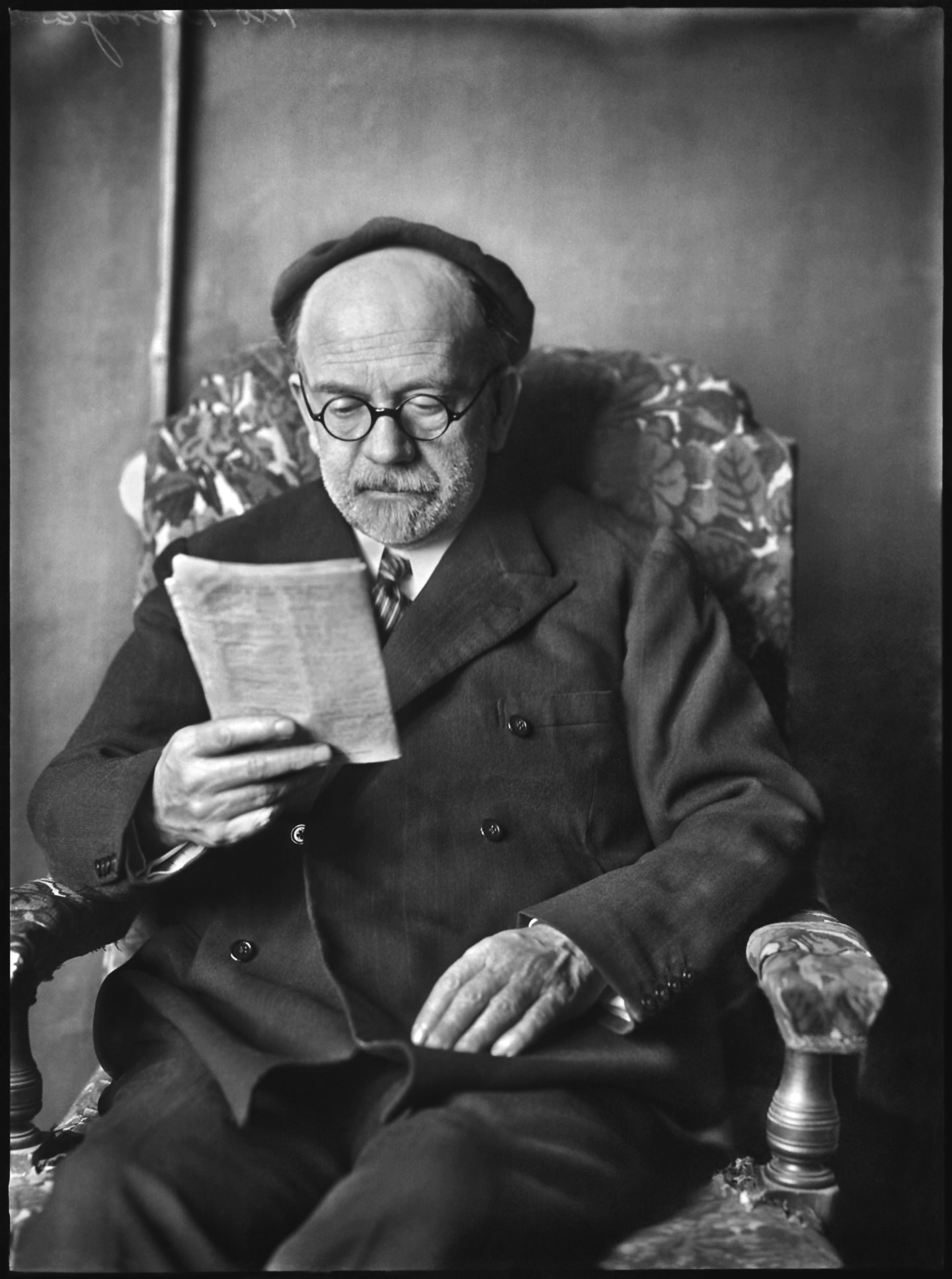
Now he lives in San Juan de Luz, in a small restaurant for workers and peasants on the road to Ascain called Restaurant du Petit-Pont. Mr. Baroja has a certain reputation for being reserved and gruff. I find him sitting at the table, eating alone, with a melancholic air in front of a small table. The Mr. Baroja is a man of more than sixty, with a white beard pointed at the end, with a resigned expression. He wears black and constantly sports the Basque beret. He had been a village doctor many years ago. He has no qualms about speaking. On the contrary, one can see that he speaks with delight. We approach him and ask him about the current events in Spain.
—I am a better or worse observer of Spanish life —he tells us—. My political opinions do not amount to much.
—No, that’s not true. You’re an independent man, and your judgments about the events of the moment could be of interest.
—I don’t know. There was a time when we all believed that Spain was settling down completely, almost too much so. Politics did not move us, there were few crimes and some prisons began to empty. It seemed that the small bourgeois described by certain writers such as Pérez Galdós, la Pardo Bazán, Palacio Valdés and others was triumphing and setting the tone of the era. With the Republic, all this changed; the country began to bristle and the fierce Spaniard of former times appeared on stage. Now the mood has arrived (sic). The bull that seemed to become a calm beast of labor returns to being a ferocious bull.
—And how do you explain that change? Where does that violence come from? What is its root?
—Ah. That is a problem we Spaniards have not solved, and naturally it will be solved even less by foreigners. Is it race? Is it climate? Is it soil? Is it a question of culture? We do not know.
—What do you think?
—There must be something predominant in the race, but we do not know what. For now, anthropologists and ethnographers have not reached any conclusion. The same happens with prehistorians. People speak of periods already historical of Ligurians, Iberians, Celts, Basques, as primitive inhabitants of Spain, but it is not known whether these names are ethnic, linguistic, or geographic. Nor can we discriminate within history the influence of Greeks, Romans, Goths and Arabs. Although our origins appear varied, there is a large unit of type within the Spanish. Thus anthropologists are somewhat perplexed when they see that in Spain there are hardly any nuclei of Gothic or Arab type, whether because foreign blood contributions have been weak or because the environment has dominated and eliminated them. I believe that contemporary Spain is ethnically the same as it was in the time of Numantia or in the time of Séneca.
—So this violence now is, in your view, ancestral violence.
—That’s right. At the siege of Calahorra the besieged eat the dead; the sieges of Numantia and of Sagunto later correspond, after centuries, to the one at Zaragoza in Napoleonic times; the war against the Roman Empire in Spain lasts longer than anywhere else.
—And there isn’t something African in this?
—I don’t think so. Some say that Spain is an African people with Muslim influence and with a predominance of Arab race. The claim seems false and superficial to me. That Arab/Muslim influence is not visible in Spain. The Arab resembles the Spanish physically and psychologically very little. The Muslim has been very tolerant in religion; the Spanish has not. The Arab and Moor are monotheists at heart. The Spanish is instinctively polytheistic. The Arab likes to wear light colors; the Spanish prefers black. The Spanish looks at the Alhambra with astonishment and with disdain. He does not like it. The same happens to me. The most classical Spanish festival, the bullfights, displeases Arabs and Moors.
—You think Spain isn’t well understood either abroad or at home.
—That seems to me. Spain is a small world apart. To know our country, beyond its ethnicity and geography, it would be essential to study its ancient history and then the nineteenth century.
—And why the nineteenth century?
—Because in many centuries prior to this, in the high Middle Ages and in the later periods of the Austrias and Bourbons, Spain lived outward. In ancient times and in the nineteenth century, Spain lived inward. Now we do not have a good history of either the ancient or the modern period.
—And what characterizes these inward-looking eras, in your view?
—I believe it is violence, and with violence dualism, what one might call extremism. Good and evil separated by a gulf. This resembles a Manichaean scheme: Ormuz and Ahriman. Spaniards dislike compromise. Either this or that, as Kierkegaard put it. You can see it in literature; everything tends toward extremes: Don Quixote and Sancho. The Cid and Don Juan. In art, the sternness of the Escorial on one side, and the baroque flair of some façades and chapels with decorations bordering on madness on the other. In religion, the same: for Saint Dominic and for Saint Ignatius of Loyola, sainthood equals action and action almost martial; for Saint John of the Cross, Fray Luis de León, or Molinos, sainthood is merely stillness and contemplation. Spain, both physically and spiritually, is a land of violent contrasts. The stock of wit is rich but cannot be utilized because it is not known. All of Spain’s contributions to culture and history are frenetic. Hernán Cortés and Pizarro, Calderón and Tirso, Quevedo and Góngora, Zurbarán and Goya come across as somewhat wild; as do many others, including the casuistic Jesuits whom Pascale, the Father Mariana who defends regicide, Miguel Servet who dies for a minor theological quibble, the Abate Marchena who explains atheism by principles… All that frenzy of the race returns today in that eternal cycle envisioned by Greek philosophers like Heraclitus and that so worried Nietzsche in his final years, but it does not return to the mind of a single individual or a group; it returns to the collective. The collective is brutal; in Spain it must be worse.
—But do ideas return, or are instincts returning?
—Ideas may be of little consequence. What endures are the instincts. You know that policy of the Popular Front. I think it is of little significance. For France it represents one of many periods in its history that allows it to continue with life. In Spain it provokes a civil war, a mystic convulsion with executions and horrors. Now the Spanish also say “either this or that,” like Kierkegaard, but civilization is not either this or that; it is the middle ground.
—And the question of law does not interest you?
—Not at all.
—Do you not believe in political rights?
—No. I think that the notion of Law is a enduring religious myth.
—And which parties are currently in struggle?
—I suppose you know as well as I do.
—Not in all the details.
—And who will win?
—Who knows? No one has clear data to foresee the final outcome. There are no opinions of value. Many, most, want to treat their wishes as judgments of some worth.
—What do you think would be best?
—I believe that if the military prevail, the majority of Spaniards will be able to live reasonably. There may be severe shocks, but life will go on. Now, if the Reds win, it will take many years before one can live with a bit of calm.
—And do you not believe that a prominent politician, a great man, could propose a solution?
—And where are those great men?
—Don’t you think there are great men?
—The truth is that it is not known whether there are no great men, or whether the world has lost its capacity to admire them. Be it one or the other, for life’s purposes it makes no difference.
Don Pio Baroja begins to speak about prehistory, which is, it seems, what now interests him the most, and we bid him farewell as we leave him drinking coffee at the small roadside restaurant on the Ascain road among a few workers and peasants.
Todas las entradas de 1936 día a día
Entrevista con José Ángel Mañas sobre 1936 día a día