
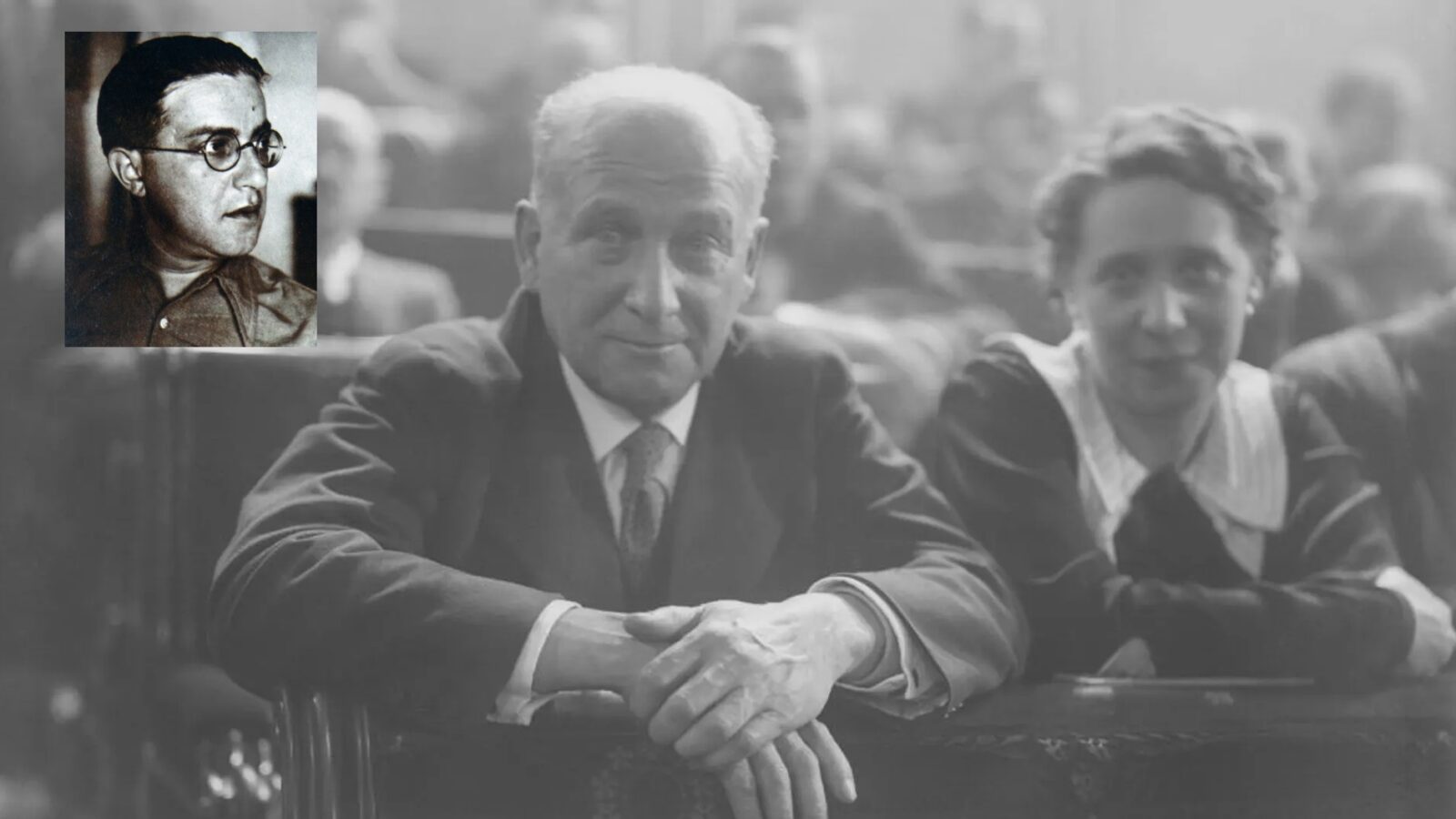
To commemorate the 90th anniversary of the Civil War, José Ángel Mañas recreates in Zenda, day by day in this section, what happened in 1936, perhaps the most pivotal year in the entire recent history of Spain.
Tuesday, September 8, 1936: Intercepted Report of Koltsov
Dear Comrade Iosif:
As you will know, during these days the Government of Spain changed. At first it was about incorporating two or three socialists into the cabinet of the republican José Giral, but without breaking with the republicans. The problem has been that suddenly Largo Caballero has demanded the Ministry of War and the presidency of the Government, provoking unanimous opposition from the other parties. Everyone considers that the aggression of the Old Man, as they call him in the Communist Party, makes collaboration with anyone impossible. Even Álvarez del Vayo, a man of his own, tried to convince him to take only the War Ministry and leave the presidency to Giral.
In the Politburo they are against Largo Caballero becoming head of the Government. But the Old Man, playing his cards, said that it was all or nothing.
Prieto, for his part, despite his poor relationship with Caballero, had already said he would accept any position in a Government presided by his rival, and he fulfilled it. That said, he protested at not being granted overall leadership of the Ministry but only that of the navy and the air force.
I insist that everyone has been annoyed that Largo Caballero is president. It is accepted, however, that at this moment he is the most prestigious figure in the labor movement and the only one capable of directing the militiamen who, for two months, have overwhelmed the Government.
Knowing himself to be strong, Largo Caballero has presented as a sine qua non condition that the Communists enter the cabinet. The Party preferred to support the Popular Front from outside, as until now. José Díaz and his collaborators consider that his presence in the Government will generate repulsion abroad. But Largo Caballero believes that those are “foolish things,” that foreign opinion matters little to him, and that if the Communists refuse, he will do the same. Consequently, the Party has resigned itself to taking on the Ministry of Public Instruction and the Ministry of Agriculture, two minor portfolios.
Under these conditions, this morning at eleven-thirty I was received at the Buenavista Palace by comrade Largo Caballero. There I was surprised by the absence of Republican politicians. The person who ushered me into the room was the same old official who days earlier had welcomed me at the House of the People.
Since he took the helm of the Government, Largo Caballero has swapped his cotton jacket and peasant’s hat for a dark suit. Today he greeted me with cold silence. His hostility toward the Communists is more than evident. After all, he apologized for not being able to devote much time to me. He says that now he does not converse with anyone about political topics, that for that there exists a Council of Ministers, but that he makes a single exception with Pravda.
In response to my questions he said that, as president of the Government of the Popular Front, he represents all the workers from the unions in a common body with a single objective: to crush fascism. His first task, he claims, is to ensure the unity of command of the Republican Army in the War Ministry, under a new General Staff formed by professional officers. The new Chief of the General Staff will be José Asensio Torrado, an officer of his trust, directly subordinate to him, and who will develop a complete plan to organize a regular Army that integrates the current militias.
As for the role of political delegates, he did not want to provide a clear answer: “That will be resolved by the War Ministry.”
He understands my interest in the matter perfectly, and he is evasive. As is natural, all of this I have discussed in person with comrade Rosenberg, who also does not view the course of the new Government favorably.
(Letter addressed to the Kremlin)
All the day-by-day entries of 1936
Interview with José Ángel Mañas about 1936 Day by Day