
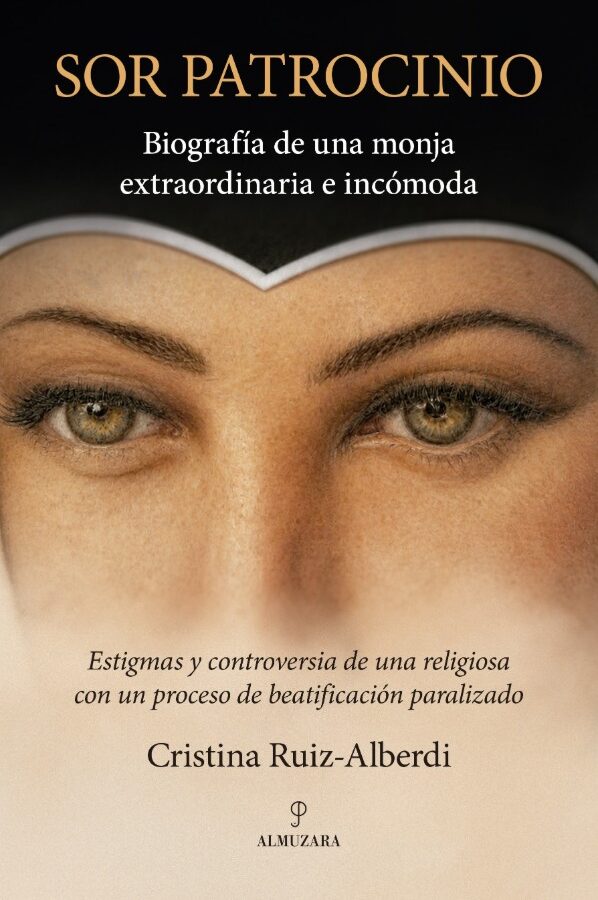
For years I had been researching the life of a woman as controversial as she was persecuted. A figure who, in my view, has been unjustly treated by history: Sor Patrocinio, Dolores Quiroga (1811-1891), better known as “the nun of the sores.”
While studying nineteenth-century Spain, I understood that her life unfolded in a period of great upheaval, marked by hunger, misery, wars, corruption, and political intrigue. For years I read dozens of documents and testimonies that allowed me to know her better, until I decided that the moment had come to write her biography. It wasn’t the first biography to be published, but I felt that there was still something left to tell: what she was really like in her daily life. I was interested in uncovering the woman who hid behind the historical figure, approaching her everyday reality, even though this reality was constantly interrupted by the convent relocations imposed by different governments.
As the investigation progressed, one question grew ever more insistent: why was she so persecuted? Perhaps her sweetness, her beauty, and her determination to follow the path she had chosen aroused passions and enmities that are hard to grasp from our viewpoint.
No eran tiempos fáciles para una mujer que pretendía decidir sobre su propio destino. Dolores Quiroga dreamed of the tranquility of the convent, the silence of the cloister, and a contemplative life. Yet she ended up becoming an involuntary protagonist of some of the most turbulent episodes of her century. It was precisely this contradiction, the distance between the life she longed for and the one she had to live, that convinced me that her story deserved to be told anew.
Sor Patrocinio had a difficult childhood, but that was only the beginning of a life marked by adversity. The appearance of the sores, the persecutions, the exclaustrations and the exiles followed one another over the years, without managing to break her will or divert her from her religious vocation.
The first time she was forced to leave Spain and seek refuge in France, she experienced the anxiety and loneliness of being in a country whose language and customs she did not know. In prayer she found the necessary consolation to endure that experience, offering to God even the most difficult moments.
When she returned to France for a second time, she did so in obedience to the Church, which feared for her life. But the circumstances were different from those of her first stay. Now she felt more self-assured, she counted on good friends in that country, and she undertook new foundations. The arrival of these women in the towns where they founded cloistered convents represented a beacon of peace and companionship for their inhabitants. Meanwhile, sor Patrocinio knew that in Spain the calumnies against her continued and that, as a consequence of the desamortizations, many of her nuns were being expelled from their convents, most of them founded by her.
Far from letting herself be crushed by circumstances, she encouraged her nuns to gather with her in France. She advised them to bring only the essentials: a change of clothes and some blankets. She also warned them of the hardships they would have to endure, including food shortages. She did not promise comforts or an easy life, but she did offer something far more important in those moments: to be safe.
Among all the documents I consulted, her letters drew my particular attention. They revealed a woman who knew human weaknesses well and could speak of them with a clarity rarely seen. Her reflections on discouragement, sadness, or the feeling of guilt retain, despite the passing years, a striking relevance. Sor Patrocinio understood how easy it is to be swept away by these feelings, and she warned against surrendering to them, allowing the enemy, ever lying in wait, to find a chance to bring us down.
That capacity to understand others’ weaknesses also manifested itself in her relationship with Queen Isabel II, who would come to the convent to confide her troubles. For the religious woman, behind the queen’s figure lay a woman of great heart, yet also profoundly alone. That friendship cost her dearly. The governments trying to influence Isabel II distrusted Sor Patrocinio and attributed to the monarch any decision she made. Before dying, the queen herself left a sworn statement stating that Sor Patrocinio had never uttered political judgments.
As I delved deeper into her life, I was struck by her relationship with the Virgin, whom Sor Patrocinio regarded as a confidante, just as the children of Fatima or Bernadette did in Lourdes. She was barely twenty when she asked to be venerated under the title of Our Lady of Forgetting, Triumph, and Mercies. The meaning of that first name, Forgetting, which alludes to how easily we forget Her, moved me, and I am struck by the image of that young nun maintaining a constant dialogue with the Mother of God.
That apparition took place in August 1831. During my research, I discovered that just a year earlier something very similar had happened in France. There, Catherine Labouré, a novice of the Sisters of Charity, had received the Virgin’s apparition, who showed her the Miraculous Medal. Two cities, Paris and Madrid, and two young religious who lived extraordinarily similar experiences, yet whose histories have followed very different courses. Today, the former is a saint and devotion to the Miraculous Medal is worldwide. Meanwhile, in Spain, the cause for Sor Patrocinio’s beatification remains stalled. It is indeed paradoxical that, almost two centuries after the Virgin asked her to be venerated under the title of Our Lady of Forgetting, her figure continues to await the recognition she deserves. This contrast between the two stories reinforced my belief that hers deserved to be rescued.
My intention, however, is not to seek out culprits; I trust that history itself will eventually reveal the truth. The tenderness and kindness of Sor Patrocinio must have left a deep imprint such that even many of those who persecuted her ended up asking for her forgiveness before dying. For my part, I have indeed sought to examine the abuses and crimes committed against her and her nuns in light of current legal standards, so that readers can better understand the gravity of the facts.
One of the most revealing examples is Salustiano de Olózaga, the former governor of Madrid, who had caused her much suffering and who, years later, could lend her assistance at the Spanish Embassy in Paris when the Paris Commune uprising caught Sor Patrocinio and several of her nuns in the French capital. They met again in old age, after many years without seeing one another. Sor Patrocinio, true to her discreet nature, never revealed the contents of that conversation, just as she rarely spoke of anything that could be used to defend herself against the accusations she faced.
A reader who went through the book offered an astute observation: he was struck by the contrast between the intrigues, conflicts, and power struggles that marked nineteenth-century Spain, and the lives of these women who, amid such chaos, remained faithful to their vocation, devoted to prayer and to caring for others.
That, precisely, is where much of the value of this story lies. Although almost two centuries have passed, Sor Patrocinio’s life still has a great deal to say to us. In a world as turbulent as ours, her example of strength, kindness, and forgiveness remains fully relevant. And that is, ultimately, why I wrote this book: so that her story is known and every reader can discover for themselves all that this woman still has to teach us.
—————————————
Author: Cristina Ruiz-Alberdi. Title: Sor Patrocinio. Publisher: Almuzara. Available from: Todostuslibros.