
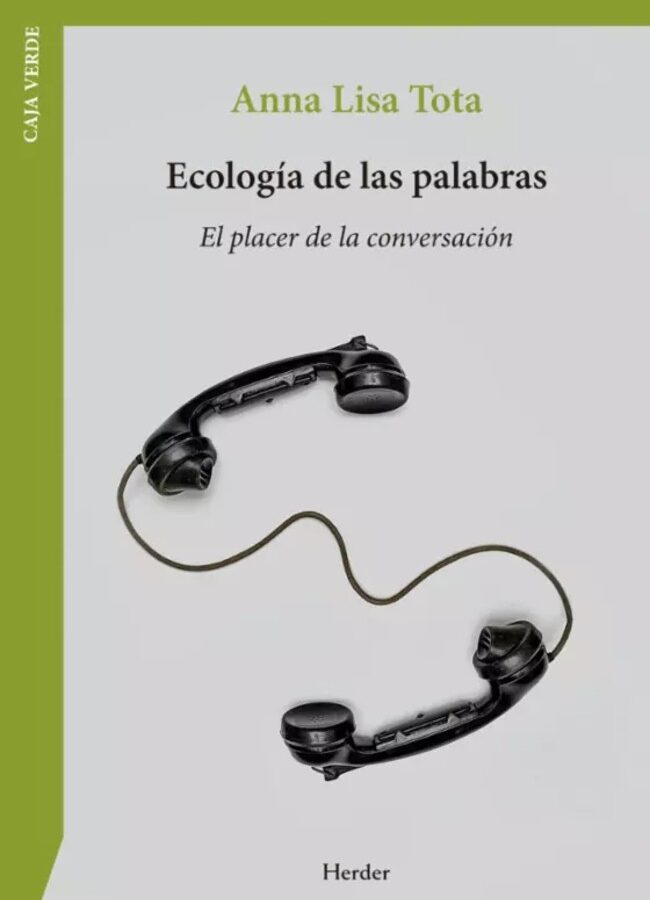
Anna Lisa Tota, a sociologist, essayist, and professor of Sociology of Cultural and Communicative Processes at Roma Tre University, is a pioneer in studies of cultural memory, the body, and public communication. Her work investigates how languages, images, and silence shape the human experience.
In an era ruled by the incessant noise of screens, the rush of communication, and the loudness of public debate,
the word suffers a quiet erosion.
We breathe words as often as we inhale air, yet rarely notice the quality of the verbal nourishment feeding our minds. Just as atmospheric pollution poisons the lungs and degrades natural ecosystems, the toxicity of discourse contaminates affective bonds, alters emotional health, and fractures everyday coexistence. Against this saturated backdrop, the essay
Ecology of Words: The Pleasure of Conversation
offers a piercing diagnosis and a moral proposition, born from the conviction that language has a constitutive force that shapes self-perception and conditions the horizon of daily interpersonal relationships.
The central premise of this inquiry holds that we become what we utter, hear, and brood over within our inner life. Aggressive terms, demeaning labels, and hurtful ironies accumulated in family or workplace spaces do not dissipate into the air. They leave a bodily mark, generate anxiety, feed insecurity, and sow lasting unease in the conscience. Similar to Carlo Levi’s famous saying (“words are stones”), the author emphasizes that vocabulary possesses the unavoidably hard nature of stones: those who endure a continuous verbal impact experience a fracture in self-esteem and in vital balance.
To counteract this destructive inertia, she proposes the deliberate practice of a verbal fast. This proposal invites us to examine how many words we utter throughout a day and how many are truly indispensable to convey our thoughts. Keeping silent, pausing, and cleansing the vocabulary of resentful remnants becomes an act of mental hygiene and a path to spiritual release. The serene conversation thus emerges as a protective space, a healing refuge where attentive listening replaces defensive impulses and the urgency to reply.
The theoretical backbone of the work stands out for its interdisciplinary richness. The argument links classic findings from the Palo Alto School on communication pathologies with the pragmatics of speech acts and the self-fulfillment prophecy described by Robert Merton and Paul Watzlawick. This sociological thread is complemented by Robin Wagner-Pacifici’s quantum sociology, Rudolf Steiner’s anthroposophy, Georges Gurdjieff’s intuitions, and the eastern philosophy of Taoism and Buddhism. Through the textile image of the patchwork, the essayist stitches together these heterogeneous epistemologies to demonstrate that communication involves participating in a living ecosystem where each sentence has real consequences in the architecture of social reality.
The reflection covers spatial dimensions and contemporary visual culture. Analyzing digital environments and mass media reveals the symbolic pollution produced by violent or stereotyped images. As a counterweight, the concept of ecovision is introduced, coined to promote a selection of graphic stimuli aligned with the ethical and personal values of the subject, capable of feeding human sensitivity and protecting the collective imagination. Regarding physical space, the essay revisits Edward Hall’s proxemics and evokes Renzo Piano’s reflections on the pursuit of pause and contemplation.
One of the most profound chapters explores the relationship between narrative memory and personal identity. Our biography is shaped by the stories we inherit and the tales we choose to tell about the past. Many times we carry invisible loyalties, family mandates, and stern judgments received in childhood that perpetuate pain into adulthood. In the face of this burden, Tota advocates building a sustainable past, capable of pacifying personal memory through forgiveness, understanding, and lucid, serene reinterpretation of one’s life path. The author teaches how to distinguish between an mistaken act and the person who commits it, and to overcome definitive accusations that entrench human evolution.
Written in an accessible style that blends scholarly rigor with autobiographical freshness, this volume presents itself as an ethical guide for transforming everyday language use. Anna Lisa Tota reminds us that caring for the language is caring for ourselves and for those around us. Learning to converse with temperance, cultivate silence, and honor the value of every term constitutes a gesture of humanist resistance amid the clamor of the contemporary world. This ecological outlook restores language to its original dignity and makes social interaction an inexhaustible source of health, beauty, and shared peace. Every verbal encounter becomes an opportunity for ethical reconstruction.
—————————————
Author: Anna Lisa Tota. Title: Ecology of Words: The Pleasure of Conversation. Translation: Victor Pina. Publisher: Herder. Availability: All Your Books.