
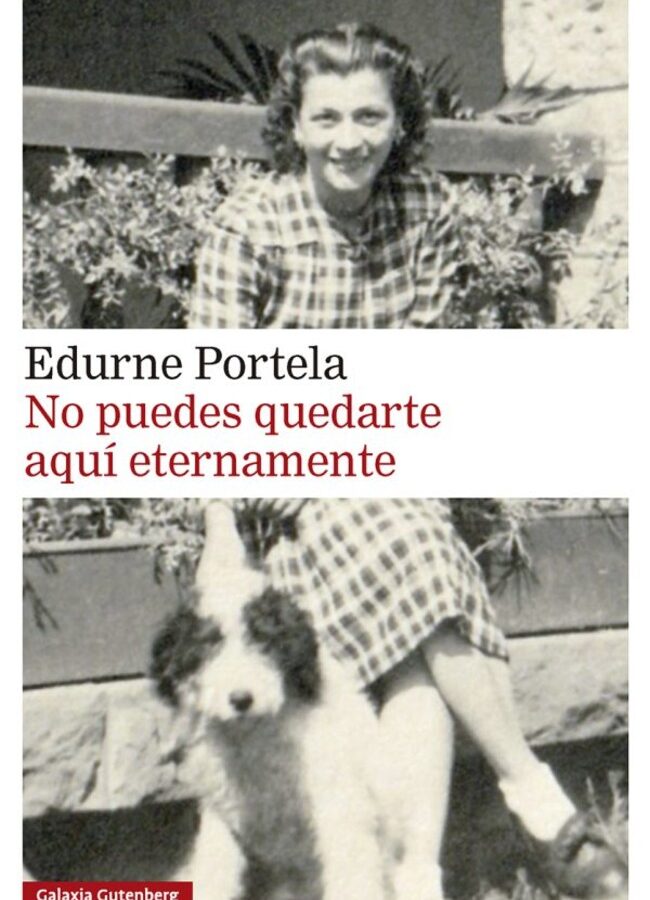
We will recall once again Albert Camus’s claim, included in the speech he delivered upon receiving the Nobel Prize, arguing that the writer cannot dedicate themselves to those who shape history, but must serve those who suffer it. Edurne Portela (Santurce, 1974) is deeply aware of this literary function, that of giving voice to those who have not been able to speak, and she chooses female figures as especially suffering in historical representation, within the symbolic order we have inherited mainly through war narratives. There, Portela asserts, women barely manage to be passive agents. And if it was already difficult to contradict this statement before Portela undertook this literary project, this You Can’t Stay Here Forever will be impossible to do after reading. We should clarify that this book is a continuation of a project that began with Maddi and the Borders, whose protagonist here occupies a secondary role. Portela undertakes research to discover the life of another woman, Marie-Jeanne Echeverría, connected to Maddi and who will endure all the ills of World War II. That means displacement, extermination camps, hunger, filth, and what we learned through accounts such as Primo Levi or Jorge Semprún, and which here emphasizes the differences that evil imposes when dealing with women, with bodies that can be violated, which heightens the terror.
As one might easily imagine, we will encounter extreme resilience, fortitude, and trauma. But Portela does not present a biographical work with the aim of reaching the reader’s core through pure storytelling. We will accompany the author’s inquiry, in which she narrates how she gradually discovers the life of the protagonist through interviews with her granddaughter or a journey that includes visits to the concentration camps. She does not achieve the reader’s emotional involvement through the history itself, but through the discovery of the horror, which is what she shares with us. To a large extent, what she achieves is an empathy that is transgenerational, because it comes from a place in the history that is eighty years before our own lives. Portela is very aware of the value of what she writes, and we would like the word value to be understood in several of its senses, the one that comes from courage and the one that entails learning. In fact, the work could fit within a genre that, if it existed, would correspond to historical-social therapy.
We will read a very restless author, also drawing on the polysemy of this word: Portela experiences discoveries with emotion while also being convinced of the necessity to make them. The work is all tension, shaded by a language that is fairly neutral, with hardly any adjectives, to allow the reader to progress without collapsing. And it teaches us how a historical reconstruction is made, as we read both the reconstruction itself and the process to reach it. At the beginning of the work, while she explains her intention at length, she speaks of a text that is openly personal and political, a “book to expand and continue the work of recovering lives denied by history, to understand and reflect on the importance of those lives in ours.” And for this, she again centers on women who managed to transmit the values that their tormentors tried to eradicate. It is likely there is no more humane approach to writing, because writing is sharing with others, hence not every cause is valid, the best cause remains the one Camus proclaimed: to place oneself at the service of those who suffer history. As Edurne Portela does in this book, which will not fail to affect anyone who reads it.
—————————————
Author: Edurne Portela. Title: You Can’t Stay Here Forever Publisher: Galaxia Gutenberg. For sale: Todos tus libros.