
Sometimes it is the small things that take on extraordinary importance. In the Early Modern period, few islands as small, barren, and hard to live on as Malta reached such strategic value. And, once again, there was a relentless struggle for a piece of land that everyone considered essential to master. The reason was simple: Malta was the key that opened the door to the western Mediterranean.
Corría el año 1565 cuando la gran flota enviada por el sultán turco
Solimán el Magnífico
apareció frente a sus costas; los caballeros de la Orden de San Juan, las tropas españolas y sus aliados saben perfectamente lo que está en juego. No se trata únicamente de conservar una isla, había que frustrar la expansión otomana.
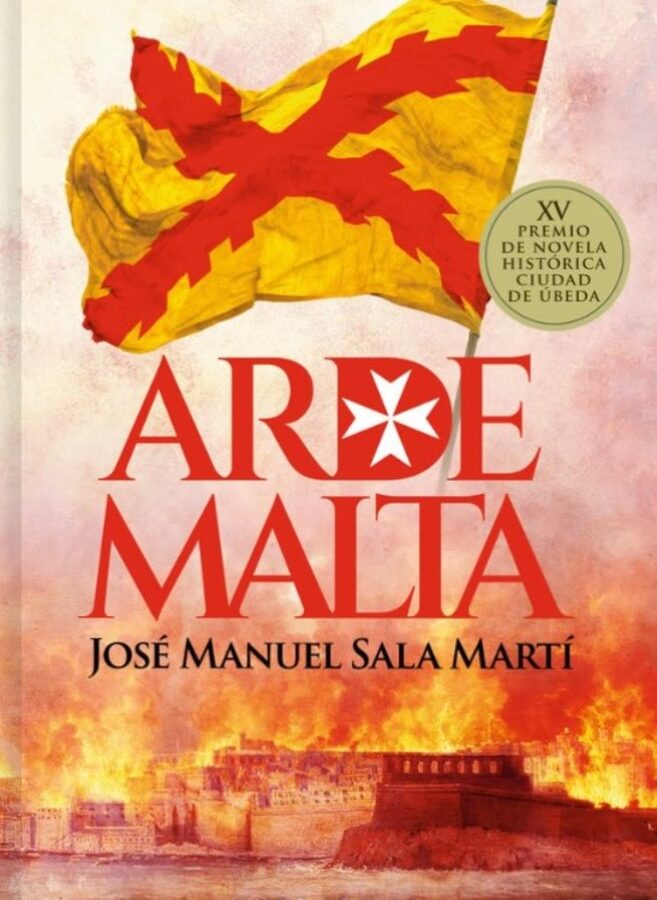
That is the setting chosen by the law graduate and practicing attorney José Manuel Sala Martí (Valencia, 1981) for Arde Malta, a novel awarded the XV Premio de Novela Histórica Ciudad de Úbeda, a work that seeks to claim its place among the few books that tackle the event known as the Great Siege of Malta of 1565, one of the most notable clashes of the sixteenth century.
It is difficult to understand that a historical fact of such magnitude has received so little attention among our novelists.
Malta proved to be the last homeland of the Knights of the Order of Saint John after having lost Rhodes to the Ottomans. From that island fortress they continued fighting the Turk and hindering his navigation through the Mare Nostrum Roman sea.
Disregarding the power of the Christian knights and motivated by the damage they caused to Turkish fleets and their corsairs, Soliman decided to expel them. A decision not very judicious, since he failed to foresee the resistance they would offer in their strongly defended stronghold.
Sala Martí, after thoroughly researching, narrates a war that hurts and terrifies. The author succeeds in making the reader clearly imagine what could have happened in the sixteenth century: a resistance that lasted, almost throughout the summer, in fortresses besieged by bombardments of artillery, Greek fire, arrows, and scimitars; while provisions, the available men, and the ammunition dwindled and, as in many other occasions, the option was to survive and await the long-awaited relief.
The novel is built from stories that converge in the Christian strongholds and in the Saracen camp that surrounds them.
Its characters display the virtues typical of men hardened by war. Sala Martí aims to convey the possible mindset of those sixteenth-century men. An attitude that is welcome in a historical novel.
To say that the narration is unsparing, sometimes bloody, and that it dwells on physical and moral suffering, and that it abounds with scenes of horror should not be understood as a reproach to the author. To be faithful to what happened, at times it is necessary to describe the struggle in all its rawness, without softening it.
Because Arde Malta does not intend to recount only what happened. It attempts to explain, in a clear example of historicism, that is, the defense that each historical era must be understood and evaluated strictly under its own terms, what happened and the circumstances surrounding the event.
There are many historical protagonists who nourish the novel’s roster; however, the author aims and succeeds in paying homage to the anonymous combatants who died or lived without knowing the grandeur of their deed. In that tribute, the fighters on the Muslim side are also included, with a narrator who tells the reality of the other side and the miseries they share with the besieged. Sala Martí achieves a goal that every novelist should set: that readers care about the fate of his characters regardless of the side they fight for. It is not easy to avoid such manicheism or the temptation to judge the past by present-day standards. Sala Martí achieves it.
It is inevitable, when reading Arde Malta, to think of what would happen six years after rejecting the Turk. Malta in 1565 was the great warning that it was possible to stop and defeat the Ottoman expansionist ambitions in the Mediterranean. In 1571 Lepanto would arrive.
They are distinct events, but they belong to the same stage: the struggle to dominate the southern European sea during the sixteenth century. Malta was the heroic precedent; Lepanto, six years later, would demonstrate how far a coordinated response by Christian powers against Ottoman naval power could go.
I believe that for a good historical novel to arise, it is not enough to present a grand epic: one must turn it into characters, plots, and emotions. Ultimately, one must be a storyteller. Perhaps that is the main conclusion I draw from Arde Malta: José Manuel Sala Martí possesses superb gifts as a narrator of historical fiction. He has known how to see, where others did not, a little-known episode with enormous potential and turn it into an entertaining, well-documented, and thrilling novel.
The awarding of the XV Premio de Novela Histórica Ciudad de Úbeda recognizes those virtues in an author to whom we should keep a close watch, because he possesses something that is not always learned: the ability to find a good story and know how to tell it. And when a writer makes us know the outcome and, nevertheless, makes us feel the need to keep reading to find out whether those men will resist until the next dawn and be able to fight for one more day, it means he has understood perfectly what his craft consists of.
Before Lepanto, that “…the highest occasion that the centuries past, present, nor do future expect to see…,” as Cervantes wrote, Malta stood: a small island that burned for almost four months and refused to surrender in a siege that, centuries later, Voltaire would consider one of the most memorable events of the sixteenth century.
—————————————
Author: José Manuel Sala Martí. Title: Arde Malta. Publisher: Pàmies. Availability: All Your Books.