
When I say that I have spent most of the summer in Madrid, there are people who look at me as if they felt obliged to offer me condolences. The Madrid summers have a terrible reputation, probably deserved in those hours when the sun bears down on the façades and the asphalt returns multiplied heat that has accumulated during the morning, and that is why I try to reassure my troubled interlocutor before they begin to explain how much it accompanies me in feeling; although it may seem that once the last borders of June are crossed the appropriate thing is to leave Madrid, as if it were an administrative obligation, I like Madrid summers, probably because in them the city begins to gain all that it loses. From the second half of July, and especially in August, Madrid begins to lack a few neighbors, several thousand cars, many decibels of noise, its habitual vertigo of haste. It is left without a substantial part of itself and, curiously, begins to seem more itself. The streets empty, the sidewalks breathe, in certain portals entire hours can pass with no one entering or leaving, some terraces close and others seem open only to not break the habit. One can stroll without having to dodge pedestrians, stop in front of a shop window without giving rise to any tumult, remember what plazas are for. Madrid forgets itself, and it turns out that it is in that lull where its truth is solidified. It seems as if it decided to take everything as a joke or to scorn the gravity that the usual hustle of clocks carries, to discover that, contrary to expectations, calm agrees with it. Hospitals and clinics keep functioning, and even the post offices; buses keep circulating and things keep happening behind the windows. But everything happens at a different pace, and even the traditional fiestas that spill into the alleyways in Cuesta de Lavapiés and La Latina seem to soften their frenzy so that the chotis can return to being a traditional dance and not merely an attraction for tourists. Even the metro, that circulatory system that irrigates the arteries and veins of the city with its millions of bodies pressed underground, behaves with a certain hospitality. There are carriages where one can even afford the luxury of choosing a seat, platforms that do not require strategic calculations to guess the exact point where it is best to stand, aisles that stop feeling like evacuation tunnels. Life, and this is a strange sensation, begins to feel like a human thing again.
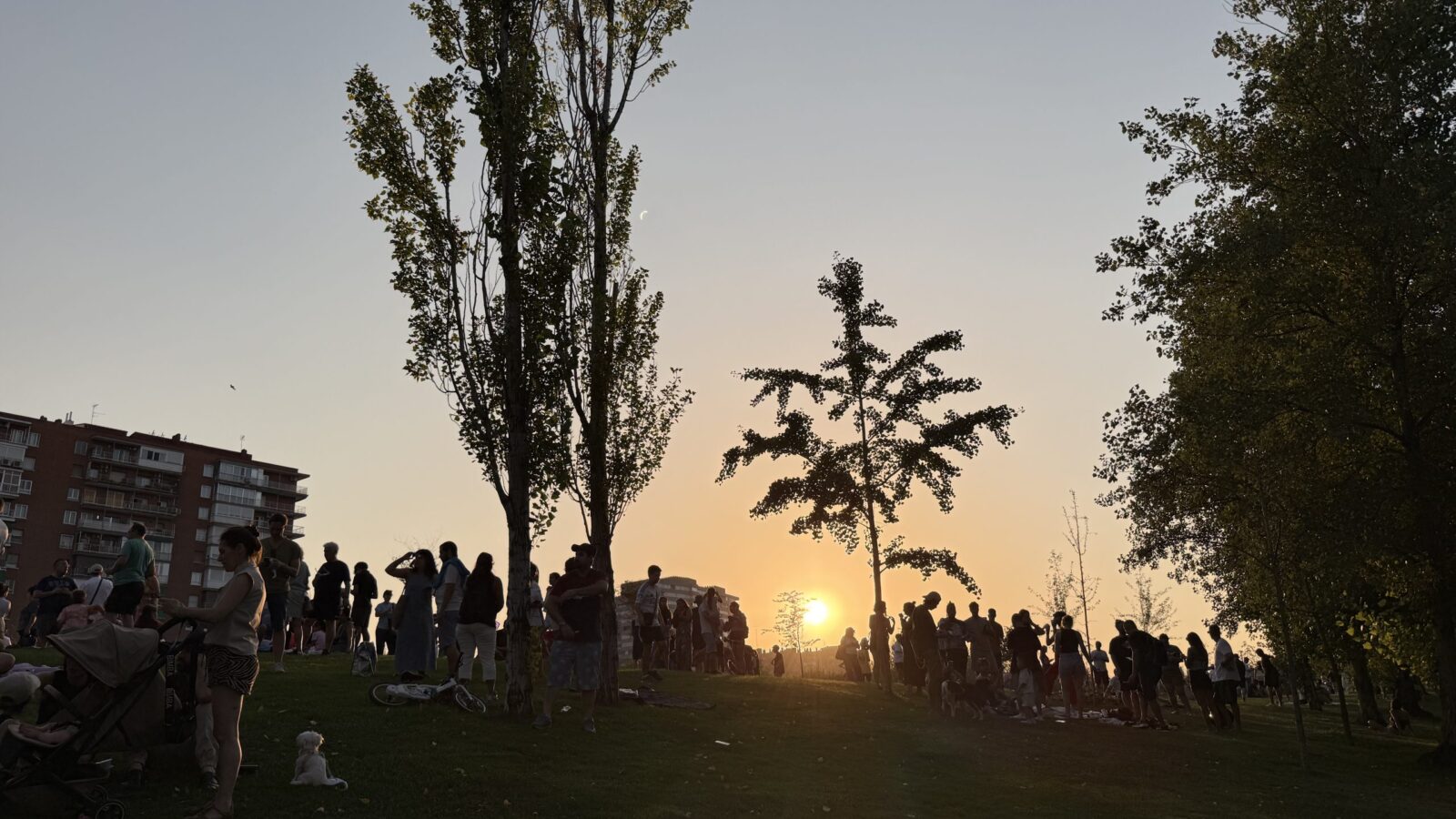
That is why it is easy to notice what the rest of the year is buried beneath in the noise, because in August a crack opens in the middle of the clamor and through it emerges a city older than the waiters who serve coffee in late morning, the elderly resting on benches in the shade, the tourists queuing under the sun with a determination as heroic as it is incomprehensible, the runners who appear at hours when any physical activity should be prohibited by all international conventions; to all those who, for one reason or another, have spent the summer here and end up recognizing themselves as temporary inhabitants of a deserted city. One day a handful of us gathered at Madrid Río to look at the sky because we were told there would be an eclipse. There was in it something beautiful that had less to do with astronomy than with humanity. Families, couples, solitary people gradually arrived, lifting their heads and sharing their glasses and moving around to see if they could find the most appropriate place from which to glimpse the dance of the stars. No one had summoned us, but the punctuality was so exact that it gave the impression that we all appeared there by prior appointment. In a city where almost everything requires a ticket, a reservation, someone who can sneak you in, a membership card or a phone app, that elemental gathering of friendly strangers who had left their homes to see how the moon would interpose itself between them and the sun felt exhilarating. There was something ancient about it, something that must resemble what moved our ancestors when they faced the same phenomenon and watched it with mortal fear, but sought shelter in one another, because they did not know what to expect. We knew the explanation, we knew what time it began and when it would end; we could consult on our phones the exact percentage of occultation, but none of that against the mystique, because science explained the mechanism to us without stealing away the childlike astonishment at the miracle. At some moments I turned away from the sun and looked at the people to fix on the mouths ajar, the tears that appeared, in that almost liturgical silence that was occasionally interrupted by brief exclamations. We were all there witnessing something that no one had organized and for which no one was going to charge us. Then the moon continued its path and we resumed ours through this city that, suddenly, stopped demanding things and grew slower, quieter, more livable. A place where it was still possible to pause in the middle of a park, look up and wait for something to happen in the sky.