
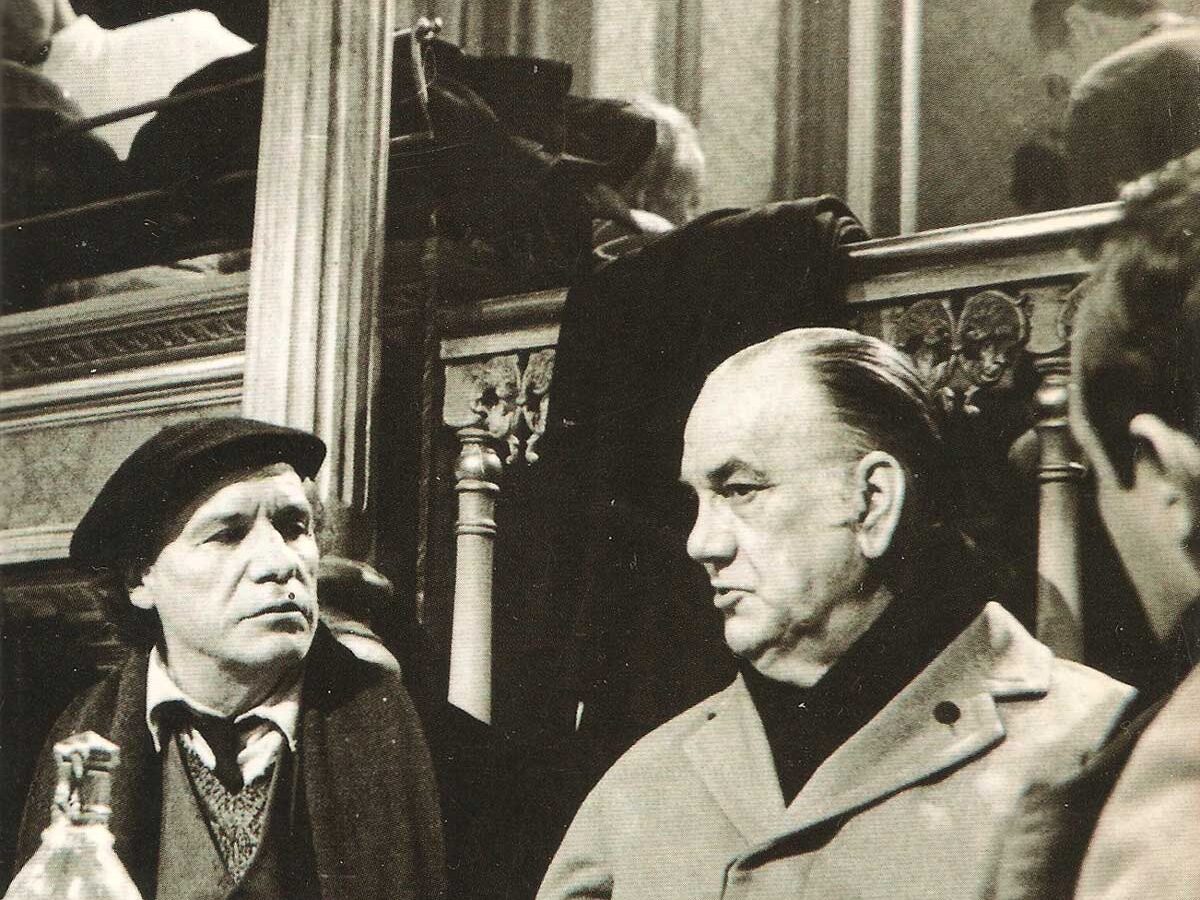
The Club of Galician Journalists in Madrid has commemorated the 75th anniversary of the publication of La colmena, by Camilo José Cela, with a day at the Nobel Prize Foundation in Iria Flavia (Padrón), where its value as a “collective portrait of postwar Spain” was asserted.
Thus, the event’s conclusions were highlighted by the Darío Villanueva, a professor of Literature, philologist, writer and former director of the RAE, and by the Alfredo Conde, a writer and National Prize for Literature, who addressed Cela’s enduring relevance as a creator and renovator of the literary language that “transformed Spanish narrative.”
The day allowed attendees to learn about the legacy the author wished to preserve and which today is safeguarded by the Foundation, ranging from manuscripts and working documents to a correspondence archive of around 95,000 letters from nearly 13,000 individuals and a library of more than 48,000 volumes. Among the holdings related to La colmena are manuscripts and editions of the novel, documentation on its creation process and correspondence with writers of his era.
The visit coincided with the 75th anniversary of a novel written in the immediate postwar years, which faced censorship and was first published in Buenos Aires in 1951. In 2025, the General Archive of the Administration located the original typewritten manuscript that Cela sent to the censors in 1946, a one-hundred-page text initially titled Caminos inciertos. Libro primero. The Beehive.
During the colloquium, a letter from the writer’s son, Camilo José Cela Conde, was read, who recalled the novel’s context and its capacity to portray postwar Spain. “The Beehive is, above all else, the chronicle of a suffocation,” Cela Conde stated in his message, adding that the work “narrates a single death, in the same way as The Family of Pascual Duarte did, though with the difference that this time it is a collective death by asphyxiation, disguised as a faint hope.” For the Nobel laureate’s son, “there are few more faithful testimonies” of that era than this novel, which allows us to revisit “the years that followed the Civil War in Spain.”
Villanueva has placed Cela at the center of Spain’s postwar novel recovery and defended the importance of La colmena in 20th-century literature. He explained that The Family of Pascual Duarte opened a narrative of existential character, and The Beehive subsequently provided a decisive impulse for the social novel. The former director of the RAE also noted that a 2005 survey among professors, critics, writers and intellectuals named The Beehive as the most prominent Spanish novel of the 20th century and among the works with the greatest future projection. He also pointed out that it is part of a contemporary current that makes the city the collective protagonist, in contrast to the 19th-century novel model centered on a single character.
Alfredo Conde also argued for the work’s relevance and its ability to reconstruct the daily life of postwar Spain. “It seems like a prodigy to render a society through dialogue,” he stated, before defining it as “a complete mirror” of the people of its time.