
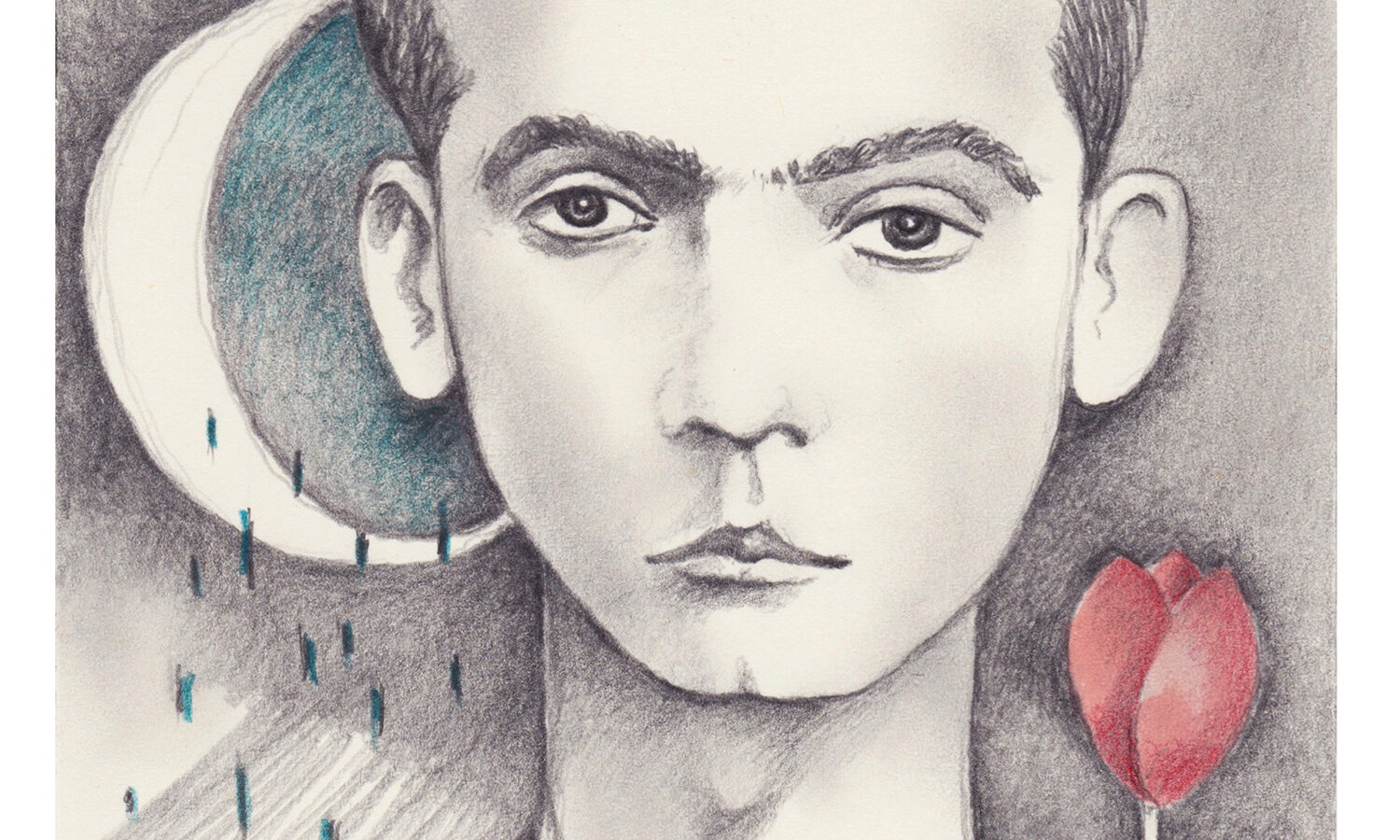
The unexpected discovery of a chest containing unpublished material by Federico García Lorca (letters, photographs, sketches from an intimate diary…) leads the narrator of this story to uncover new aspects of the poet’s and lover’s life—an ode to tenderness.
In this Making Of, Manuel Avís explains how he wrote Let Me Dance (Cabaret Voltaire).
***
Writing a novel is to flood oneself. To feel all the images, each idea, beating around like twinkling, extraordinarily noisy bees; a galaxy in every memory, and the long breath of the imagination — always young and naked (these adjectives came from Federico).
I have written the scenes of
Déjame que baile
as one discards a burning object.
The process of creation and writing of this book stands apart abruptly from all the ones I have written. Often, I need to be immersed in the creation of a novel for years. I finished a manuscript in 2024 that took three and a half years of dedication, and at the time it did not seem like much. But Let Me Dance burst into my life as an impulse and an irreplaceable instinct. I have never felt a writing pass through my body so exalted, agile, urgent, tireless.
Clinging to the attainable love of a novel. It is what, for me, gives true meaning to life.
When I received the proposal from Zenda magazine to tell how the writing process of this book had been, I knew from the first moment that the fairest and most coherent, the most honest thing to do, since I have always kept a personal diary in which all my creative processes are laid bare, was to transcribe some fragments from that diary, the most faithful mirror of the happy days in which I lived immersed in the life of Federico García Lorca.
I would like, before passing to this diary, to condense here four lines of reflection, four statements, four principles that have guided my writing experience:
- Always write from what emanates affection. The deepest, most vital feelings.
- The process must liberate happiness. One does not write to suffer. “The work is a sign of happiness,” wrote Proust.
- Every novel is a love letter.
- The modern novel is compassion and understanding –as George Eliot showed, one of its foundational voices–.
***
The diary is a tool that reveals one’s submerged consciousness. The diary inaugurates the full mastery of an inner time. It is a retreat of life so that, on that other face, in that doubleness, one can understand it, clarify it, compose it, record it, measure its forces, commit to it our dignity and our hope, arm ourselves with meaning.
Fragments of Manuel Avís’s intimate diary
18 August 2025
89 years since his assassination.
I wish to see him alive. His warm, beating ghost. He would give me a long embrace.
24 August 2025
We had scheduled this morning with Federico: the Huerta de San Vicente, the FGL Foundation, with some manuscripts on display, and the Via Crucis Viznar-Alfacar.
31 August 2025
One week since our visit to Granada. That night, seven days ago, I began writing a book dedicated to Federico. I have spent this entire week working on the project, reading books, watching documentaries…; I have written 11,715 words. I have read more than I have written: I prepared myself before going on stage, and now I feel I am completing the few steps that separate me from the true writing milestones.
I have the entire structure assembled, the themes delimited, the beginning and end composed. I will paste here, in this notebook, one of the entries to the Huerta, and I will paste the other the day I finish this book.
1 September 2025
Annie Ernaux’s birthday.
I have sent her an Isler orchid. She wrote me an email this morning, with the flower’s arrival at her home. She has turned 85. She remains essential, as we discussed in a letter months ago about El Público.
There is a twist in the tree, and there, where the wood moans, the cracks burst with hard shoots, with leaves that will shine and see the birth of this novel. The emotion is feeling the shelter of the poplar every day. At every deep noon.
I feel, alongside the resilient life of the leaves, my commitment to writing.
3 September 2025
Plans to guide the disorder of the coming days: 1. prepare a Jane Austen lecture. 2. write with voracity Let Me Dance. 3. the passage that has been forging all August, for a new book, A Handful of Lilies, with the description of the invented trip to Greece. 4. write the article about Emilia Pardo Bazán.
5 September 2025
I often return to the rehearsal afternoon of Chekhov’s play (was it Chekhov or Turgenev?), eleven years ago, when, in an empty room, M. and I kissed, beyond a door, for a long while. A happiness too fragile, too brief.
What was Federico’s first kiss? Did it leave him a wound, as it did to me?
7 September 2025
Blood moon. A total lunar eclipse. I have felt it. Saturn, very close to the full moon.
I have devoted myself completely to the Lorca book. Today, two weeks since I started this book. 18,087 words. It will be a beautiful week, very awaited fragments lie ahead, the arrival of writing in Víznar. Immersed as I am in Federico, I feel accompanied by him. I tell myself I must be intimate and bold with this text. Daring to recreate his voice.
14 September 2025
The sails of my vessel remain firm. 22,064 words.
19 September 2025
Perhaps we authors are doomed to believe we die of nostalgia.
21 September 2025
25,160 words in Let Me Dance.
The need to always keep a candle burning (white hawthorn, the scent of awakening in Marcel Proust’s writings) while I write this book.
28 September 2025
All day writing.
31,765 words.
Writing the novel now is an inundation. Scenes strike me, images. What a great relief to be out of the world, and to expand it from within, to enlarge its dimensions, its reverberation.
30 September 2025
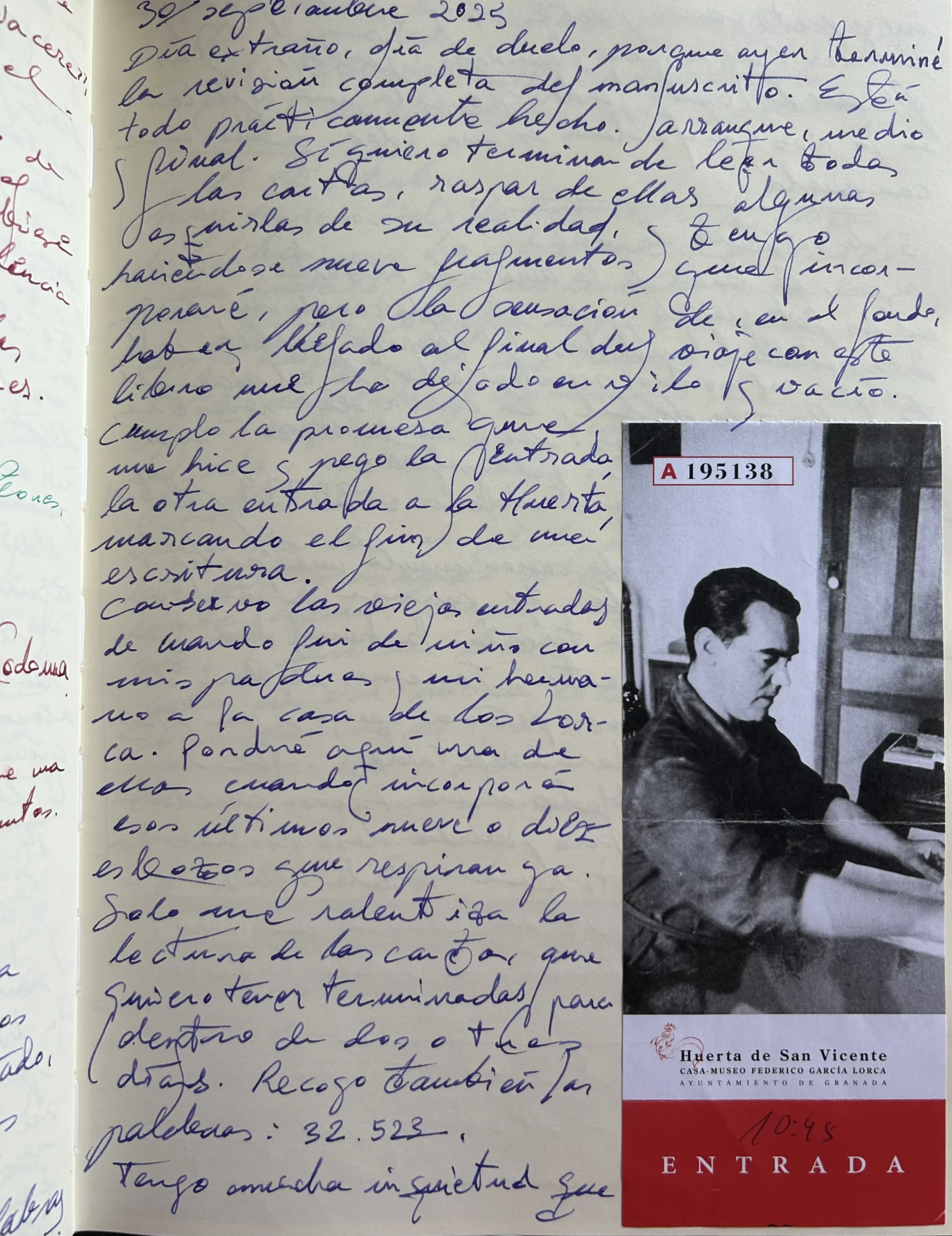
A strange day, a day of mourning, because yesterday I finished the complete revision of the manuscript. Everything is practically done, beginning, middle, and end. I want to finish re-reading all the letters, scrape from them some slivers of their reality, and I have nine fragments to incorporate, but the sense of, deep down, having reached the end of the journey with this book has left me unsettled and hollow.
I keep the promise I made and paste this entry, the other entry to the Huerta, marking the end of a writing.
I preserve the old entries from when I went as a child with my parents and my brother Carlos to the Lorca house. I will place one here when I incorporate those last nine or ten sketches that are already breathing. Reading the letters only slows me down; I want to have them finished within two or three days. I also collect the words: 32,523.
I am very restless, which I interpret as part of the book’s mourning. I will read once more Canciones and Suites, and Poema del cante jondo. Keep them very fresh in the voice and in the soul. It is a comforting idea.
5 October 2025
35,779 words.
The desire is the pure, faithful, and vehement hunger for knowledge. The first stage of desire is tenderness, the humility that a face awakens. We have the gift of being able to look at a person as a god, illuminating their irrepeatable value.
12 October 2025
It has begun to rain for the first time in weeks. Alberto and I have gone out onto the terrace, relieved, at last the humidity, the coolness. I have definitively finished the book.
15 October 2025
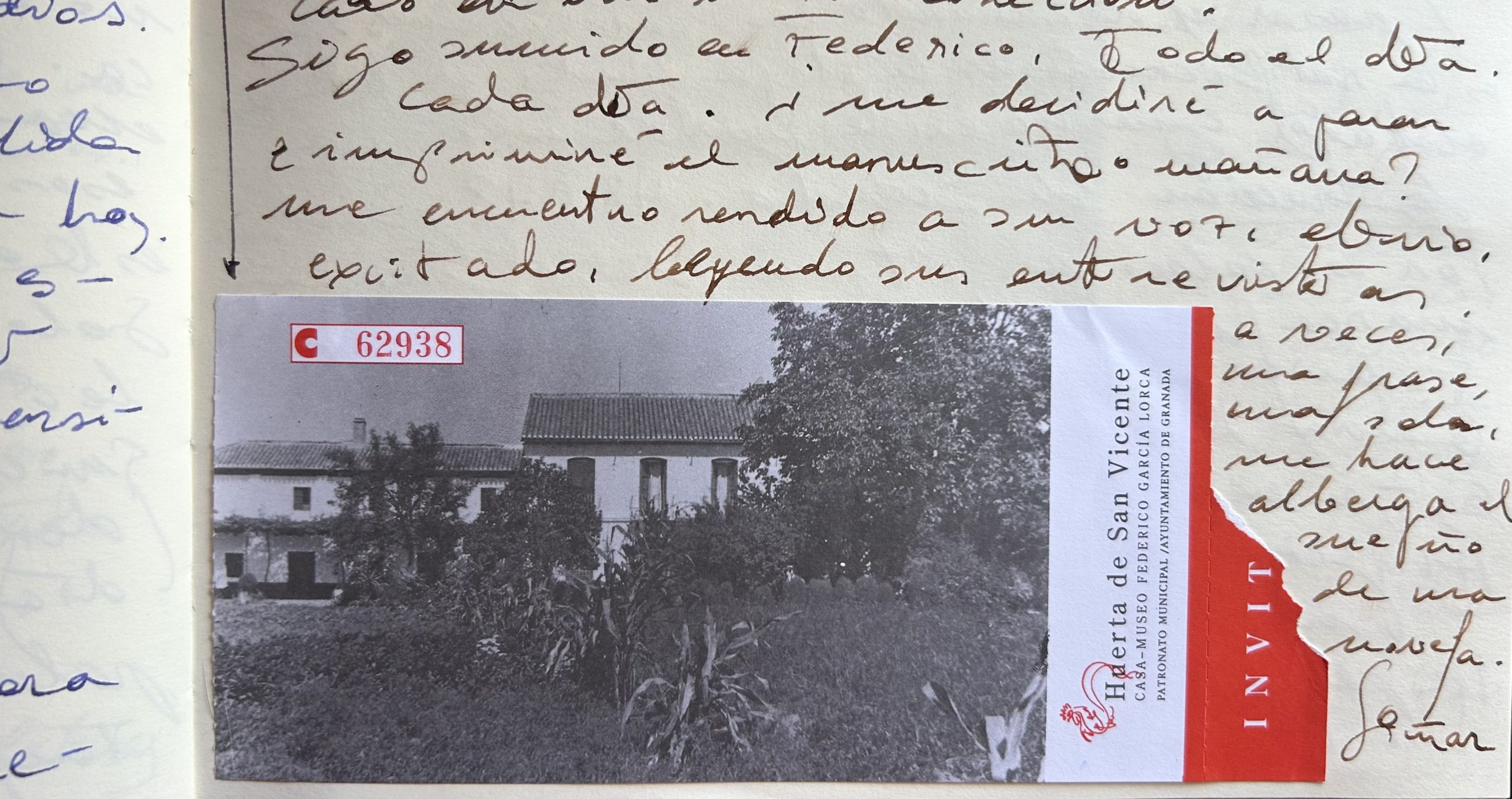
I remain immersed in Federico, all day. Every day. Will I decide to stop once and for all and print the manuscript at home tomorrow? I am surrendered to his voice, intoxicated, excited, rereading his interviews. Sometimes, a single sentence, a single phrase, makes me harbor the dream of a novel.
Dreaming amid the myth of his life has no end.
17 October 2025
Let Me Dance: 47,344 words.
Alberto is now printing the manuscript for me.
The gardenia is beautiful, enormous. Four blooms have blossomed. I have finished Lorca’s book with its scent.
Since we do not have a bookbinder at home, Alberto has patiently punch-pinned the manuscript’s margins in at least five places, and then he has sewn and tied a dense turquoise thread so the pages are well bound. The care and affection he put into this task makes me view my work through his eyes. This gives me deep energy.
25 October 2025
I have finished the revision, which I did on paper with orange ink, and I have just transferred the corrections to the document. This is the ratification of the final stage, the finished book that now exists outside of me. 48,048 words.
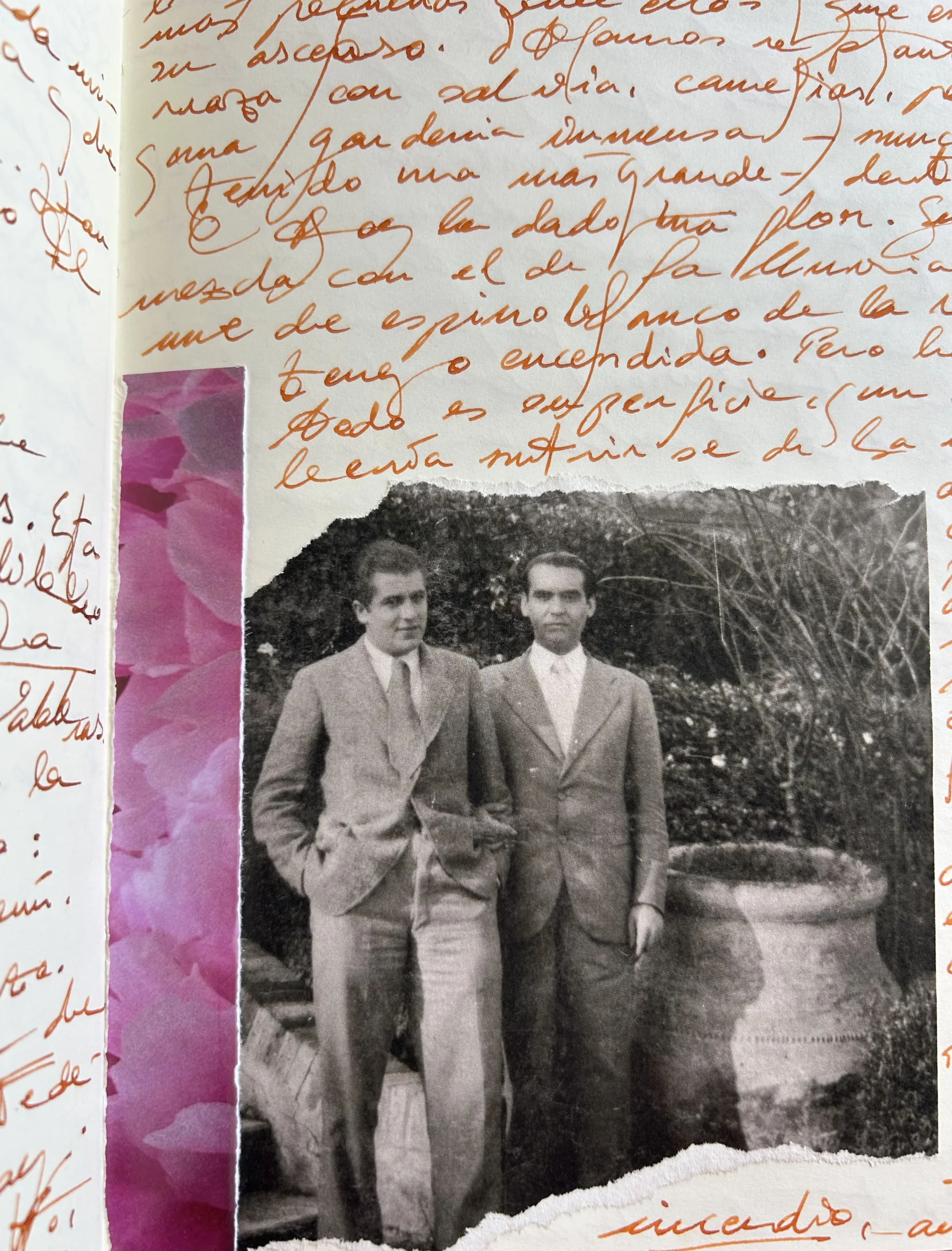
That is why I place one last photograph in this notebook, the definitive mark of the end of my work: Federico and Rafael Rodríguez Rapún. García Lorca holds his arm. They are at the Reina Cristina Hotel in Algeciras in 1934, on Federico’s return from Argentina and Uruguay. I have pasted next to him, like a votive offering, a clipped strip from one of the photographs I took of the peonies. I am satisfied with what I have achieved with this book. It has brought me happiness, during these almost two months.
31 October 2025
Yesterday we went to see Extraño río, by Jaume Claret Muxart. The film eased something within me.
I look at myself at fourteen and wish for the same boat as in the film, the same boy.
1 November 2025
Drowsiness from the antihistamine. I have several books to write, but I remain anchored to the image of Federico, and deep down I do not want to detach from him completely. Yet I do not advance, I cannot channel all this strong longing that remains stagnant. Now it stays with me because it does not flow into the writing, and its weight is unbearable. I need to distance myself, but at the last moment I cling to him.
Immensely wanting to breathe again in Paris.
It is very late. Four in the morning. Staying up late is a virtue, a gift of rebellion.
14 November 2025
Alberto has fallen asleep beside me while I write. His breath marks the internal rhythm of these lines. I welcome the piercing joy of having the gentlest, most honest, generous, and protective man by my side. He has given me an extraordinary life far from the pain of the world.
8 December 2025
In the Palais Royale, despite winter, there are roses that confront time’s aggression and stand tall, clear. How would Federico react to them?
9 December 2025
An intense day. The best winter sun in Paris. We cross the Pont de la Concorde on our way to Orsay. The fountains in the square were lit.
The eroticism of Sargent’s male figures is like a mist that nourishes and invigorates. True happiness in the museum. Fascination before the portrait of his lover, Albert de Belleroche, the Venice paintings, the starry sky of the flamenco dancers. They had digitized an entire album of the painter’s memories and photographs; on one page, the visible signs left by photographs pulled out, torn, now vanished. I told myself that what I want to do by writing has its origin in this image: to compose the emptied pages, to recreate the photographs made to disappear. That is exactly what I wanted to do with the Lorca book. Break that fog. The rings Sargent places on the fingers of his subjects are unmistakable. Emeralds and rubies. Large diamonds. I am entranced by the lips of Dr. Pozzi. Nothing prepares you for a painting like his. A piercing nostalgia for another time, without memory. Nostalgia and desire.
Moved by a letter that John Singer Sargent sent to Albert de Belleroche in 1883. I approach the glass closely; I observe the folds of the paper, the painter’s delicate handwriting, long strokes at the end of some words. I study the wrinkles on the vellum-like surface as lines on a map that could reconstruct the emptinesses of time, of voices extinct.
At the end of the day, fatigue mixes in my head the memories of Sargent’s letter and the photographs from the manuscripts of Poeta Nueva York, which I have spent hours viewing before our trip to Paris thanks to Mario Hernández’s 1990 book on Federico’s New York manuscripts.
Relief of the fresh air on Rue de Lille, after leaving Orsay. We take a taxi to the Rodin Museum. We are lucky to arrive under the day’s strongest sun, a sun without limits that bathes the sculptures. Of them all, I remain faithful to the one called Le Bronze Age or The Man Who Awakens. I observe the great dimensions of the body, its nakedness. I photograph its light-filled sex. Its abdomen. I hope that someday my writing will evoke what these, at this moment, in this room, evoke—the light and the sculpture of the naked man. Its beauty.
Then we stroll among the garden sculptures, as alive as the bare trees that flank them. As evening falls, a bit more cold and a soft sadness born of fatigue and the concentration of impressions. Still, we keep the plan to visit Marcel’s tomb, a gesture of love, an act of respect.
Alberto finds the small Hahn family chapel nearby, very close, but nearly hidden. I open the door without hesitation. There is a slab to the left with the name Reynaldo. I like that from Marcel’s tomb you can see the one that embodied the great love of his life. There is a sense of justice in their proximity.
I think Federico García Lorca should be buried beside the men he loved. That he should be buried next to Rafael and Juan.
10 December 2025
Seven days to meet with Miguel Lázaro at Cabaret Voltaire’s headquarters.
I am eager to meet him.
The willow of Parc Monceau bursts with yellow. We stroll along the Allée de la Comtesse de Ségur.
11 December 2025
The Tuileries Pond is full of seagulls.
In the Palais Royal, a reddish haze clung to the bare trees, the dark branches. That crimson color radiated from them. “They are the buds of the floral buds, already there for spring,” Alberto explained to me, and he held a branch, lowering it carefully so I could see that tiny magenta bud that gave the avenue the inflamed hue at the tips. It gave me hope that, despite the winter’s cold, spring was already promised, secured, contained, in those very dark purple tears.
“Very good things will happen next spring,” he assured me.
24 December 2025
A Coruña. Strangeness and sorrow at seeing the pedestal of the Fountain of Wishes in Azcárraga Square empty, the goddess disappeared. A boy climbed up and knocked it to the ground. They are restoring it. I find this representative image. As if we all bear the duty to look back at history and rebuild pedestals for vanished figures. I think of Pura Ucelay, Lorca’s great friend.
Yesterday, the 23rd, the most beautiful bright noon facing the sea, in Orzán.
25 December 2025
Every Christmas here, each year, we have followed the tradition of going to the Tower of Hercules, always on the morning of the 25th. The sea was full of foam that, as it dissolved, left on the water the pattern of a marble-like sheet. I stood still, following the waves’ breathing. I made a wish: that Cabaret Voltaire would want to publish me.
A couple of two boys arriving at the lighthouse in front of us, who hugged and kissed, reappeared when we were seated on one of the higher benches, on the hill. I tell myself that I am living in the best possible time. The sun’s strength nearly scorched my nose and forehead. I think, and it appears in me as wounds, in the difficulties Federico faced to love freely in the midst of a cruel society, the long shadow of the holy mafia, which is how Maruja Mayo called the Catholic Church.
28 January 2026
It is snowing this morning, very early, in Madrid; the park tilts white, but the light, so strong, begins to melt the snow. It is 12:05.
Nostalgia for the cormorants and seagulls of Oleiros.
22:07. Cabaret Voltaire will publish in September my Lorca book. This afternoon Miguel Lázaro called me on the phone (we spoke for more than an hour) and gave me news that I still absorb and that transforms me, that lights up a part of my reality. “The snow brings good things,” Alberto told me, happy. Miguel has praised the book a lot. He wants to put all his energies into it. “Make a beautiful book,” he told me.
Seven months. Only seven months until the book exists.
It is very lucky to have orchid buds opening, and today, beside me, at least seven orchids have shed their sepals, the magenta labellum. I strive to find everything that has participated in today’s big news. I cannot sleep. It is raining. It is 01:49. I need time to accept this, to truly believe it.
I told my parents quickly, who were happy, to my friend Leonor, to my brother
Carlos, to Alba, to Mercedes and María, to Maca.
Before Miguel’s call, who warned me 10 minutes before, I called Alberto, but the lab had no coverage; then I called my mother, but there was no signal, and I called my friend Leonor, who answered quickly (she was on the street, looking for a taxi, in the rain). I told her that Miguel was going to call me. She burst with happiness: “They’re going to publish you!” Talking for those minutes with Leonor helped me relax. I was really nervous. An inner voice told me that whatever Miguel was going to communicate would change my life.
29 January 2026
I write to Annie to share the news. She replied quickly: “Bravo, Manuel! It’s magnificent! I can well imagine what you must be feeling. I’ve known this moment for 52 years.”
It is unique and for me something far more exultant than even the Nobel announcement. It lives in every second. I’m eager to be able to read your book in French, as it seems exciting both literarily and humanly. What is the title? The photo you sent me is magnificent, moving (it was a photograph of the Aynadamar canal, which I had attached to the email). Je vous embrasse. Annie.”
9 February 2026
At the end of the day, I need everything to fade away into the writing.
17 February 2026
Evenings with pink skies (vibrant roses) and lantern-lit reds (orange-reds that crumble) have begun.
Today I signed the contract with the publisher. I realized the date (the 17th), for it was exactly on 17 December when I met Miguel at Cabaret Voltaire’s offices and handed him the manuscripts.
I like the title we have given the book, this line from the “Romance of the Moon Moon.” Since Miguel suggested it to me, it has kept resonating in me. Déjame que baile.
Distinct for its directness, a clear address, its simplicity—crystal clear. I like the rebellious tone it conveys. There is also in it a mark of defense, of safeguarding one’s own desires. A declaration of freedom that encompasses all realms: the creative, the affective, the sexual, the social, the political…
20 February 2026
A few days ago, while talking on the phone with my editor, Miguel, something arose in my heart and I told him: I would like that when this book becomes a reality, and we have it in our hands, we would travel to Granada, leave a copy on the ground between Víznar and Alfacar. I need us to do this.
—————————————
Author: Manuel Avís. Title: Let Me Dance. Publisher: Cabaret Voltaire. Sales: Todos tus libros.