
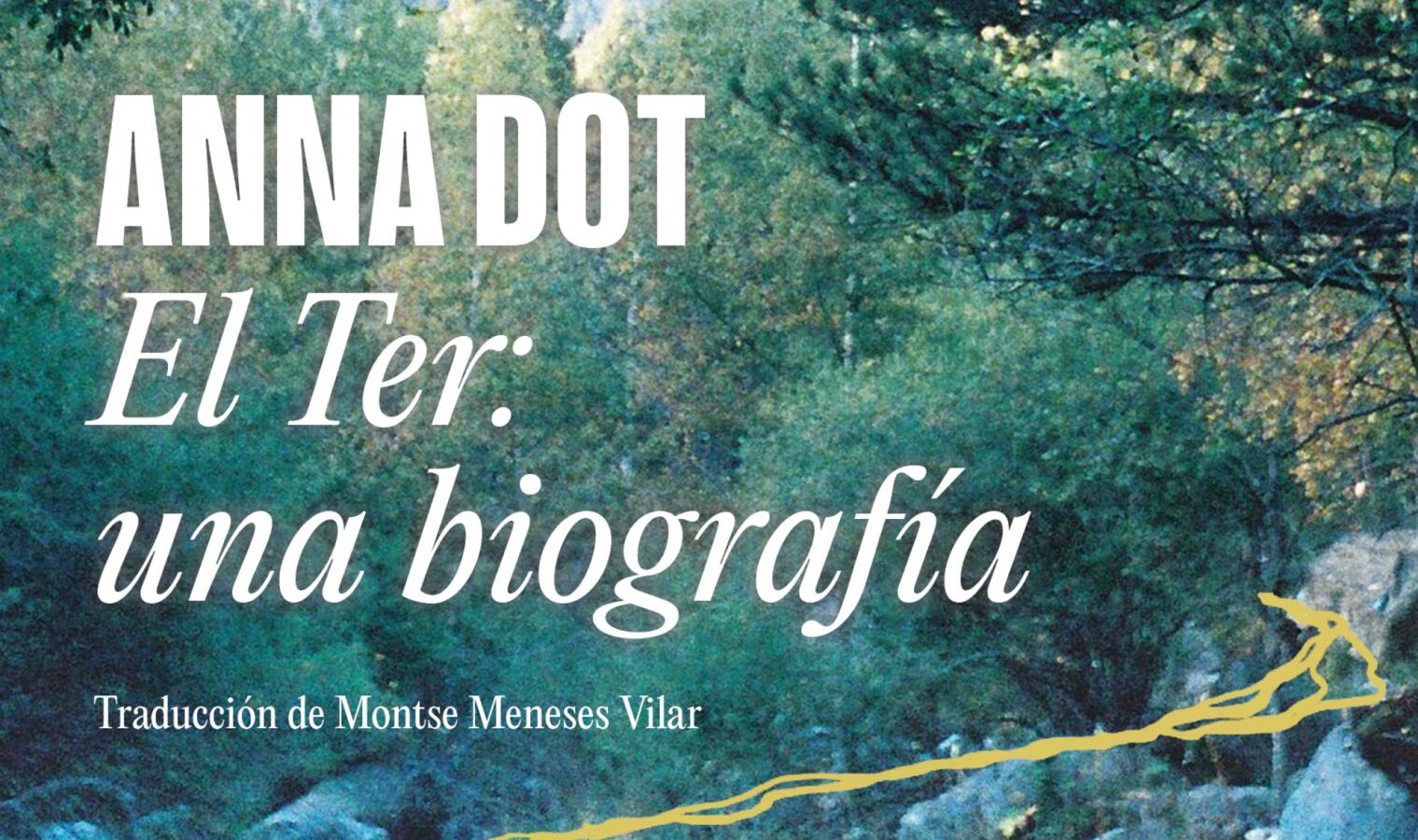
In the midst of the climate crisis, the planet begs us to listen to it. A reflection on how we relate to our surroundings is essential. This book — recipient of the Because of Many Suns Prize, the Art Nou Prize, and the winner of the Almería Art Biennale — proposes a different approach to nature.
In this making-of Anna Dot explains how she wrote The Ter: A Biography (Random House).
***
In 2017 I was surprised by the news about the declaration of the rights of the Whanganui River, in New Zealand. Over the years, and within the framework of my research in translation and artistic practices, I delved into the topic and sought the legislative article that recognized the rights of that river. It seemed to me that that piece of legislation functioned like a kind of translation: from the way of life of the Māori people, native to New Zealand, to the country’s political system, a member of the Commonwealth and clearly influenced by British political forms.
I thought about all this and walked along the banks of the Ter River, which borders my town, Torelló. According to the Whanganui River law, for the Māori community the river is a physical and spiritual entity; a living, indivisible whole. I gazed at the Ter and thought about the culture I grew up in, about the water cycle, about the reservoirs, the transfers, the production of hydroelectric power, the enormous sprinklers that irrigate the fields nearby, about the foul smell of the treatment plant between them, and about all the polluted sources in the area. From there emerged a question: could the Ter river be declared a rights-bearing subject?
I researched this possibility and spoke with Cesc Andreu, a law graduate, who told me that Popular Legislative Initiatives (ILP) are tools at the disposal of citizens to propose laws. We also mentioned the ILP that was being carried out in Murcia, regarding the Mar Menor lagoon. From all this came the video “Letting Yourself Run,” in which one can hear the text of the legislative proposal that could serve to recognize the Ter River as a rights-bearing subject while images of its entire course appear. This was what was shown at the collective exhibition “Towards the Gods: A River Grammar” at the Bòlit, Centre d’Art Contemporani de Girona.
However, at the end of the video, I felt a certain discomfort. It seemed to me that, while a law could be a useful tool to better protect the Ter River’s ecosystems, I was not sure it would manage to alter our relationship with this river. And what truly interested me was the fact that there are people in the world who relate to the river by understanding it as a living being, while others simply see it as a resource. What do we need to change our relationship with the river? Why don’t we understand it as a living being?
From these questions, and from the desire to experiment with another kind of relationship with the river, the literary project The Ter: A Biography was born in the summer of 2022. With it I set out to understand the river as a living being and, therefore, to write its biography. To do this I would rely on the same form of writing—an act of thought and discovery—based, above all, on imagination. To invoke the latter and help it a little, I decided to cast a spell; some magical words that I loved and that I share here, as in the book, to enchant the reader as well:
“Ter, Tik, Water that exists and lives,
that may those who do not see life in all that is be swallowed by you,
drown their ideas,
bathe them in the certainty that you are, Ter, Tik, Water existing and,
like us and everyone else, you live.”
Thus the Ter stops being “the” and becomes simply “Ter.” And thus begins the journey of the Biographer, determined to traverse Ter’s body to get to know it up close. She walks in search of all possible information to craft a rigorous biography; a biography that, despite everything, escapes from the very beginning, overflowing into the writing. In this sense, there is a moment in the journey when a very revealing scene occurs. A mayfly (an insect that lives no more than 24 hours) lands on the Biographer’s arm and asks her: “Could you tell me the story of humanity? I want to share it with my kin”, and before the human can begin to respond, the insect has already found a mate, reproduced, and died. The Biographer sees herself, in relation to Ter, as that mayfly.
Thus, one of the main difficulties in drafting this book has been confronting the very impossibility of the project itself; to accept it and, at the same time, to continue with the idea. The spell helped me persevere until the end of the project. However, magic has come under threat on several occasions; for suddenly a highly rational voice would colonize my head and reproach me with impertinent questions about the meaning of what I had proposed and was doing.
When this happened, I tried reading people such as Graham Harvey, author of “An Animist Manifesto” (2013), Perejaume and Fonts líquides i fonts lignificades, Virginia Woolf and her Orlando, Astrida Neimanis and her hydrofeminist theory, or Pier Paolo Pasolini and his essay on the long take. Moreover, as a guiding principle, I reminded myself of a phrase said by Swiss architect Peter Zumthor: “Everything I perceive exists, beyond how quiet, hidden, or mysterious it may seem” (in Die Geschichte in den Dingen, a conversation with Mari Lending, my own translation of the fragment). Also the words and the wonderful support of Mireia Lite, the editor, and Rita Andreu, from the cooperative Cultural Rizoma, have kept the spell alive when needed. Similarly, the friendship, growing over these years, of the women on the ecofeminist committee of the Ter Defense Group has been essential.
To carry out this project, I walked along all stretches of the Ter, alone and well accompanied. I napped on its shore, I went upstream along its waters, I let myself be wetted by them, I entered inside a hazelnut, I managed to understand the existence of the fake saffron, I found a rounded XPS pebble, I lost my body in the waters, I listened to its voices, I organized picnics with friends by its side, and even a book club and several editions of the annual badminton tournament “Along the Ter.” I saw night fall on Ter and its body turn black, blending with all the other lives and with myself, and also, how the sun rose again and all boundaries dissolved.
—————————————
Author: Anna Dot. Title: The Ter: A Biography. Translation: Montse Meneses Vilar. Publisher: Random House. Availability: All Your Books.