
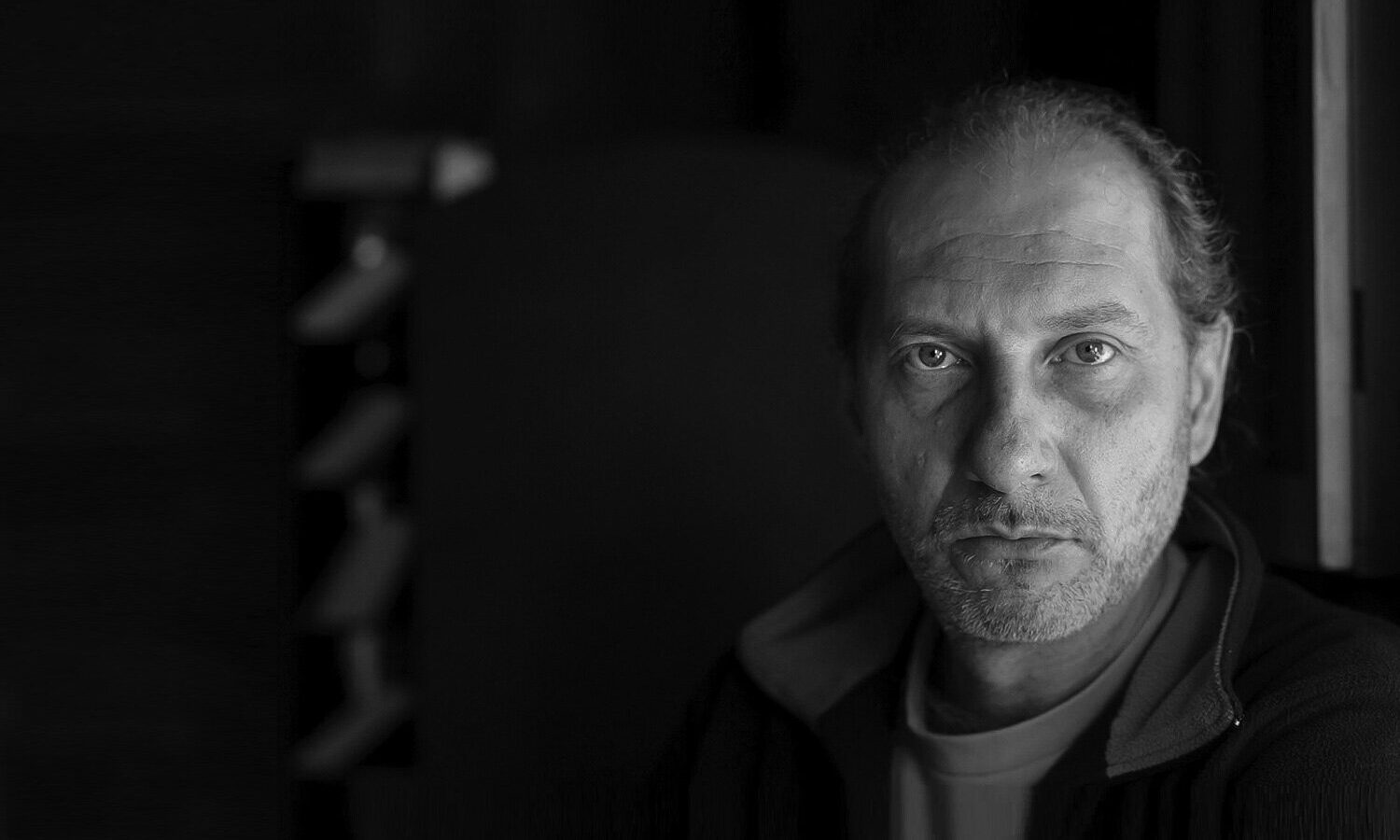
Álvaro Colomer continues to probe the founding myth hidden in the biography of every writer, in other words, uncovering the origins of their callings, the seed of their awakening to the world of letters, the exact moment when they felt a calling not necessarily from God, but from something more perplexing to many: literature.
*****
Luis Sagasti would not have become a writer if his grandfather Serafín hadn’t given him twelve volumes of the youth encyclopedia Lo sé todo (Larousse, 1959). Grandfather Serafín, a lawyer devoted to freedom, whom the very Raúl Alfonsín appointed to head the commission that would investigate disappearances in the Bahía Blanca region during the military dictatorship, that very Serafín, gave his grandson an encyclopedia whose articles were not alphabetically arranged but scattered in the most random way one could imagine. Practically speaking, this means that if the first entry spoke about Confucianism, the second dealt with the panda’s diet, the third about the conquest of the West, the fourth about the musculature of the human body, and so on until the last page of a book as miscellaneous as it was truly chance-driven. The child that Sagasti was read those texts—and the illustrations that accompanied them—convinced him that this chaotic order was, in fact, the order of the world, and today, when he sits down to write a collection of stories, for instance Absolute Reality (Eterna Cadencia), it begins a tale with Martin Heidegger and ends, if not with the story of cherubs who devoured a hermit, then with the one about the composer who stood on a corner of Sixth Avenue dressed as a Viking. And so Sagasti builds his narratives: weaving with invisible—and often viscous—threads realities that others feel are completely distant.
*
The mother of Luis Sagasti devoured novels by Corín Tellado; the father, adventure comics and copies of the Pinacoteca de los genios (Codex, 1965). A middle-class family, with tastes that leaned toward culture as both social and moral leverage, which did not hesitate to educate their children in the art of reading in bed. In fact, from the moment they planted that habit in little Luis until the day he decided he would become a writer, those bed-times were filled with a parade of authors in this order—Julio Verne, Emilio Salgari, Agatha Christie, Henry Miller, Graham Greene, Jorge Luis Borges, Franz Kafka—and so many other narrators who, even now, he remembers with pleasure. So fond was that memory that, when asked to summarize his childhood in a single image, he recalls the occasions when, as a child, he fell asleep with a book open on his chest.
*
Now, there is another image that rises in the memory of Luis Sagasti when he tries to link his youth with culture: his beginnings as an illustrator. The impulse came one day at school, perhaps during one of those mathematics classes that he enjoyed so much, when he saw a classmate—if memory serves, named José Manuel—drawing a comic in his exercise book. Sagasti watched his friend’s doodles and at once thought: “I can do that too.” And so he took a book from the library, specifically the Odyssey by Homer, and began to draw Cyclopes, mermaids, and the craftiest sailor of them all. When he finished, he kept those sketches in a brass box and, after marking the treasure-map location prepared for the occasion, buried it in the garden of his grandparents’ house. From that moment on, each time he drew a new comic, he dug up the chest, stored the sheets inside, and buried it again. He does not recall what happened to that box; it is possible that it remains buried in the same place and that someday someone will build a building on top of it.
————————
Luis Sagasti has just published Absolute Reality (Eterna Cadencia).