
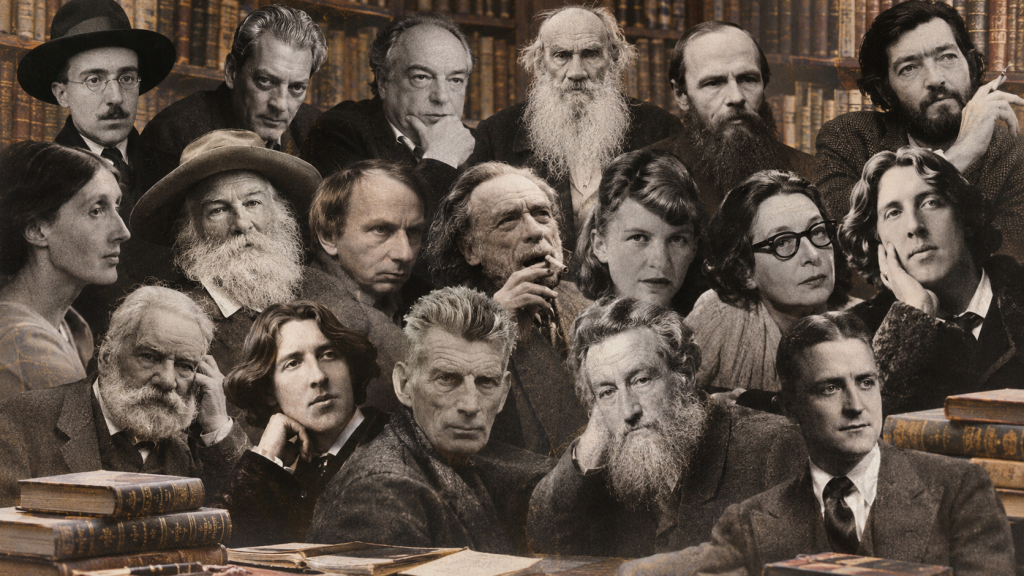
A library is a life project. Perhaps the most intimate and revealing of all the ventures we undertake. The books we keep, those we reread, the ones that accompany us from home to home and from one age to another compose a kind of involuntary autobiography, though I suspect our libraries reflect not so much what we are as what we would like to be. On their shelves we store our ambitions, our defeats, the loves we never had, the journeys we did not take, the lives we would have liked to live. A library is a strange mirror, that does not return exactly our face, but that of someone we have spent a lifetime trying to resemble.
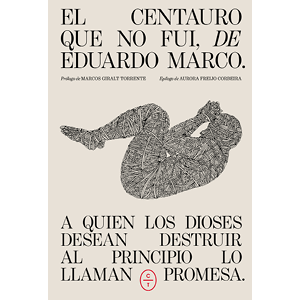
Eduardo Marco has done with his own something extraordinary. He has written a novel without composing a single original sentence. To construct his book The Centaur I Was Not, which has just been published by Círculo de Tiza in an edition as beautiful as it is peculiar—the literary artifact it contains—he has drawn on one hundred writers and 136 books. From Tolstoy to Pessoa, from Virginia Woolf to Dostoevsky, from Sylvia Plath to Vila-Matas, from Goethe to Bukowski. For years he has selected, cut, assembled and arranged other people’s words until they collectively tell a new story. His. Or perhaps ours.
However, we are not dealing with an anthology of memorable quotes nor with one of those clever exercises in experimental literature, and the truly disconcerting thing is that it works. That all those sentences about love, fear, desire, loneliness, failure, or death, snipped from their original books and rearranged, suddenly sound as if they had just been written. As if a hundred dead and living writers had been waiting for centuries for someone to seat them at the same table to hold a conversation.
Just opening the book to any one of its pages makes clear the scope of the prodigy. There are hardly any visible seams. Literature slides from one consciousness to another, from one century to another, from one life to another, with the natural ease with which our own thoughts flow. Marco has managed to make a hundred writers seem to recall the same existence.
The Centaur I Was Not also poses a fascinating question about artificial intelligence. A machine could collect thousands of fragments, classify them by theme, and recombine them with impeccable efficiency. But what interests me about this experiment is that it belongs to another category of intelligence: existential intelligence. The one acquired by living, reading, losing, desiring. The one that recognizes in a sentence written two hundred years ago a wound of one’s own. The one that knows that certain words, read at twenty, mean something very different when we meet them again at fifty.
The method has, moreover, venerable precedents. The ancients composed centos from the verses of other poets; Ausonius even built one with Virgil. Borges imagined Pierre Menard writing anew, word for word, the Don Quixote, and demonstrated that an identical text can become another work when the author, the era, and the gaze change. Marco seems to have taken the reverse path: a hundred different authors, a hundred sensitivities, a hundred ways of looking at the world, gathered into a single consciousness. The novelty lies not in the words, but in the life that arranges them.
The title, The Centaur I Was Not, contains a final and beautiful paradox. The centaur is a creature of two natures, an impossible being composed of two halves. This book also seems to have been born of a double condition: writing and reading, one’s own memory and others’ memory, invention and recognition. Perhaps all readers are, at heart, centaurs we never become: creatures made from the lives we have lived and from those other lives that books allowed us to imagine.
And thus, with this strange literary machine, Eduardo Marco comes to certify, like a notary of the imagination, that idea we tend to attribute to Joseph Conrad: half of a book is written by the author; the other half, by the reader. Only Marco has carried that idea to its ultimate consequences. He has turned the reader into a writer and a hundred writers into a single voice. And he has shown that when a lifetime of reading finally finds its order, even other people’s words can say something that no one had said before.
—————————————
Author: Eduardo Marco. Title: The Centaur I Was Not. Publisher: Círculo de Tiza. Sales: Todostuslibros.