

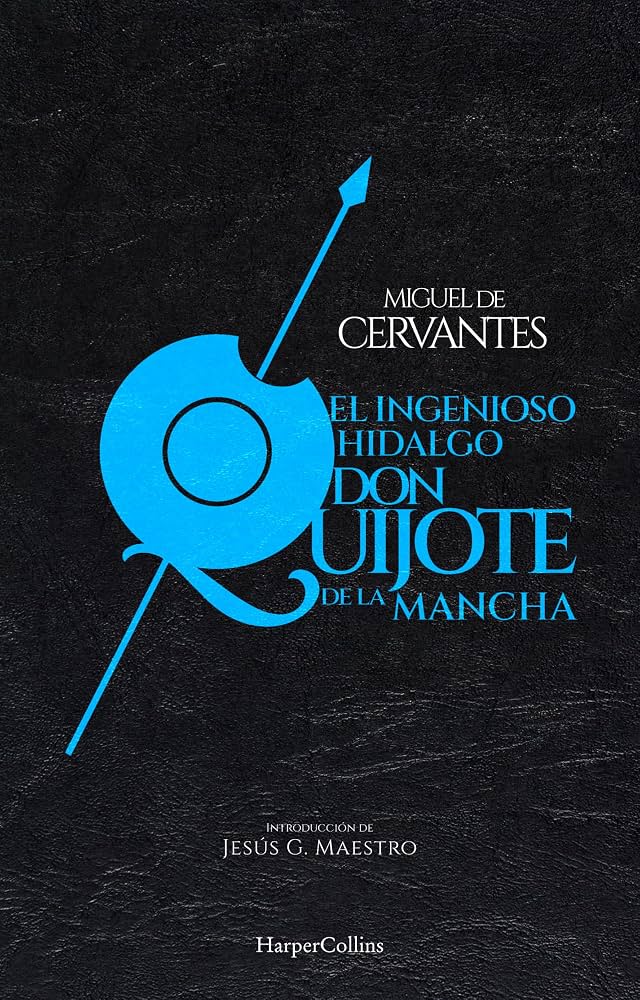
Harper Collins publishes a unique and luxurious edition of The Ingenious Gentleman Don Quixote of La Mancha, the crown jewel of Miguel de Cervantes and one of the fundamental pillars of world literature. This volume recovers the celebrated edition by Francisco Rodríguez Marín, one of the most rigorous and recognized in the Cervantine tradition, presented here in a carefully produced volume intended both for readers approaching the novel for the first time and for those wishing to rediscover it in all its richness.
This work includes an unpublished introduction by Jesús G. Maestro, a university professor of Theory of Literature and Comparative Literature and one of the most influential voices in contemporary Cervantine studies. Maestro writes next about the phenomenon of the «Generación cervantina».
*****
When do readers tire of the “new book releases”? Do classics return because contemporary fiction fails to satisfy a portion of the audience? If we examine the latest data from the book market, we observe an original trend since 2022: the backlist gains ground against new titles. And the Quijote, more than four centuries after its publication, occupies again a leading place. Why?
Literature possesses a virtue that the publishing industry does not always know how to exploit, because it does not see it easily. Classic books do not age at the same pace as their readers nor in the same way as their academic interpreters. While publishers multiply their new releases and concentrate much of their advertising on the latest launches, market data reveal that interest in classic books is rising. We have witnessed it with the three most important works of universal literature: the Iliad by Homer, the Divine Comedy by Dante, and Cervantes’ Don Quixote. The so-called “backlist” books, far from disappearing under the avalanche of new titles, retain a decisive commercial presence.
It is crucial to note that universities and educational institutions have turned their backs in recent years on literature, whose teaching has been replaced by a mix of gimmicks and fashionable ideologies. Yet the market and readers remain attentive to Homer, Petrarch, Dante, Lazarillo de Tormes, Cervantes, Calderón de la Barca, Galdós and his world or the passions of La Regenta, which cinema returns to again and again, i.e., the classic characters of our literary history, even as universities no longer discuss them and many millennial teachers have replaced them in classrooms with ideological prejudices in a curriculum that generationally has never challenged itself.
Why does this happen? The usual explanations are economic and technological. Online sales extend the commercial life of books, digital platforms facilitate locating ancient titles, print-on-demand allows catalogs to be preserved without large warehouses, and rising costs compel publishers to monetize their publications for longer. These are pertinent reasons, but perhaps insufficient, because there is something more… It is argued that it is easier to keep a book on sale, but there is no explanation for why a reader decides to buy a classic. And what is surprising is that the reader prefers reading the Quixote before other authors of our century—no one will be named—despite the fact that universities and secondary schools no longer talk about literature to their young students and adolescents. Nevertheless, the youngsters reach the Quixote.
Hence two hypotheses that go beyond commercial and educational literature, i.e., beyond the market and the schools, institutes, and universities: YouTube and social networks. Why? Because of what I will say next. Pay close attention to this.
And what if part of the public begins to distrust new editorial releases? And what if an ever-growing portion of teenagers begins to doubt their teachers? And if the multiplication of titles does not correspond to a proportional multiplication of works capable of generating lasting interest? What if younger readers find in the classics a captivating complexity, an alluring intelligence, and a capacity to interpret reality that they do not always recognize in contemporary fiction? And what if YouTube and social networks have filled with figures who awaken, beyond the market and better than their own teachers, an unprecedented interest in literature and the classics?
The Cervantes case is particularly eloquent. At the 2026 Forum Edita, estimates suggested that the Quixote had sold more than two million copies in the last twenty-five years. These are accumulated and approximate figures, spread across multiple editions, but enough to remind us of something weekly bestseller lists do not always reflect: classics can sustain extraordinary demand without depending on a specific advertising campaign, which, when properly incentivized, can yield extraordinary results. Its sales are spread among numerous publishers, translations, formats, and series, so its commercial presence is less spectacular, yet far more persistent.
This revival of Cervantes allows linking interest in the classics with a particularly meaningful interpretation of contemporary youth. I myself have coined and explained the concept of the “Cervantine Generation” to refer to young people who, far from constituting a supposed “crystal generation,” face a world characterized by disillusionment, disappointment, and disenchantment—the three dises that define, from this perspective, their historical experience. The term does not simply designate those who read the Quixote, but a generation that recognizes, in its own circumstances, conflicts similar to those Cervantes turned into literary material. The distance between promises and deeds, between dominant fictions and actual reality, is one of the meeting points between the experience of these young people and Cervantes’s literature. Cervantes saw all utopias of the Renaissance crumble before him. Today’s young people, born in the twenty-first century—the so-called “Cervantine Generation”—see all the ideals of the Enlightenment and Romanticism crumble, which are essentially three: the failure of democracy, the destruction of the State, and the dehumanization of human life, paradoxically, with the mechanization of everything around us. The twenty-first century is a dehumanized and war-torn world, in which natural intelligence is kept in check by the digitalization and mechanization of human life. And the omnipresence of war. Classical literature is a weapon of survival against the inhuman that has become our current world.
Are we, then, facing a new form of youthful approach to the classics? Yes, unequivocally. It is possible that many readers discover in Cervantes a form of knowledge that they do not necessarily find in the market’s latest offerings. Young readers who access his works through books, videos, conversations, open courses, and digital content; who do not consider contemporary technology incompatible with reading a work from the Golden Age; and who can recognize in the Quixote issues of fiction, politics, liberty, interpretation, and reality as relevant as those in any debate of our time. From this perspective, the Cervantine Generation is not defined by a literary fashion, but by historical conditions and convictions that may make Cervantes’s and the Quixote’s present particularly intelligible. For them we have prepared this edition and our critical and up-to-date introduction.
The possible revival of the classics also raises a question for the publishing industry: to what extent does an abundance of new releases mask a shortage of truly valuable works? Publishing more does not necessarily mean publishing better. When there is no good new editorial release, advertising becomes a disappointing message for the reader. Getting a book to hold the top spots on a sales chart for a few weeks does not prove it will retain readers for decades. Immediate profitability and literary longevity respond to different criteria, though they may sometimes align.
Would it be premature to claim that young people predominantly prefer Cervantes over contemporary novelists? No. I have reasons to think and to demonstrate that this is so. General data from GfK suggests as much, and recent fiction, while achieving significant commercial successes, cannot compete with Cervantes. To confirm such a shift one would need to know the specific evolution of classical sales, the age of buyers, and their reading habits. But these facts are in constant flux, and the absence of stable verification does not prevent forming a reasonable hypothesis, nor does it stop recognizing the cultural importance of new editions and of the readers who approach them.
Perhaps the most interesting phenomenon is not that Cervantes returns, because he never left, but that certain readers discover they do not need to wait for the next editorial novelty to find literature capable of critically explaining their world. And more importantly: that they do not need a tutor to read Don Quixote. This direct access of the youngest to literature occurs for the first time in the most recent history, and is directly linked to the failure of educational institutions, mainly the university, which, in the realm of the humanities, has abandoned the classics.
And more importantly: young people do not want a Quijote translated into contemporary Spanish, because they regard such a rendition not as a translation but as an adulteration. What for cynics was a commercial gimmick, for today’s youths is a scam. The youngsters want to read Cervantes’s original Quijote. They do not want Plato’s cave shadows; they want freedom. They do not want the original book to be denied to them. If they seek anything in Quijote, it is to separate truth from deceit. They want the oasis, not the mirage. They know the mirage is a designed lie, and that you cannot live in lies. They want to live in reality, not in a third semantic world. This is the Cervantine Generation, and its survival manual is Cervantes’s Quijote. The original, not an adaptation made for them by the jailers of Plato’s cave.
—————————————
Author: Miguel de Cervantes. Title: The Ingenious Gentleman Don Quixote of La Mancha. Introduction: Jesús G. Maestro. Publisher: Harper Collins. Distributor: Todostuslibros.