
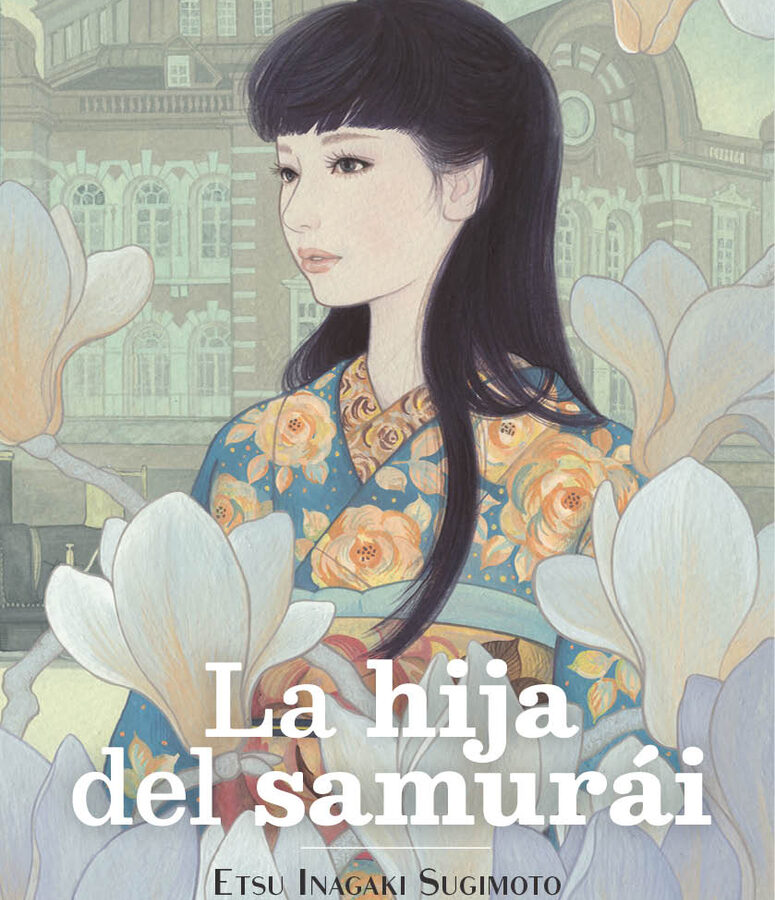
This classic of feminist literature is an autobiography that reminds us there was a time when the daughters of samurai learned to walk on the tatami without making a sound and calmly accepted the destiny others chose for them.
At Zenda we present the opening pages of The Daughter of the Samurai (Satori), by Etsu Inagaki Sugimoto.
***
I. The Winters in Echigo
Foreigners often call Japan the land of the sun and the cherry blossoms. This is because, in general, tourists only visit the eastern and southern areas of the country, where the climate remains mild all year round. In the northwest coast, winters are long, and snow often blankets the ground from December through March or April.
In Echigo Province, where my home stood, winter usually began with a massive snowfall that fell furiously and persistently until only the thick round posts of the thatched-roof eaves remained visible. Then groups of coolies with mats slung over their shoulders and large interwoven straw hats resembling umbrellas came to clear tunnels from one side of the street to the other with broad wooden shovels. The snow was never removed from the middle of the street all winter. It was piled into a long heap that rose prominently above the rooftops of the houses. The coolies carved steps into this mound, hauling snow there at intervals throughout the season, and the children would climb and scamper along its crest. We played many games there; sometimes imagining ourselves as knights rescuing a village trapped by snow or as ruthless outlaws sacking it during an assault.
But, for us, an even more exciting moment was the period just before the arrival of the snow, when the city prepared for winter. This always took several weeks, and each day, as we went to and from school, we paused to watch the coolies, dressed in their winter straw garb, wrapping the statues and small shrines along the streets with care. The stone lanterns, as well as all the trees and shrubs in our gardens, were wrapped in straw. Even the outer walls of the temples were protected with layers of mats tied with bamboo strips or with enormous nets made from straw cords. The streets took on a new look each day, and by the time they had covered the great carved lions on the temple steps, we had become a city of grotesque straw shops of every shape and size, waiting for the snow that would bury us for three or four months.
The majority of large houses boasted thatched roofs with wide overhangs, while the street stalls had roofs lined with tiles reinforced with stones to prevent avalanches when the snow began to melt in spring. Above every sidewalk stretched a permanent roof, and during winter these were enclosed by vertical plank walls, with occasional panels of oiled paper converting them into long rooms; through which we could traverse the entire city, shielded from the fiercest weather, wind, and snow. The lighting in those rooms was dim, though not dark, since light filtered fairly well through the snow. Even in the street corners, which we crossed through snow tunnels, we possessed enough light to read characters in reasonably large sizes. On numerous occasions, when I walked home from school, I read my lessons in the tunnel, pretending to be one of the ancient sages studying by the light of the snow.
Echigo, meaning “behind the mountains,” was so isolated from the rest of Japan due to the long KesA range that, in those primitive feudal days, the Government treated it merely as a chilly border outpost, suitable for exiling offenders with power or influence too formidable to be treated as mere criminals. The reformists fell into that category. At the time, Japan tolerated reforms poorly, whether in politics or religion, and an especially progressive intellectual at court or an open-minded monk were labeled equally detestable and sent to some desolate corner where their ambitions would be crushed permanently. The majority of political offenders sent to Echigo either filled the graves of the small cemetery beyond the area of executions or vanished into some humble house among the peasants. Our literature portrays a multitude of pathetic stories where a young nobleman, disguised as a pilgrim, wanders through Echigo’s villages in search of his lost father.
Religious reformists fared better because they generally spent their lives quietly and harmlessly among the people. Some founders of new Buddhist sects who were exiled for life were men endowed with considerable prowess, and their beliefs spread so widely that Echigo became known throughout Japan as the stronghold of reformist Buddhism. From my earliest childhood I was familiar with tales of bonzos and grew accustomed to seeing Buddhist stone statues or carvings up on the mountainsides in upright poses—the work of the tireless hands of those ancient monks.
My home was in the old castle town of Nagaoka. Our family unit consisted of my father and mother, my venerable grandmother, my brother, my sister, and myself. Then there was Jiya, my father’s chief servant, and my nurse Ishi, in addition to Kin and Toshi. Sometimes other former servants would come and go. I had sisters married off, all in distant homes, except the eldest, who lived a half-day’s journey away by jinrikisha from Nagaoka; she came to visit occasionally, and from time to time I joined her to go to her home and spend several days at her large farm with a thatched roof, which, in the past, had been the fortress of the three mountains. Samurai families often wed people from the peasant class, the next tier after the military and widely respected, since “he who owns rice fields sustains the life of the nation.”
[…]
—————————————
Author: Etsu Inagaki Sugimoto. Title: The Daughter of the Samurai. Translation: Barbara Pesquer. Publisher: Satori. Retail: Todos tus libros.