
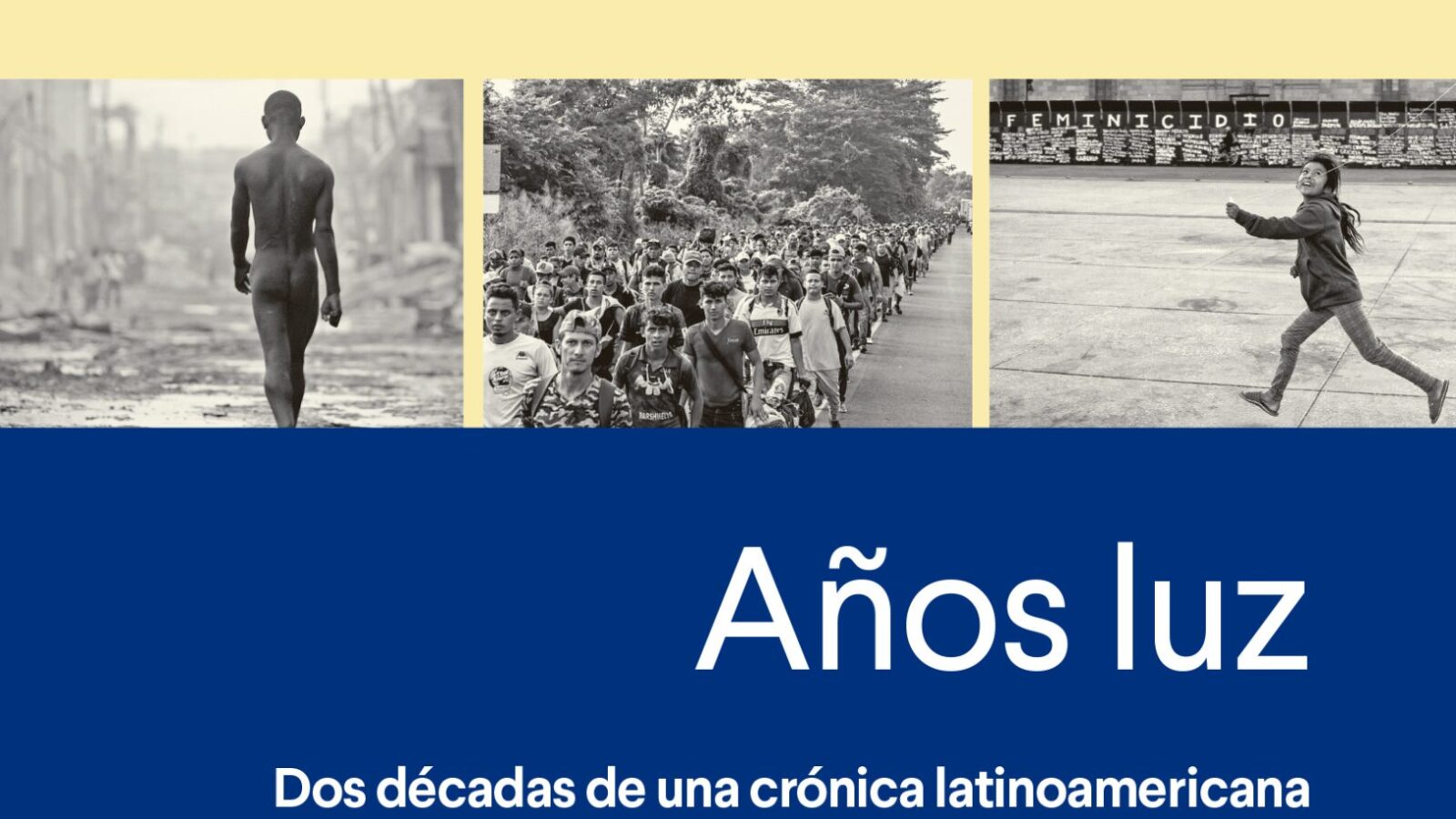
The winning book of the seventh Anagrama Chronicle Prize / Giangiacomo Feltrinelli Foundation, Lightyears (Anagrama, 2026), by journalist Jacobo García, is a manifesto of principles. The work suggests that the traumas of Latin America lie at a celestial remove from Europe’s comfortable welfare society. The author writes from a Spain where petty problems — which bore him and made him yawn — often swell into loud media outcries. García looks back to condense two decades of correspondence. His gaze is humane, profound, honest, and surprisingly objective, straddling reportage and the personal essay with chapters arranged into six sections.
Jacobo García demonstrates the heart of a Latin American chronicler, and his book approaches the works of
Juan Villoro, Martín Caparrós, Leila Guerriero, or Alberto Salcedo Ramos,
, in which, as they dissect reality — bravely delving into the sources of conflicts — they also engage in reflections on journalism. The work breathes with the spirit of Ryszard Kapuściński and recalls Michael Herr’s War Dispatches, understanding that on the continent wars wear masks and that many are nonconventional or never declared.
In the first section, titled “Everything Began on a Dance Floor,” the author transports us to 2006, specifically to Uruapan, Mexico, when the appearance of five human heads on the floor of the Sol y Sombra club inaugurated the era of terror of the Michoacán’s Familia. By presenting a deft profile of Ciudad Juárez through parallels with the atmosphere of Apocalypse Now, García raises one of the book’s most forceful premises: the comparison of fear. The author confesses that, after passing through Ukraine or Afghanistan, he discovered he would rather cover ten open wars than be a journalist in Tamaulipas. In Ukraine, as a correspondent in Kyiv a few weeks after the start of Putin’s war, he says that the rules of the conflict allow him to sleep; there is certainty within uncertainty, while in Mexico’s land of poverty and impunity the danger is an invisible specter. Leaving his Ukraine post brought sadness; leaving Mexico, a nearly guilty relief. The opening line of the book is a stroke of genius: “This is a book about Latin America that begins in Ukraine.”
García possesses the virtue of dodging exotism or condescension; temptations of the surrealism of Latin America. His prose is clean, intimate, and devoid of the ideological venom that tends to distort trench journalism and, to help the reader grasp the issue at hand, he quotes fragments from chronicles published in outlets such as El Mundo, El País, or Associated Press. For him, humility and understanding of local codes are worth more than the most coveted interview: “In Haiti what looks like an ambush is a friendly gathering of neighbors with whom you end up getting drunk.” The essential observational skill is demonstrated by the list of weapons carried by the “Frankenstein caravan” of Michoacán’s self-defense leader, Teto.
More than dangerous situations, the chronicler asserts that “half of my current wrinkles” come from years spent covering the Guadalajara International Book Fair “body and soul.” Honesty leads him to demystify the image of the infallible reporter, humorously recalling when he became the epicenter of the powers’ ire at the Guadalajara Book Fair of 2011. That awkward question to Enrique Peña Nieto about the three books that shaped his life exposed the candidate — who hesitated, confused Carlos Fuentes with Enrique Krauze, and could only recall the Bible — and cost the journalist the tapping of his phone and the siege of absolute power in the form of a hollow leadership.
The book injects political density in the section “A Goal for a Coup d’État,” where García analyzes the phenomenon of caudillismo: “Latin American politics is a powerful grinder in which only the most refined butchers survive.” His critique does not bow to ideological banners. While he recognizes the magnetic fascination of figures such as Hugo Chávez, Álvaro Uribe, or Nayib Bukele, he places them as faces of the same coin. In portraying the decay of Venezuela — a country whose tearing hurts him personally — García does not pull his punches: he denounces the xenophobia of Chávez’s era, which expropriated European immigrants, and he reckons with Spanish diplomacy by celebrating the conviction of the former ambassador in Caracas, Raúl Morodo, for tax fraud linked to PDVSA. That clinical gaze extends to El Salvador’s present. The profile of Bukele and his perpetual authoritarian selfie serves as a template for understanding the region’s new rising leaders: radical entrepreneurs who turn the State into a personal-brand enterprise.
Lightyears also pulses alongside great tragedies. In the chronicle “Haiti, the Republic of NGOs,” it shows how corruption led to barely one percent of international funds from the 2010 earthquake reaching local hands. One of the starkest passages describes the image of bloated and burned corpses in the streets. The island territory swallows him, and, on the edge of delirium, months later his wife arrives to save him. Delving into Honduras’ Mosquitia in the chronicle “The Invalids of the Lobster,” with cruel and poetic realism, he recounts how thousands of Indigenous people lie in wheelchairs with a damaged nervous system from nitrogen, victims of submarine fishing controlled by multinationals. At a rainy seaside sunset he concludes: “In a land of the poor, washing the disabled is a job that only a downpour wants to do.”
Despite the brutal panorama, the text breathes thanks to humor (“my return to the Madrid newsroom felt like moving from a carnival to a noon Mass”) and to contrast. In the face of misfortune, García opposes networks of civil solidarity, a community fabric that Europe lacks. He exemplifies this when recalling Valencia’s flood: while Spain warned that the country resembled Latin America, García clarifies that, had it truly been so, the communal response would have been immediate, for the American continent “has a doctorate in natural disasters.” The solidarity of people can be witnessed on his street in Mexico, among popular figures who collect funds to bury a pauper. Or through Raúl, a juice vendor who helps him to craft a piece about Björk from his stand in front of the hotel where the artist stayed. Or through the solidarity of Las Patronas in Veracruz: women who feed migrants clinging to the roofs of the train known as La Bestia.
In the final and more concise section —which points in several directions— one senses the book’s ending. Thus, García presents profiles of mythical figures such as the singer Chavela Vargas or the indigenous shaman María Sabina as vehicles to reflect on Mexican culture, revisiting unreleased reporting stories, mentioning Latin American authors he discovered over the years, and speaking about the backstage of the journalistic trade (including a humorous anecdote about how he was shut out by Shakira’s circle after asking her about Hugo Chávez).
Lightyears is the testimony of a person who has lost the ability to detect first-world pains. Jacobo García has written a work of significance for understanding Latin America from a European vantage point, deftly avoiding cliché and picturesque stereotypes. The author manages to convey that Latin American realities navigate between horror and the brightest kindness. A reading that unsettles, moves, and pulls off the blindfolds of prejudice, questioning with lucidity and personal experiences the frivolity of the dramas in affluent societies.
—————————————
Author: Jacobo García. Title: Lightyears. Publisher: Anagrama. Available at: Todos tus libros.