
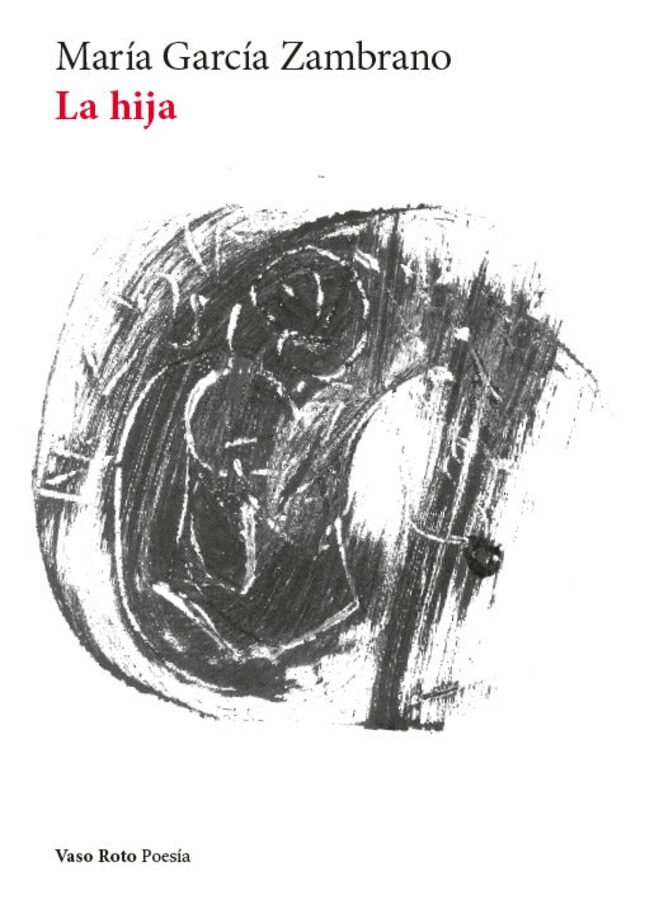
The sorrow and distress of Demeter after the abduction of her daughter Persephone returned the earth to sterility, upending the order of the world and driving humanity toward disappearance. Only Zeus’s intervention could subvert the chaos and famine. When Persephone returns from the subterranean mansion of Hades to be by her mother’s side, joy returns to Demeter, who restores fertility to the fields in spring and summer. Unlike the Greek goddess, for the poet María García Zambrano the sadness and impotence born from the illness of her daughter have given rise to a trilogy, The Daughter, This Rage and Her Body Speaks, a canto of mirla, whose first work is now rescued by Vaso roto after being published in 2015 by El sastre de Apollinaire.
Despite starting from personal experience, the work stands out from its very title,
The Daughter, where the possessive and indefiniteness have been omitted and the singular concretion of this particular ‘daughter’ is chosen, an intentionality in the writing that shifts the autobiographical fact toward a collective dimension, for this reason, while the opening poem asserts with certainty the daughter’s own existence and essence, it will gradually drift into a ‘flock’ of mothers:
“I am the sweet litany of the children who died in this hospital.
The one who quietly dries their tears.
The one who prays for every neonate.
(…)
I am the mother assisted by the mother
and we sign an armistice with the scalpels.
(My body fights against the pathology).
I am the scribe who records the heartbeat.”
And this idea is reinforced in ‘Prelude’ where the mother moves away from the enunciation, observing herself alongside other mothers who share the hospital, the anguish and the uncertainty. The personal pain opens to shared pain thanks to that distancing, reflected in the image of the armor: “The mother clothes herself in armor. / She walks upright with her scar.” In this way, a female solidarity of maternities underpins the text and extends toward the mothers who came before her: “The woman leaves home and dresses / all the women who preceded her: / mothers who breastfed,” building an identity through other mothers, as if a umbilical cord transmitted the learning of the lineage:
“All the mothers gathered around a body
that redeems
with its scant centimeters
weaving this sadness together
the despair of not seeing THE DAUGHTER
only a body that overflows
and floods the eyes
the mouth
the heart.”
These verses give way to ‘The Writing’, a poem where poetry rises as a refuge against pain, a space of resistance to pour out and confront fear, hope and rage: “(obedient words for my thirst and its voices) / the verbs abandon their organic firmness / only signs marking the limit / this pain / the enclosure that guards my animal of madness.” While the meta-linguistic tension reaches in Her Body Speaks a depth and radiance, for there it becomes the book’s backbone — the impossibility of spoken language and the encounter with another way of saying — in The Daughter there is not a little of that tension, though here the language, still tempered by experience, yields to the impossibility of freeing suffering in words: “I seek a language that incarnates / frees this pain from its cage,” and the belief in its possibilities remains intact, thus ‘The Play of Others’ writes:
“The woman leaves home and drags
the entire weaving
of useless words that suffocate her
and a thousand bomb words for her captivity.
The woman leaves home and knows
that this game is not exempt from pain.”
This book, written around the daughter’s illness, is organized in four parts that weave a narrative from unconditional love to possible loss and, finally, to the return to life, like Persephone. What happens is subordinated to the emotions and feelings it provokes. ‘Desire’, ‘Pain’, ‘Collateral Damage’ and ‘Love’ trace a journey from the mother-daughter bond to the hospital space, from there to the community of those who inhabit it and, again, to the encounter between both. In this way, the structure reproduces the process itself: to desire, to fear, to traverse pain, and to return to love, from the moment of a complicated birth with repercussions.
In ‘Desire’ there is a promise of unconditional love, even as death, like the sword of Damocles, hangs over the newborn’s life. The fear of death lingers until the end of the book, but that fear is sustained by that line of mothers who accompany her in the hospital, because loving her daughter makes the heart gamble against despair: “To stitch death, its skeleton, and break the joke of fate.” “Hide the threat / that the Grim Reaper is far from her pure body,” writes in the second part, ‘Pain’, the exact center of the book. In it stands out the appropriation of hospital language: disinfection, ward, machine, oxygen, gauze, serum… The hospital intrudes into the poem and they merge, thus creating an antiseptic and cold atmosphere that contrasts with the love and pain stitching the verses; in the poem ‘The Operating Room’ we read:
“A monitor records your heartbeat
paper that never ends and in itsdetachment
drags tears.”
A foreboding duel is woven between the words and the omen of death, which appears only to be banished:
“I rummage in the wardrobe of death
for a mourning that will cover my ribs.I dress in patches.
There is no fabric
that can shield
this corpse.”
Whoever has read her later books, This Rage and Her Body Speaks, will know that Mirla rises victorious with the wings of life in this book; yet death does not stop hovering over her. The white Mirla, Martina, is not yet named as such in The Daughter, however we already find the seed that will later fecundate the identification, in the poem ‘The Girl-Bird’: “If you were a mirla or hummingbird / and you flew.” The characteristic bestiary of this trilogy is scarcely sketched in a scorpion, a metaphor for illness, and in ravens, who keep vigil over death, or the she-wolf, the mother who defends and protects her offspring.
Fear begets pain. Uncertainty births anguish. Nothing halts the tremor, neither language nor faith shelter against the inexorable future, just as the incubator’s nest does not shield the daughter, while the home nest awaits empty. And loneliness grows when she cannot breastfeed in the lactation room:
“Exhausted. You stand absorbed
before the light
you bend your knees slowly
you join your hands
you interlock your fingers.”
The following six poems form ‘Collateral Damage’, focused on the hospital workers with whom she interacts daily: nurse, specialist, bureaucrat, cleaner… Their everyday dealings with illness and death seem, at times, to immunize them from others’ pain: “Only four square meters at her death / the slaughterhouse office / teaches you to mend in the shroud / lemon stitches over the wound” or “watch the wound of your wound / disinfect the fear / converse with death.” The mother’s wound bleeds; impotently, we see her march through the hospital corridors, begging life for the daughter until the non-death arrives in The Transit Room. In this regard, Julieta Valero writes in the epilogue to This Rage: “In The Daughter, the arrival of the girl, the outbreak of illness and the devastating ensemble of it integrate into life. In the words of the poet and scholar Mª Ángeles Pérez López, it was an ‘inquisitive inquiry into the aseptic and merciless truth that hospitals breathe’.”
And just as Persephone returns to Demeter, the daughter returns to her mother: “She says: it is time to reap.” The glow of joy, the gratitude for having saved her daughter from Hades’ arms and the immaculate love dissolve the illness, thus the ‘Love’, the final part and the epicenter where the radical power of love blossoms, an always-unbreakable thread that binds them forever. Returning with the daughter turns poison into medicine and pain into gratitude. Now, at last, it is possible to return home together: “This sofa is our barricade, a pile of gauze, you and me.” In the fullness of the encounter, of generations, the song subsides.
Finally, the ‘Coda’ of The Daughter, a poem that becomes a personal signature in later works, concentrates the essence of the book:
“I advance along the corridor that the dead traverse.
I seek the glow that happens to life.
-You are witness to my struggle-.
I return along the white corridor with the daughter intact.
Come what may, I have prevailed.”
The poet closes the last verse with self-reference, for, unfortunately, not all mothers walk these same corridors with the same fortune.
From a stylistic perspective, The Daughter takes fewer syntactic risks than the later volumes. There is an incipient play of enjambments and capitalizations, yet they do not approach the breakouts of This Rage or Her Body Speaks, which have, on occasion, consecrated the poet. The poems rest on sobriety and restraint, which contrast with the suffering that motivates them, grounded in very material images and a precise conceptual condensation. It avoids rhetorical excess in favor of a plain syntax, pauses and silences that reflect waiting, anxiety and vulnerability before the situation. It strips the poem of sentimentality and, instead, reveals humanity. The re-signification—or rather the amplification—of the meanings of everyday, hospital language drags the words and explores their sonic and semantic possibilities. Thus, an apparently simple verbal surface hides a notable metaphorical density: the poem does not explain the pain; it materializes it in bodies, objects, spaces and images that ultimately attain a universal dimension. This collection plants the seed for This Rage and Her Body Speaks, establishing a vital thread, a single story; yet the three maintain their individuality and autonomy.
The Daughter, This Rage and Her Body Speaks by María García Zambrano turn the extreme experience of suffering into poetic matter. The word germinates in writing in the face of the daughter’s illness and at the edge of death. Provided one accepts this pain as part of existence, the poet offers us joy and gratitude for life and the courage to keep loving beyond utopia and time, because, without a doubt, to love is the most revolutionary act in the face of death.
—————————————
Author: María García Zambrano. Title: The Daughter. Publisher: Vaso Roto. Available at: Todos tus libros.