
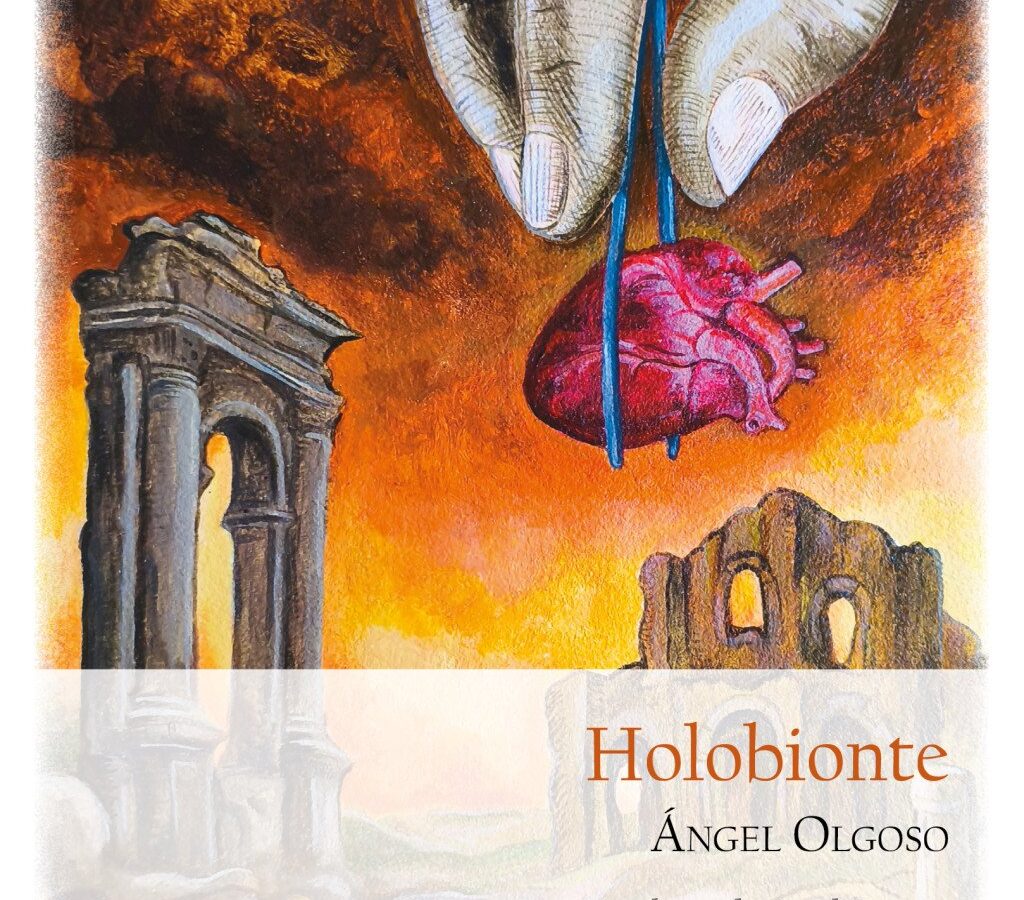
I select one of the modified titles from among the stories that Ángel Olgoso offers in this new volume, because his writing arrives with a tear in its fabric, and I say this for several reasons: the unique ability to shift register, both within the book and beyond it, to probe erotic love stories, and to move into the pure science fiction of his earlier works, as in Sideral (Eolas, 2024), for example; or to explore the events in this book concerning the neighbor, as well as how we see ourselves within this shifting society in which we are movable cogs of the great technological narratives crafted by large lobbies, where we are digital subjects.
That said, Olgoso’s short and not-so-short fiction stands at the level of the great Spanish narrators thanks to its meticulousness, its lexical care, and its unprecedented situations. Medardo Fraile, Aldecoa, Ferlosio—already a notable lineage—move through Olgoso’s pages, for he is the continuator of a style that has borne excellent fruit in Spanish literature. And I say this because he does not resemble any other Spanish writer of his generation, nor of later generations. Olgoso is one of the best-equipped all-terrain writers shaping contemporary short literature. It is a fact.
In Holobionte (Eolas, 2026) his obsessions cohere around the figure of the Other, that furious stranger we are ourselves.
In Holobionte (Eolas, 2026) his obsessions gather around the figure of the Other, that furious unknown we are ourselves, or the one we greet in the elevator about whom we have no idea who they are. Or the filial-paternal relationship, embodied here through Kafka and his father, who writes a letter to his son, reproaching everything Kafka had written to his father.
“Dear Franz: I have learned, through your mother, that you wrote me a long letter of reproach in which you recorded the loathing that my presence causes you …” Thus begins this story of a Kafka wounded by his father’s behavior, in which the parent turns the relationship around and makes it a letter of apology about his son.
On the other hand, Olgoso also introduces an extended tale, “The Lugrís Syndrome,” set in mythical Galicia, where one of the friends begins to feel an exaggerated fear of others in a city transformed by the arrival of outsiders, the tourist seeking the coveted Compostela. The mass influx turns this Galician into a depressive agoraphobe, because he none of all humanity in others, instead becoming a formless mass, a headless monster. And his city becomes a bottomless storefront, at a time when the two friends embodied secular values of unity with the land and with customs. If we extrapolate that situation to any other Spanish city, the problem of poverty-creating tourism is revealed, turning people into a crowd and places into decor.
“There, on Rua do Doiro, I then took his hand (as if to say, ‘I understand you now’) and Manuel Lugrís, still under the influence, squeezed it a little, without any strength, but grounding the contact in an offering of loyalty …”
But what greater awareness of the Other is there than feeling with the Other’s own consciousness, that other being who lives and loves with us? That is the moment, paraphrasing Rilke when he said that we are the guarantors of our partner’s solitude. No less, guardians of the silences of the person we love. Thus it presents itself: “My homeland walks with heels or with small condor-steps, it carries scarves of color, floral dangling earrings and plush headbands, it ties back its ungovernable hair with bands and pins, and it brightens its Reinette apple of a face.”
The customs of others when we live in community, that collective living and the deeply rooted way of understanding silence as we coexist—and which so many of us find bothersome. In “The Clothesline,” it is described as: “A concentric creak. A cry cut off at the peak. A stupefying litany. A compact anger. We, meanwhile, bend until our chins touch our feet, we moan impotently …”
As I have said, this stands as a prime example of narrative mastery, of reader pleasure, to delight in how Olgoso inhabits so many registers and how he manipulates them to offer us these collections of urgency. Read it to remember the Other, so that the Other does not disappear, so that we do not disappear into that formless mass of impoverished globalization that was sold to us as wealth.
Read it; there are 64 reasons to do so.
—————
Author: Ángel Olgoso. Title: Holobionte. Publisher: Eolas. Sale: Todostuslibros.