
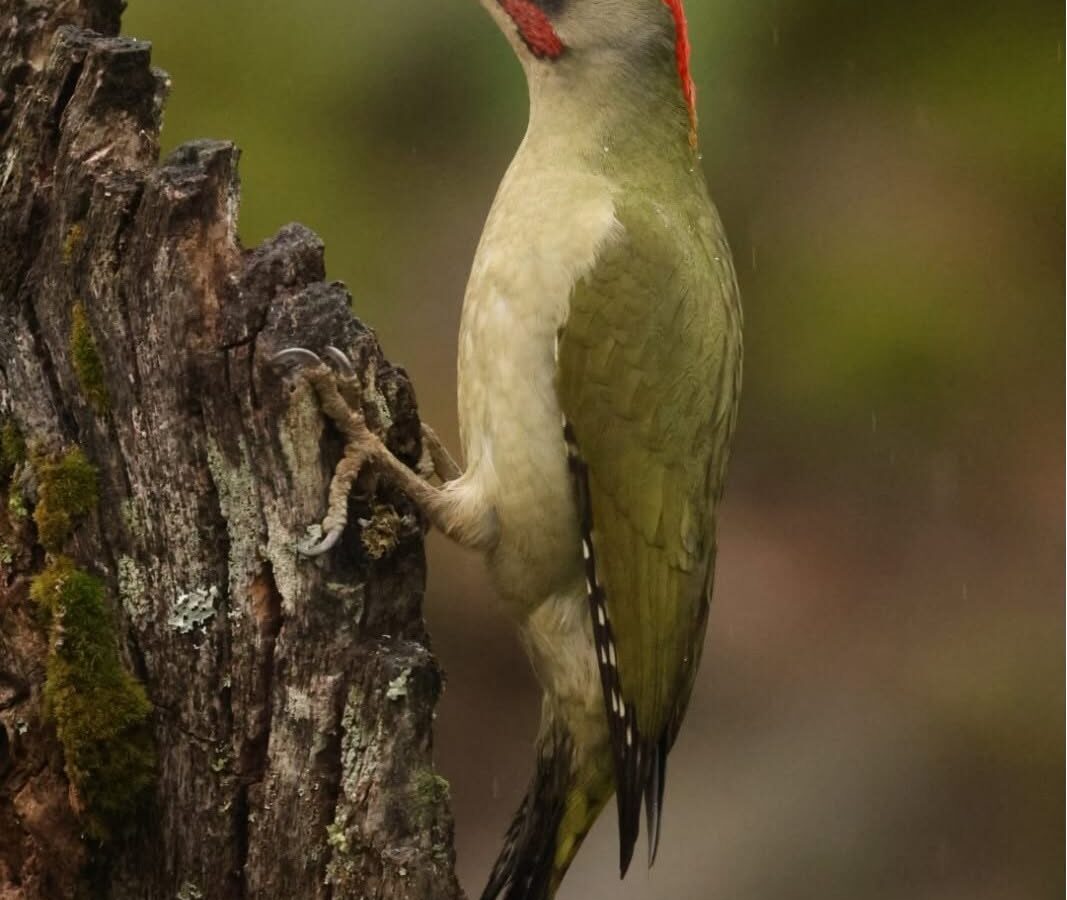
Woodpecker for your song. But also for your beak. From there comes your name, picus, derived into pito because in the countryside your song prevails. This is how you were named by the peasants as they walked among those towers of sound you raise into the air, which I imagine as liquid cypresses. They rise for an instant, unexpectedly, and then crumble.
This is your land. Iberia. You know it better than I. When I behold the olive groves and the elm woods, I feel this is my place and that the earth forgives my past vanities, my urban chatter, my municipal whispers. All of that I offer to silence and to the wind. But it is something you have done again and again long before Homo sapiens inhabited these places. You were an offering from the very beginning.
Before any of us arrived, you were already marking the trees with that sharp, transparent whinny you send into the sky as if you wished to fish in its interior a gust of mysterious presence: your very being. You leap from one tree to another. You probe an elm; then a thousand-year-old olive; finally an almond tree. What prey you hunt. What unsettles you.
You glean larvae and ants with your long tongue in the crevices of the trunks, in their holes, between their bark; and with your mighty bill you polish, bore, carve the wood as needed to shelter yourself or to trap your prey. You are a hammering carpenter, and your beak sounds deeper or higher depending on whether you tap the soft bark of the poplars or the Herculean mass of an olive. You take pleasure in the syncopated rhythm and in the variety of lows and highs that you coax from the trees.
Often you descend to the ground, continuing your search for earthworms and devastating ant nests with your beak. Then you seek the refreshment of a late fruit or a hawthorn berry. Yet still you are not satisfied. Something occupies you, something that neither insects nor trees can satisfy.
You always fly at mid-height, undulating; your wings—a gust of intense green—ride waves visible only to you, and your head crowned in red rises with resolve toward a sky you do not reach, for you rarely rise above the trees.
Ah, there it is: you are a banished king, and nostalgia oozes from the shards of your song. You are a being of above and below.
That is why you always perch on the trunk vertically, still drawn by the earth’s gravity. But you stretch your head upward and open your beak and unleash upward your whistle of longing, thinner and more crystalline than that of horses, yet just as impetuous.
You are asking and you are not made for answers, which fall around us, like arrows from an invisible archer. But another ant hill is already calling us.