
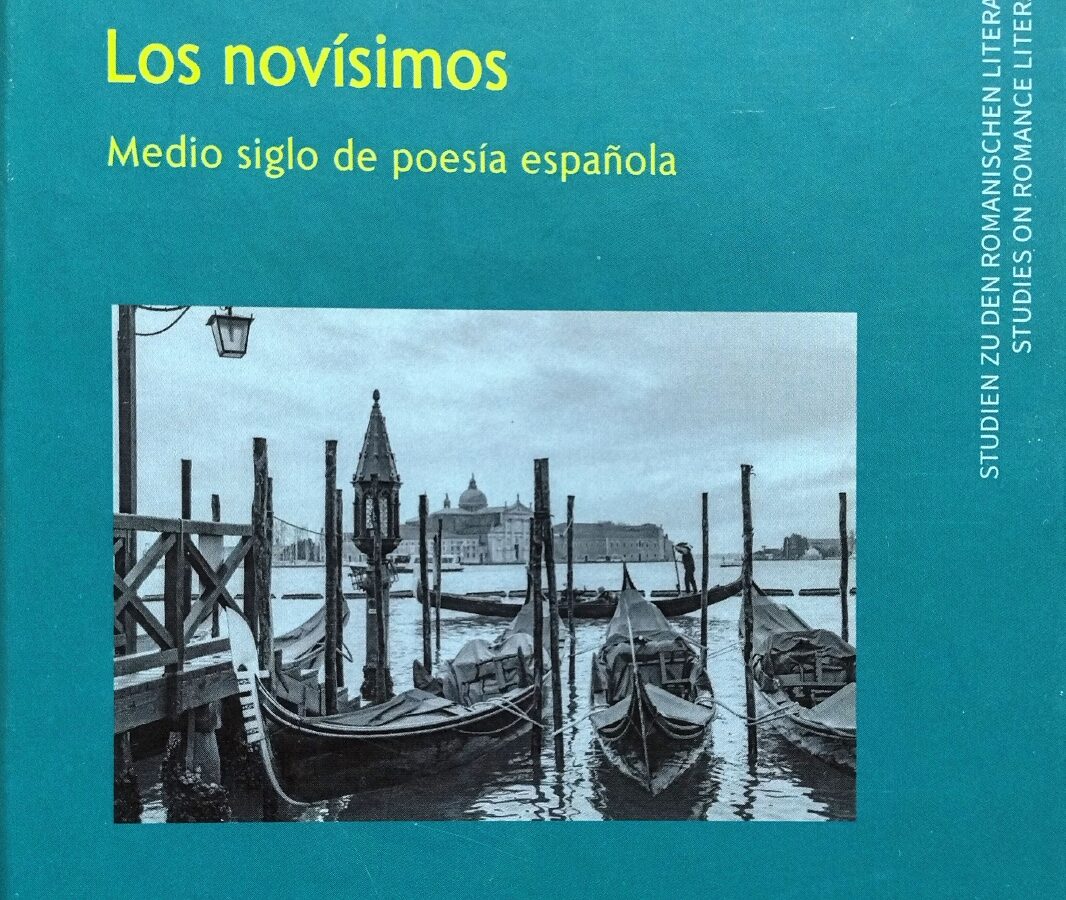
Sergio Santiago Romero, the compiler of this collective work on José María Castellet’s arduous anthology Nueve novísimos, rightly states that the work not only offered a canon but also helped to make “history of literature beyond its own boundaries as a book”. Indeed. It detected a literary mood of its era in poetry—and not only there, though its reflection tends to be anchored in lyric—and it became a historiographical milestone already established in the Peninsular letters of the past century. To those already established partitions—novecentismo, the generation of 27 and the Republic, mid‑century literature, the most common—there was added from that 1970 when the controversial “novísimos” appeared a new stage in academic manuals. It is the period I long ago dubbed the generation of ’68, a label that has already solidified in our literary periodization. Hence the astonishing number of writings, long and short, entire books and professorly articles, chronicles, impressions, witticisms and even some burlesque poem that has provoked.
Se diría coloquialmente que todo el pescado está ya vendido y que el asunto no da más de sí. Pero este
Los novísimos: Medio siglo de poesía española
muestra que quedan parcelas por esclarecer y análisis que contribuyan a su enmarcación histórica. Ello se debe a la perspectiva general que adopta Sergio Santiago en su compilación panorámica. El libro, surgido en un encuentro en Astorga conmemorativo del cincuentenario de la antología, aborda los sucesos de entonces, la historia menuda de la gestación y difusión de la antología, también el movimiento estético en que germinó y los efectos que tuvo en tiempos posteriores.
The examination, in terms of the historical panorama, is undertaken by the solid and expert names of Juan José Lanz and Araceli Iravedra. I would have added the wise and meticulous connoisseur of Castellet and his endeavors Laureano Bonet, but as is known, a conference has its limits. As for the specific output of the novísimos and their circle, it is addressed by a lineup of young scholars who indicate how alive the novísima venture remains among the concerns of the latest generations of philologists (not, in my view, among the creators).
The book opens with what, in the end, will arouse more curiosity than the minutiae of scholars. I am referring to the involvement of three protagonists, by active or passive means, in that once scandalous literary episode. At the forefront is Guillermo Carnero, who recounts his “personal history.” It is not the first time he refers to it, but here he provides valuable new details. In facsimile, Castellet’s letter from the summer of ’69—the date matters—in which he asked for poems is reproduced. Recalling from memory, Carnero remembers how his “recruitment as novísimo” by Castellet occurred, whom, he says with a frank, brazen candor not surprising in him, “saw him as the sectarian apostle of poetry that did not interest me, and I could not suspect the twist he had in mind.” The author of Dibujo de la muerte offers a valuable testimony that corroborates, if needed, all that there was of improvisation, haste and whim in the cultural maneuver, more than mere aesthetics, of the Catalan master.
Protagonist by proxy was Jaime Siles, not included in Castellet’s canon but very representative of the poetic concerns of the late sixties, to which he responds with informative breadth and measured explanations. His personal stance within that broad renewing current led him to formulate the apt label “generation of the language” to define it. It implied a return to expressive demand in the face of the (supposed) neglect of the Machadian Realists. It signified aligning with those who—also with the fickle Castellet, and with the converted Juan Goytisolo—had been saying that our literary language was a corpse. Siles details that artistic challenge with precision.
Pena produces the explanation of Antonio Colinas about his case, in his view that of a man harmed by not appearing on the novísima roster. It is not the first time he feels pursued. I vaguely recall his accusation against the poet who had stolen the Adonais prize from him, being he much superior. The beneficiary was one of the bad ones, of the Realists, and he, a person of a higher category, came to say. This view—of someone who thinks highly of himself, being only a character and nothing more than a complement to a moment of change and crisis—adds nothing to the historical panorama.
Two notes are worth adding about this miscellany on the novísimos. Since the anthologized were poets, lyric poetry has taken the lion’s share of the novísima phenomenon. It is forgotten that that spirit did not confine itself to verse and also affected prose. Several of Castellet’s favorites were pros writers: Azúa, Molina Foix, Martínez Sarrión, Ana María Moix… An entire section devoted to narrative would have deserved inclusion, but not everything can be gathered in a conference and, without a doubt, the compiler has given it a significant place with a study of Azúa’s novel Historia de un idiota contado por sí mismo.
Novel for those of us still operating in the analog era is a stylometry study by Guillermo Marco that compares Gimferrer’s and Carnero’s metrics using digital resources and allows him to conjecture a possible metrical pattern among the novísimos. For now, it shows that Gimferrer has a more isosyllabic work than Carnero. I confess I do not understand much of what he explains, though I accept it as valid, and I am sure that readers of this commentary—if any—will find it exotic and of little value. I have, however, found it timely to point it out simply to indicate the possibilities that new technologies open for literary studies.
Sergio Santiago has made a good contribution to the better understanding of the anthology and the novísima phenomenon with a volume that gathers varied and relevant analyses, within university orthodoxy. Although it is a work for very scholarly minds, as it has become fashionable to say now, perhaps it may also awaken the interest of the immense cultured minority concerned with this kind of not very lucrative endeavor.
—————————————
Author: Sergio Santiago Romero, Title: The novísimos: Half a Century of Spanish Poetry. Publisher: Peter Lang.