
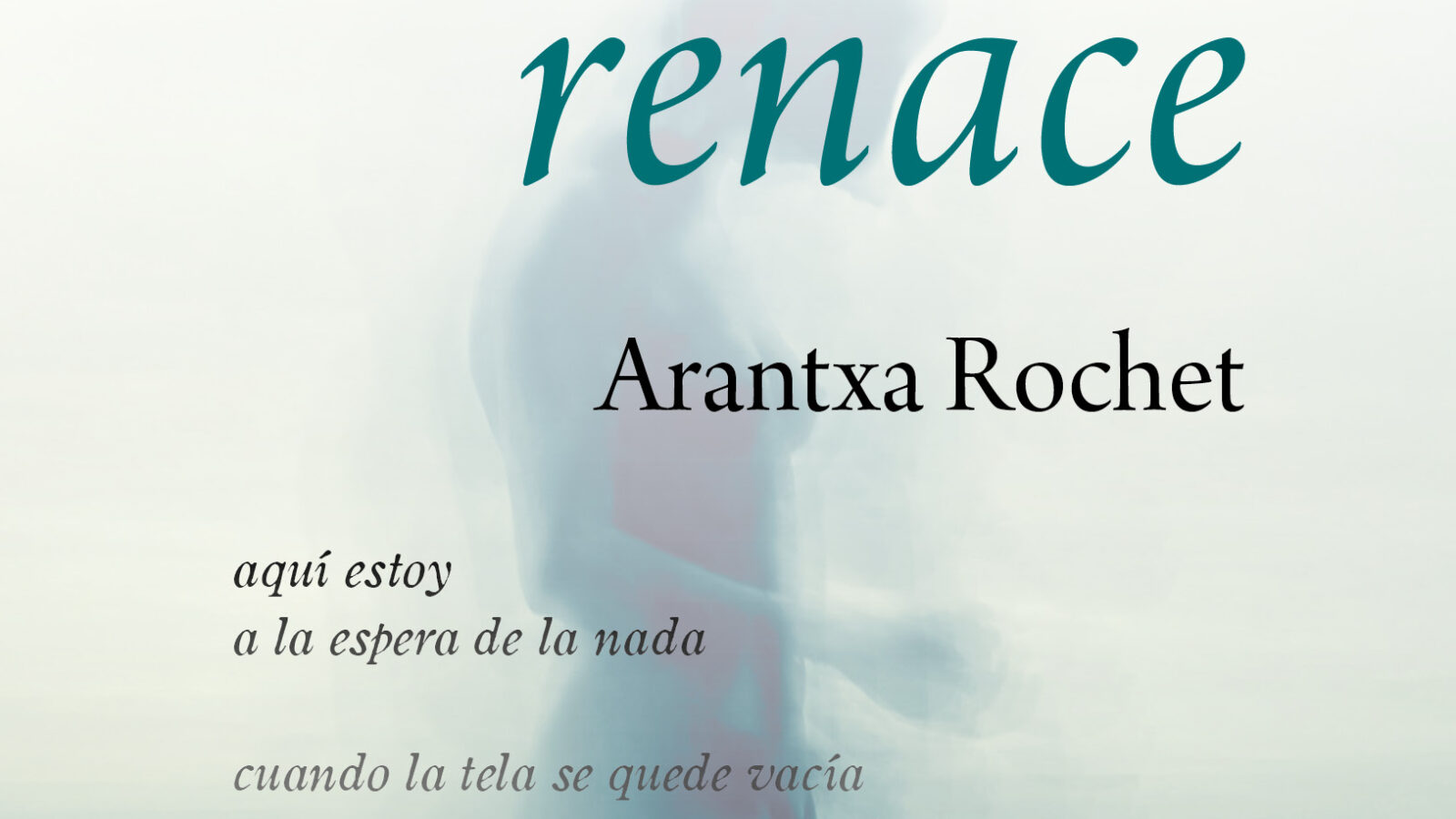
Arantxa Rochet surprises us with a poetry collection of profound emotional depth that appeals to language and nature as paths to navigate grief, and offers us, more than a lament or elegy, the possibility of finding in poetry a way of being in the world.
Aunque
Even If Nothing Is Reborn
constitutes her first published poetry collection, Arantxa Rochet has long been tied to poetry and Madrid’s cultural life. Selected in 2008 as an emerging author by the Red de Arte Joven de la Comunidad de Madrid, she has developed a literary career that includes the short story volumes
Jaulas de aire
(Torremozas, 2017) and
Carne de arena
(Eolas, 2024) as well as participation in various anthologies of short stories and poetry such as
Voces Nuevas
(Torremozas, 2024) among others. This experience is perceived in a mature voice, one that knows the subtleties of language and how to exploit its expressive possibilities, both in the rhythm and arrangement of verses and in the multiplicity of meanings and the metaphorical and symbolic capacity it unfolds.
Ralph Waldo Emerson writes in The Spirit of Nature: “The stars awaken a certain reverence, for though they are always present, they are inaccessible.” And there is something of that fascination with the incomprehensible in Even If Nothing Is Reborn, not only in its exploration of what escapes our understanding: time, death, and the possibility that a part of us endures when the body disappears, but also in the book’s own structure, cleverly organized around an emotional and symbolic journey based on astronomical cycles. From the “Equinox Toward Darkness” to the “Warm Perihelion,” passing through the “Perihelion of Cold,” the “Suspended Solstice,” and the “Equinox Toward Light,” the section titles sketch a celestial map that guides us through a deeply intimate territory. This allows the author to provide a frame of reference against the irreversibility of time and, at the same time, opens up the possibility of imagining other universes, where a single life could unfold in very different forms.
Arantxa’s interest in science fiction is evident in her previous writings, and this is something that will also materialize in her poetry, not only through references to that imaginary realm but through the existential and reflective background characteristic of the genre. One of the most striking questions and, in my view, a central element in this book is how, on occasions, the poem faces on the same page a different version of itself, as if words, like images, could bend in their reflection or exist in parallel “in the folds of spacetime” or in the “memory of another world / improbable / to be discovered.” This longing to find an alternative reality in which loss can dissolve, even if only for the duration of the poem, poses a series of questions for the reader: What would have happened if circumstances had been different? Could there exist a universe in which the father (to whom the work is dedicated) remained alive, in which the armchair was not empty and everyday gestures had not become memories? The writing tests these possibilities without confusing them with a solution.
Another major territory of exploration in the book is matter, for, as the voice of the poem rightly asserts, “one must touch to feel.” In this sense, we encounter different levels of presence/absence: recurring motifs such as the cold, decomposition, the worm, humus, and earth point to physical disappearance, while everyday objects—the armchair, shoes, clothing—preserve traces of a presence that can no longer inhabit. The question then is: how can one touch what no longer has a body? Absence becomes tangible, occupies rooms, and transforms familiar spaces into strange places. Memories, Arantxa writes, “explore / the corners of my house,” as if they too needed to find a place to stay.
The empty chair is one of the most powerful symbols of this absence: an object that remains there, intact, while everything it signified has changed. In front of it, the shoes and garments preserve the memory of the body, but also recall its disappearance. The poetic voice attempts to reconstruct what was lost from those remnants, as if it could gather the pieces of an identity that resists being reduced to nothing. Fear threads this process and takes the form of threads, knots, and skeins that the author tries to sew, embroider, or unravel. Thus, writing becomes a Penelopean labor: weaving to sustain absence, unwinding to begin again.
The garden, the leaves, and the seeds introduce another possibility: a transformation that does not necessarily equate to resurrection: “nothing will be reborn in a god nor a heaven / only in the leaves.” Matter re-enters the cycles of nature; the body decomposes, but its elements do not disappear from the world. “Nothing differentiates us from the earth.” This materialist intuition does not erase the mystery of death, but nuance the question: perhaps it is not about recovering intact what has been lost, but about learning to recognize its transformations, “that which became part of a whole / and gave life to others with what you were.”
The garden also evokes childhood, that lost paradise to which we return through nostalgia and memory. It is a place where loss and regeneration coexist, and toward which the poet’s search seems to head. In this sense, Arantxa’s writing finds a certain kinship with that of Alejandra Pizarnik or Louise Glück in The Wild Iris, where the dialogue between the human voice, nature, and a creative force turns the natural world into a stage for questions about life, death, and transcendence. In Even If Nothing Is Reborn, the father sometimes acquires something of that creator figure: someone who helped shape the writer and whose presence can no longer be found in an empty chair, but in the interpretation of the signs he left behind.
The reconstruction of memory thus becomes a way of reconstructing one’s own identity. In childhood memories, in shared stories, in Puccini’s music or in the books they have both read, the poetic voice again finds fragments of a life that time cannot return but cannot completely erase either. This weave includes references to Albert Camus, Dan Simmons, Ursula K. Le Guin, Stanislaw Lem, Mary Shelley, Carl Sagan, Aldous Huxley and the myths that have long served to think about time, fate, and the human condition. Physics and cosmology, for their part, provide a vocabulary with which to imagine other modes of existence and other relationships between matter, space, and time, broadening the horizon of what is imaginable.
Some verses function as authentic leitmotivs that give cohesion to the structure and that, upon reappearance, compel us to read them in another way and to discover new meanings, new paths in the search. Sequences such as “the ink is seed,” “the ink was seed,” and “the ink will be seed” accompany the movement of the poetry collection and modify our perception of writing, which shifts from a way of preserving what is lost (“no one can prevent me from seizing language in a clenched fist”) to becoming a possibility for the future (“and there the words sprout like shoots / and it is with them that I bring you back”).
But what then? What will happen when the poetic subject itself has crossed the threshold, “when I can only name you through a mouth of earth”? In Even If Nothing Is Reborn, Arantxa reminds us that “poetry is not made by meaning either”, that what matters is not to reach a definitive answer, but to sustain the very process of the search, continuing to name even when language proves insufficient.
—————————————
Author: Arantxa Rochet. Title: Even If Nothing Is Reborn. Publisher: Eolas. Sales: Todos tus libros.