
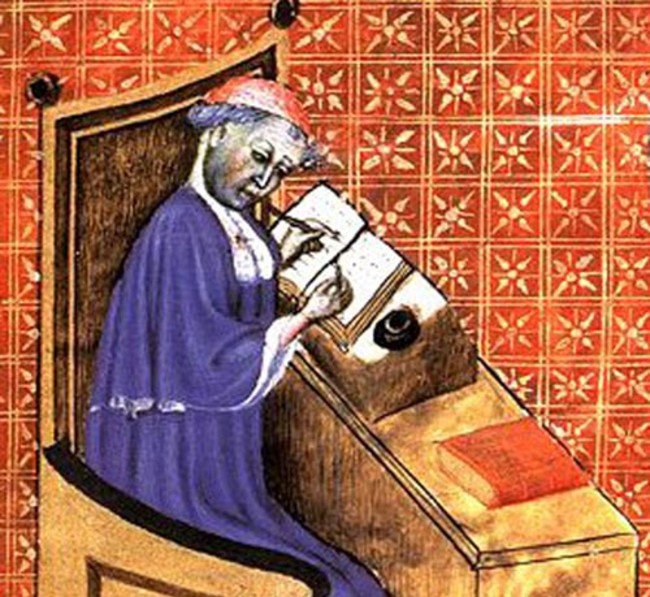
Raimundo of Toledo, or Raimundo of Sauvetat, although hailing from beyond the Pyrenees—appears to have been born in Gascony in the eleventh century—was a Cluniac monk, a linguist, and a translator who history remembers as a man of good will. Archbishop of Toledo (1126-1152) and grand chancellor of Castile, he played a decisive role in the cultural flourishing of Spain under Ferdinand III and his son, Alfonso X the Wise.
“As the sediment left by Muslim culture accumulated in Castile as the Reconquista advanced, with the capture of Toledo (1085) and the expulsion of Jews from Andalusia by the Almohads not long afterward, the Hebrews also sought asylum in the city of the Tagus. The archbishop quickly understood that Toledo brought together the three great cultures of Castile—the Christian, the Muslim, and the Jewish—and, displaying a goodwill rarely recorded in the annals of History, his excellency, reverend as he was, decided to initiate the Toledo School of Translators. Once this initiative took shape, it became one of the medieval world’s cultural hubs; the seat that most often housed royal power in Castile radiated its knowledge of philosophy, medicine, the natural sciences, and Oriental literature across Europe. Yet among all the knowledges of those days, dark and remote from the Middle Ages, stood out astronomy, a science perceived almost as sacred. Medieval astronomy, however, remained deeply linked to philosophical and religious beliefs rather than the kind of empirical study we associate with our twenty-first century approach.
Among the scholars of Toledo’s School, who worked there translating into Latin—and often also into vernacular languages—the Arabic and Jewish texts, in the Cathedral Chapter Library of Santa Maria, or in the numerous Arab and Hebrew libraries scattered throughout the city, there was a Jewish convert from Seville, not without notoriety, known as Juan Hispalense. Having gained renown for his translations of Arabic works on astronomy and mathematical astrology, eight hundred and forty years ago he sparked a panic across the known world, an announcement of the end of the world that gave rise to one of the earliest recorded outbreaks of collective hysteria.
The twenty-third of September 1186, according to The Toledo Letter (1184), attributed to the Sevillian, was likely the eighth and final day of the end of the world. Yet something went awry in its predictions, and the world would continue to turn, and turn again, to the present day. The prognostication rested on an exceptional planetary alignment. On September 23, 1186, the known planets—Saturn, Jupiter, Mars, Venus, and Mercury—would align in the sign of Libra, together with the Moon and the Sun. Since Libra is an air sign, the text foresaw devastating disasters wrought by the elements. Thus, from the preceding fifteenth of the month, there would be colossal, violent winds that would topple buildings, fortresses, and forests. Amid such catastrophe, earthquakes, epidemics, and the darkening of the sky would not be lacking. Floods and spectacular fires would set empires ablaze as wars and uprisings raged that August would never have imagined.
According to the Aristotelian-astrological physics of the era, the accumulation of influence from heavy planets—such as Saturn and Mars—would heat and agitate the Earth’s atmosphere on a global scale. “There shall be such disruption in the air that houses will fall, trees will be torn up by their roots, and dust will dim the daylight,” reads one of the translated fragments that has reached us in 2026.
Translated into Latin and into several vernacular languages, sent to princes and kings, even to Pope Urban III, the social and political impact of the Toledo Letter was unimaginable—a preeminent instance of apocalyptic panic, collective and historic, of which we have record. One must acknowledge, in defense of the Sevillian, that it cannot be categorically stated that he authored such an unfortunate epistle. There are those who contend that it could have been the work of an Englishman, a certain John de Hanville—or de la Croix—a cleric and intellectual educated in the Toledo milieu who used a pseudonym to lend his writings the weight of authority.
But perhaps more important is to call attention to the extent to which a manuscript could spread when literacy was not widespread, neither in vernacular nor in Latin. The panic did not spread merely by rumor; it was propelled by a concerted epistolary campaign, akin to a modern advertising blitz. Dozens of copies survive in European libraries—the Bodleian in Oxford, or the Bibliothèque nationale de France—showing that it multiplied widely within the scriptoriums of monasteries. There were customized copies, as we would say today, made for Pope Urban III, for the Holy Roman Emperor Frederick I Barbarossa, for King Philip II of France, and for Henry II of England. As the great political and religious authorities came to believe that the world would end, days of fasting, collective prayers, and an inspection of fortifications were ordered. Fear soon spilled over to the common people. That event, now eight hundred and forty years in the past, inaugurated the tradition of collective apocalyptic panics: defining moments in history when a prophecy, an astrological reading, or a scholarly milestone triggered mass hysteria, driving societies to seek refuge, to liquidate possessions, or to gather in penitence.
It would appear that once the indicated week had passed, astrologers claimed that the intense prayers of Christendom and divine mercy had “turned aside” the magnitude of the catastrophe, or that the planetary conjunction had produced effects that were imperceptible yet politically consequential. And at this juncture, some scholars assert that the tensions of that September 1186 throughout Christendom were the proximate cause for launching the Third Crusade following Jerusalem’s fall in 1187. Such is how history writes itself.