
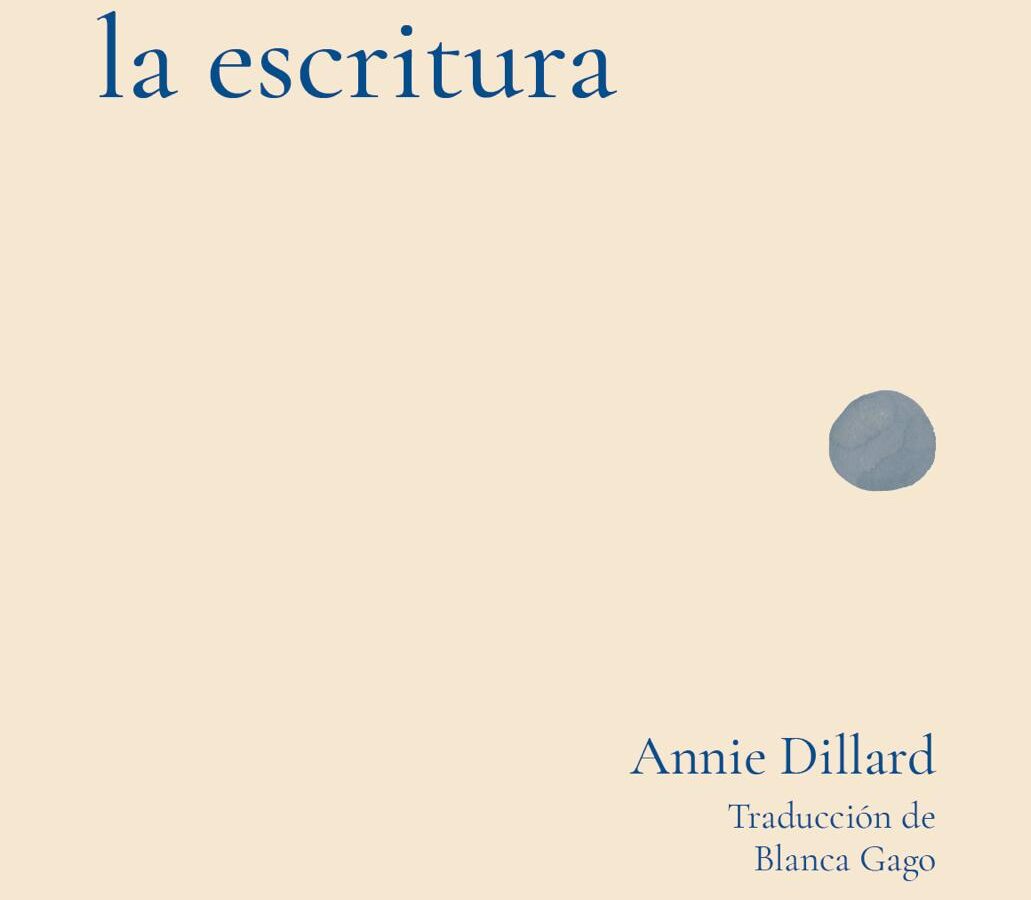
What does it mean to dedicate a life to writing? How does a writer live with uncertainty, discipline, and the vertigo of facing the blank page? For the first time in Spanish, this essay by Annie Dillard, a Pulitzer Prize winner, offers an intimate and deeply honest view of the creative process.
At Zenda we reproduce a fragment fromThe Writing Life(Bamba), by Annie Dillard.
***
I
“Do not hurry; do not rest.”
Goethe
When you write, you trace a line, a string of words that is the pick of a miner, the chisel of a carver, the catheter of a surgeon. By wielding it, you dig a path and follow it. Soon you find yourself in unknown territory. Is it a dead end, or have you found the true subject? Tomorrow you’ll know, or perhaps next year, around this time.
You press forward boldly and traverse it with caution. You head where the path leads you. In the end you find yourself boxed in a gorge. Then you set about finishing reports, dispatching bulletins.
Writing has changed in your hands and, in the blink of an eye, the expression of an intimate notion has become an epistemic tool. This new space interests you because it is unclear. You witness something. In your humility, you yield the words with care, watching from every angle. Now the previous writing seems faint, neglectful. The process is nothing; erase the traces. The path is not the work. I hope the undergrowth has covered the footprints and the birds have eaten the crumbs; I hope you discard it all and do not look back.
The string of words is a hammer. You hammer the walls of your house. You strike them softly all around. After many years of paying attention to these things, you know what you must listen for. Some walls are load-bearing; they must stay or else everything will come down. Others, by contrast, can be knocked down with the greatest ease; by how they sound, you can tell them apart. Unfortunately, it is usually the load-bearing walls that you must tear down. There is no other choice. The only solution, though it terrifies you, is that. Tear them down. Step back.
The boldness stands in opposition to the audacious hope that the work, or the world, may need such delicate labor. The boldness, exhausted, rises above the naked reality: what is written weakens the work. You must demolish it and start anew. You can save certain phrases, like bricks. It would be a miracle if you could save any paragraph, no matter how excellent, no matter how hard you have worked. You can waste a year lamenting, or you can remove the matter in a flash — are you a woman or a mouse?
The part you must cast overboard is not only the best written; oddly, it is also the part that would give sense to everything else. It is the original key passage, the passage that sustained the rest and from which you drew the courage to begin. Henry James knew this well and was the one who expressed it best. In his preface to The Treasures of Poynton, he consoles the author with a comic pair of lines that rise into a howl: “In what work has one not, subjected to the most terrible crucifixion, renounced the very best one hoped to preserve? In which, before the horrific climax, has one not wondered what had become of that which led him to such an extreme course?”
For all this, the author writes many books. In each, she had intended to lay out several elements as urgent as they are vivid, many of which she sacrificed as the form of the book gained substance. “Youth compiles its materials to build a bridge to the moon — noted a melancholic Thoreau — or, perhaps, a palace or a temple on earth, and, in the end, maturity ends up erecting a shed with them.” The author returns again and again to those materials, to those fascinating themes, as an unfinished matter, since they constitute a lifetime’s work.
[…]
—————————————
Author: Annie Dillard. Title: The Writing Life. Translation: Blanca Gago. Publisher: Bamba. Retail: Todos tus libros.