
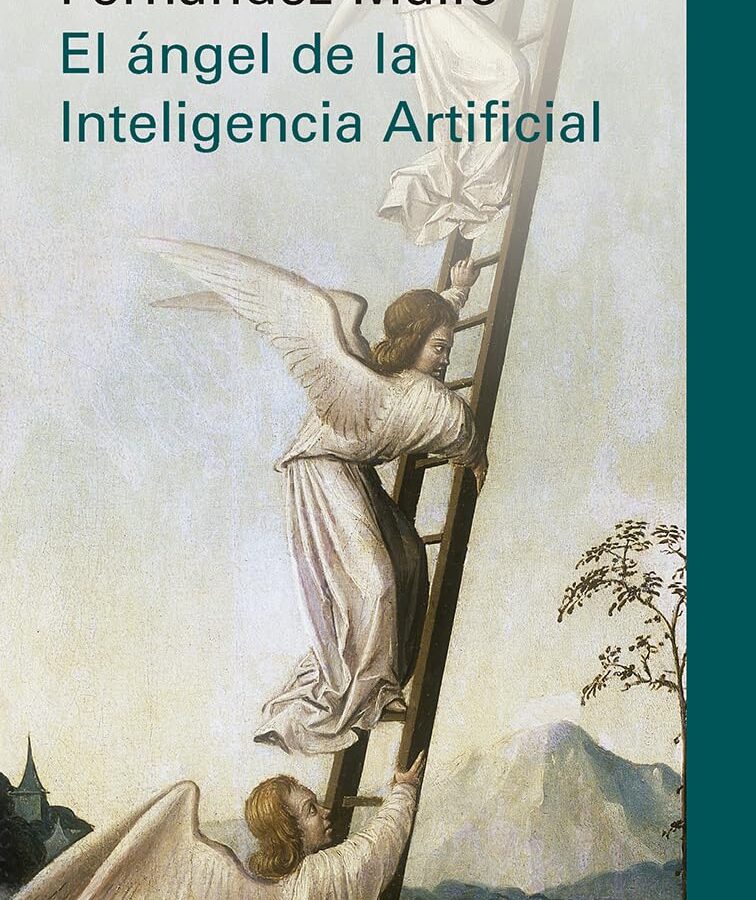
There are few topics today as popular as Artificial Intelligence. About what it is, what it implies, and what awaits us from it, countless messages have been launched and continue to be launched. Those who articulate them (except, perhaps, when it comes to entrepreneurs or workers involved in these projects themselves) tend to do so without much rigor and with superficial notions of the matter. That is why it is particularly interesting to read someone with knowledge of the subject, and even more so if they approach it from a multidisciplinary perspective.
Agustín Fernández Mallo
, in addition to being a novelist and poet, is a physicist and essayist. Publishing
The Angel of Artificial Intelligence
he does not limit himself to elaborating an isolated reflection on the topic of the moment, but delivers a work closely associated with his other works (such as
The Shape of the Multitude
or
General Theory of Garbage), and extends the trajectory of some of his ideas (for example, identity as a construct inseparable from the gaze of others), linking them with a deep vision, of sociological, anthropological and philosophical dimensions on AI.
It is worth reading this book with attention and patience, because the implications of Artificial Intelligence (what it says about us, what it can and cannot become for society) involve understanding a multitude of elements that range from the material properties of data processing in a machine (of a nature utterly incomparable to the biological) to the physical peculiarities of human intelligence as such and the distinctive nature of our way of thinking.
Thus, Fernández Mallo discusses deductive and inductive reasoning (in addition to abductive), quantum thermodynamics, the relationship between entropy and information, parallel processing versus serial processing (and the concept of the hypercube), Gödel’s theorem and the subsequent Penrose-Lucas theory, and with all these elements, as well as other ideas and analogies that help to understand the nature of thinking beings (the concepts of the guardian angel and fallen angel, reproduction and death, experience, self-awareness, hypo-subject, judgment or witness), gives us an idea of the magnitude that a venture as singular as creating an evolved Artificial Intelligence would have, and also helps us understand the difficulties that such a claim entails in terms of resources, the futility of equating a data-processing system with an intelligence like ours, our own inability to know what is unique about our way of thinking and experiencing the world, and how remarkable, when contemplated, our interest in pushing that hypothetical evolution to its furthest consequences.
All of this can be overwhelming when stated this way, but the text flows thanks to a wide range of eclectic examples (from mathematical formulas to quotes from Heraclitus, including references to The Simpsons) and a clear prose that sheds light on complex concepts, leading us to relate them through unexpected associations. It is not a popular-science essay as such, it is not a text meant to be read with the TV on in the background while you carry on a conversation, and that is its main virtue, because delving into the keys of a matter like this, and developing revealing reflections from them, could not be done in a work that could be reduced to a half-minute TikTok clip. Yet, across four well-differentiated parts full of reflections, The Angel of Artificial Intelligence does not impose an incontestable thesis, but opens our minds to consider, at least, that this matter of much talk is not at all as simple as it is usually framed.
—————————————
Author: Agustín Fernández Mallo. Title: The Angel of Artificial Intelligence. Publisher: Galaxia Gutenberg. Availability: All Your Books.