
It happened mostly during the great family gatherings; as soon as it was time for desserts or coffee, someone would start recounting a story that had occurred many years earlier and whose protagonists were usually dead. We children listened to those conversations with a mix of curiosity and boredom, and we had no idea that someday we would regret not having paid more attention. We did not know that those tales constituted the last breath of a world that was vanishing without anyone seeming to notice. All of that came to mind as I read Mil Venecies (Impronta), an extraordinary graphic novel that bears the signatures of Guti del Río and Álex Castrillo. The former is the uncle of the latter, and the two have joined their talents to reconstruct the life of a woman from Asturias throughout the twentieth century. Del Río handles the storytelling and Castrillo the illustrations, and the result is a work of undeniable beauty and moving power that earned in 2025 the Alfonso Iglesias Prize for comics in the Asturian language. There is in its panels an exercise in recovering family memory, but also a will to find in a particular existence the keys to a shared experience.
Those of us who grew up in the mining basins were surrounded by stories that did not appear in books—stories of men who went down into the mine and of women who kept the world turning while they were underground, of privations and sacrifices, of solidarities that did not need to be publicized because they were part of daily life. There were also joys, small conquests that took on enormous significance in settings where almost everything had cost too much effort. All of that is reflected in Mil Venecies. Its pages reconstruct a human landscape that has been fading before our eyes, but without turning it into a picturesque postcard nor into a museum of vanished customs. The history of the mining basins runs through the narration because it provides the backdrop for the lives being told, not because its authors intend to lecture us about the past. History, with a capital H, usually advances by extraordinary events, but its consequences are almost always revealed in the intimacy of ordinary people. They are the ones who endure its upheavals and who end up carrying them on their shoulders. For too long we have confused memory with the enumeration of great events, as if the lives of those who did not star in any major drama were devoid of importance. Yet an anonymous biography can explain a period better than many official chronicles. It suffices to pay attention to its details, to the seemingly insignificant decisions that end up shaping a destiny, to the renunciations that never found reward, and to the affections that helped withstand hardship. Mil Venecies shows that exceptional characters are not a prerequisite for building an extraordinary story.
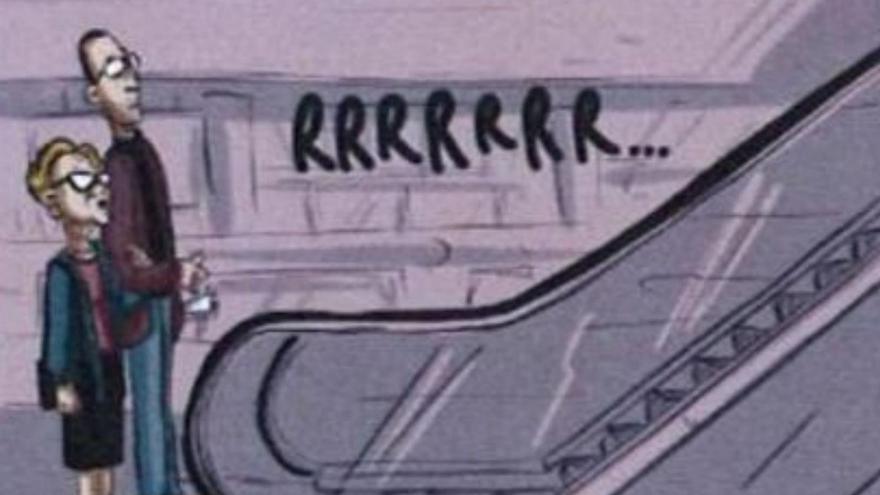
It is also worth pausing to consider its graphic dimension, because Álex Castrillo does not merely illustrate what Guti del Río tells, but constructs a visual discourse that broadens and enriches the narrative. There is a special sensitivity in the treatment of memories and in the incorporation of dreamlike elements that allow entry into territories that words alone would struggle to reach. Text and image engage in a dialogue of admirable naturalness, and from that complicity arises much of the work’s expressive strength. It is worth noting, in this regard, that Mil Venecies is written in Asturian, which is fully coherent with the nature of the work and the universe it recreates, though it will probably limit its diffusion beyond our community. Not so much because of its difficulty—any reader on the peninsula, whatever language they use, could read it without missing anything essential—as because of the challenges faced by a small, peripheral publisher when promoting and distributing its releases outside the territory where it operates, even more so in a language different from Spanish. It would be good if a more globally reaching publisher dared to bring out a Spanish edition to extend its journey, because the greatest virtue of Mil Venecies lies precisely in its ability to demonstrate that the local and the universal are not opposing categories. The deeper a narrative delves into the particularities of a world, the more possibilities it has to reach a truth that concerns all of us. The Asturian mining basins have their peculiarities, but the lives that developed there were traversed by the same yearnings, fears, losses, and hopes as those of any other place. I closed the book thinking about all the stories that disappeared with those who could tell them, about the questions we failed to ask in time, about the fragility of that intimate heritage that vanishes without making a sound. Guti del Río and Álex Castrillo have managed to save a small part of that shipwreck, and in doing so they remind us that no life is insignificant as long as there is someone willing to tell it, and that we are also the product of all those peoples that preceded us; after all, they were the lives that made us.